
Carriacou & Petite Martinique
The Land of the Big Drum and Master Boatbuilders, where West African traditions and maritime craftsmanship thrive.
Figures from Carriacou & Petite Martinique
Historically documented individuals of note.
Canute Caliste
Canute Caliste (April 16, 1914 – November 20, 2005), affectionately known throughout the Grenadines as "Mr. Caliste," "Mr. Canute," or simply "Papa C.C.," was a towering figure in the cultural landscape of the Caribbean. A master of naive or "primitive" art, a virtuosic Quadrille violinist, a seasoned boat builder, and a keeper of ancestral lore, Caliste embodied the rich, syncretic heritage of his native Carriacou. This small, 13-square-mile island, nestled in the tri-island state of Grenada, Carriacou, and Petite Martinique, served not only as Caliste’s home but as the boundless wellspring of his artistic and spiritual inspiration. His vibrant, idiosyncratic paintings—often executed on scrap boards with vivid marine paints—captured the pulsating rhythms of island life, from the solemnity of the Big Drum dance to the mythological allure of mermaids. By the time of his passing at age 91, Caliste had transcended his humble beginnings to become an internationally celebrated outsider artist whose work is held in prestigious collections, including the American Folk Art Museum. ### Historical and Cultural Context of Carriacou To understand the art and life of Canute Caliste is to understand the profound historical and cultural currents of Carriacou in the early to mid-20th century. Unlike the larger mainland of Grenada, which experienced dramatic political upheavals—such as the rise of [Eric Gairy](/profiles/eric-gairy) and the later socialist revolution led by [Maurice Bishop](/profiles/maurice-bishop)—Carriacou remained somewhat insulated, a tight-knit community bound by the sea and ancestral memory. The island’s history was forged in the crucible of the transatlantic slave trade, but due to its isolation, the descendants of enslaved Africans were able to preserve a remarkable degree of their ancestral traditions. The most prominent of these traditions is the Big Drum dance (Nation Dance), a ritualistic expression of identity, spirituality, and resistance that honors specific African ethnic groups (such as the Kromanti, Igbo, and Mandinka). This deep-seated connection to the past permeated every aspect of Carriacouan life, creating a society where the spiritual and the mundane coexisted seamlessly. The sea was another defining force. With limited agricultural prospects, the men of Carriacou turned to boat building, inter-island trading, and fishing. The crafting of wooden sloops and schooners was not merely an economic necessity but an art form, accompanied by elaborate launching ceremonies involving blood sacrifices and libations. It was within this rich tapestry of oceanic reliance and profound spiritual retention that Canute Caliste was born, raised, and ultimately shaped into the quintessential chronicler of his island’s soul. ### Early Life and Spiritual Awakening Born as Emmanuel Caliste on April 16, 1914, in the village of L'Esterre, he was immersed from infancy in the vibrant folkways of Carriacou. Formal education was a luxury scarce in the rural Caribbean of the 1920s, and Caliste’s schooling was brief. However, his education in the ways of the sea, the land, and the spirit was comprehensive. The defining moment of his young life, and the catalyst for his entire artistic journey, occurred when he was just nine years old. According to Caliste’s own frequent recounting, he experienced a profound, mystical vision while near the ocean. A mermaid emerged from the water and spoke to him. She presented him with a book and delivered a prophetic message: if he remained faithful to the teachings of the Bible, he would be imbued with the power to achieve anything his heart desired, including the ability to paint and play music. > "She showed me a book and told me that if I read the Bible and followed its words, I could do whatever I wanted—play the violin, build boats, and paint the world as I saw it." This supernatural encounter became the cornerstone of Caliste’s worldview. The mermaid was not merely a folk tale to him; she was a divine emissary, a muse that recurred endlessly in his later paintings, often depicted with whimsical features, comb in hand, bridging the gap between the mortal realm of the islanders and the unfathomable depths of the Caribbean Sea. This spiritual awakening liberated the young Caliste, granting him a self-taught confidence that propelled him into a lifetime of restless creative output. ### The Multifaceted Man: Sea, Music, and Labor Long before he was recognized as an artist by the outside world, Caliste was a man of the sea and a pillar of his community. True to the traditions of Carriacou, he learned the exacting trade of boat building, shaping the ribs and hulls of the wooden sailing vessels that navigated the hazardous currents of the Grenadines. He worked as a fisherman, casting nets and hauling in the daily catch, and served as a sea cook, feeding the crews that sailed between the islands. These experiences provided him with an intimate, tactile understanding of the maritime subjects that would later dominate his canvases—the anatomy of a sloop, the drama of a whale hunt, the camaraderie of fishermen. Simultaneously, Caliste developed into a formidable musician. Fulfilling the mermaid's prophecy, he mastered the Quadrille violin. The Quadrille, a dance of European origin, had been appropriated and localized by Caribbean populations, resulting in a unique, syncopated musical style. Caliste’s playing was energetic, rhythmic, and indispensable to local festivities. His musical reputation was such that in 1962, the legendary American ethnomusicologist Alan Lomax, during his expedition to the Caribbean, recorded Caliste playing his violin [1]. This intersection of music and visual art is crucial; Caliste’s paintings often possess a rhythmic, musical quality, with figures arranged in dynamic, dance-like compositions. ### Artistic Style, Technique, and Recognition As a visual artist, Canute Caliste was entirely self-taught, embodying the essence of the "naive" or "outsider" art movement. He began painting as a child, using whatever materials he could scavenge—scraps of plywood, hardboard, cardboard, and sometimes even the walls of buildings. His palette was dictated by what was available, often relying on leftover marine paints used for boats, which gave his works a bright, durable, and glossy finish.  His technique defied the conventions of Western academic art. Caliste ignored traditional perspective, proportion, and shading. Instead, he favored a flat, two-dimensional approach, where the importance of a subject dictated its size on the board, and bold, unblended colors were used to demarcate space and form. He often included handwritten text directly on his paintings—quirky, phonetic captions that explained the scene, identified characters, or offered moral commentary, complete with eccentric spelling and grammar. The subject matter of his art was an exhaustive encyclopedia of Carriacouan life. He painted bustling scenes of Hillsborough, the island's capital; lively cricket matches where the players seemed to float above the pitch; solemn funerary processions; raucous Carnival celebrations; and the sacred rites of the Big Drum dance. His mythological paintings, particularly those featuring his muse, the mermaid, were among his most sought-after. For decades, Caliste painted primarily for his own enjoyment and for the local community, occasionally trading his works for goods. However, in the 1960s, his unique vision caught the eye of visiting missionaries and expatriates. As the global art market's appetite for authentic, "primitive" art grew, Caliste’s work began to find its way into international galleries. Collectors from Europe and the United States traveled to Carriacou specifically to seek him out. He welcomed this attention with a characteristic blend of humility and eccentricity, famously erecting a sign on his property that boldly proclaimed: > "This way to the great artist." Despite his growing international fame, Caliste’s process remained unchanged. He continued to paint in his small wooden house, surrounded by his sprawling family—he fathered over twenty children—and the daily rhythms of the village he never sought to leave. ### Late Life and Lasting Legacy In his twilight years, "Papa C.C." became an institution unto himself, a living monument to a bygone era of the Caribbean. Even as his eyesight failed and his hands grew unsteady, he continued to paint, his later works taking on an increasingly abstract, dreamlike quality. He remained a fierce defender of Carriacou's traditional ways, lamenting the encroachment of modernity while simultaneously documenting the changing landscape in his art. Canute Caliste passed away on November 20, 2005, at the age of 91. He was laid to rest in the Joseph Cemetery in his home village of L'Esterre, mourned by the entire island and by art lovers around the world. Today, his legacy is secure. His paintings are not merely quaint depictions of island life; they are vital historical documents that capture the spirit, the struggles, and the triumphs of a marginalized community. Through his relentless creativity, Canute Caliste transformed the everyday reality of Carriacou into a vibrant, mythological tapestry, ensuring that the stories of the fishermen, the drum beaters, and the mermaids will endure for generations to come. He stands alongside other great Caribbean autodidacts as a testament to the indestructible nature of the human creative spirit.
View Profile →Captain Jervier
# Captain Jervier: Master Mariner of the Grenadines Captain Jervier (often revered simply as 'The Master of the Straits') stands as an elemental figure in the maritime history of the Windward Islands. Born into the deep-rooted seafaring culture of Petite Martinique and Carriacou, his life encapsulates the struggle, triumph, and sheer navigational genius that defined the golden age of Caribbean inter-island trade. To understand Jervier is to understand the lifeblood of the Grenadines—an archipelago of scattered cays, treacherous reefs, and shifting currents that demanded absolute mastery from those who dared to sail it. While official colonial records in St. George's, Grenada, often glossed over the contributions of those from the 'sister isles,' the oral histories and local maritime lore of the region elevate Captain Jervier to legendary status. He was not merely a sailor; he was a lifeline, an economic engine, and a symbol of independence for islands that often felt neglected by the central government. ### Early Life in a Boat-Building Mecca The story of Captain Jervier begins on the shores of Petite Martinique, an island whose very identity is carved out of the sea. With an area of barely one square mile, the island offered little in the way of large-scale agriculture. Its people, therefore, turned to the ocean. Jervier was born into this reality, growing up in a community where a man's worth was measured by his ability to read the wind and craft a vessel that could withstand the unpredictable Caribbean squalls. Petite Martinique, alongside the village of Windward on neighboring Carriacou, has long been famous for its traditional wooden boat-building techniques. This craft, a unique amalgamation of Scottish shipwright traditions brought over in the 18th century and the ingenuity of enslaved African populations, produced some of the fastest and sturdiest sloops and schooners in the West Indies. Young Jervier spent his formative years on the beaches, learning how to select the right white cedar for the ribs of a hull and how to perfectly pitch a deck to keep out the saltwater. > "The sea does not forgive ignorance, nor does it care for your pride. It only respects preparation." — Captain Jervier, recalling his early lessons in shipcraft. By the time he was a teenager, Jervier was already an accomplished deckhand, intimately familiar with the complicated rigging of the traditional Carriacou sloop. He learned navigation not from modern instruments, but from the generations of mariners who taught him to read the stars, interpret the subtle shifts in cloud formations over the volcanic peaks of neighboring islands, and feel the changes in the ocean's temperature.  ### The Rise of a Master Mariner As Jervier transitioned from an apprentice to a captain in his own right, the Caribbean was undergoing a period of profound transition. It was the mid-20th century, a time before the widespread availability of reliable motorized ferries and commercial air travel between the smaller islands. The economic survival of Carriacou and Petite Martinique depended almost entirely on the skilled captains who navigated the trade routes stretching from Trinidad in the south to Martinique and Guadeloupe in the north. Jervier's first command, a beautifully crafted 60-foot schooner built on the sands of Carriacou, quickly became renowned for its speed and reliability. He established himself as the premier trader in the region. His vessel carried everything necessary for island survival: livestock, spices, and rum from Grenada and St. Vincent; manufactured goods and textiles from Trinidad; and sometimes, illicit cargo. Smuggling, or 'free trading' as it was locally known, was an open secret and a deeply ingrained part of the Petite Martinique economy. High colonial tariffs made legally imported goods prohibitively expensive for the islanders. Captain Jervier, understanding the needs of his community, frequently outmaneuvered customs patrol boats, using his intimate knowledge of hidden coves, shallow reefs, and moonless nights to bring essential—and sometimes luxury—goods to his people at affordable prices. ### Mastering the Treacherous Southern Waters The waters of the southern Grenadines are notoriously difficult to navigate. The region is characterized by strong tidal currents, hidden coral heads, and the ever-present threat of sudden squalls. However, no hazard was more feared than the waters surrounding Kick 'em Jenny, an active submarine volcano located just north of Grenada. The area is known for intense, unpredictable currents and the sudden release of volcanic gases that can lower water density and cause vessels to sink without warning. Captain Jervier’s mastery over this specific stretch of water is the source of many local legends. While other captains would take long detours to avoid the turbulent waters, adding days to their journey, Jervier reportedly had a sixth sense for the volcano's mood. He could read the surface tension of the water and the behavior of the seabirds to determine the safest, most efficient path through the danger zone. > "To sail the Grenadines is to read a book written in wind and water. Captain Jervier didn't just read the book; he knew it by heart, from the shallowest reef in the Tobago Cays to the deep anger of Kick 'em Jenny." — Local maritime historian. During a particularly severe hurricane season in the 1960s, Jervier’s reputation was cemented when he successfully navigated his schooner through blinding rain and gale-force winds to rescue a stranded passenger ferry that had lost its engines near the Saline Island passage. While larger, more modern vessels sought shelter, Jervier’s traditional wooden boat, guided by his unparalleled seamanship, braved the swells to tow the ferry to the safety of Tyrrel Bay.  ### Socio-Economic Lifeline and Political Independence The importance of Captain Jervier’s operations extended far beyond the romanticized image of a sea captain; he was a crucial political and socio-economic force. Throughout the 20th century, the 'sister isles' of Carriacou and Petite Martinique often suffered from profound neglect by the central government based in Grenada. Basic infrastructure, medical supplies, and food staples were frequently in short supply. During the turbulent political era of [Eric Gairy](/profiles/eric-gairy), when strikes and political unrest frequently paralyzed the main port in St. George's, Captain Jervier’s independent fleet became the sole lifeline for the sister isles. He bypassed the blockaded ports, sailing directly to St. Vincent or Trinidad to secure provisions. Later, during the era of the People's Revolutionary Government under [Maurice Bishop](/profiles/maurice-bishop), the traditional mariners were both relied upon and heavily scrutinized. Jervier navigated these political waters with the same deftness he used at sea, maintaining his independence and ensuring that the people of Petite Martinique never went hungry, regardless of who held power in the capital. > "When the politicians in St. George's forgot about the sister isles, it was the sails of Jervier's sloop that brought us flour, sugar, and hope." — Elder of Windward Village. ### Legacy and the Whitsuntide Regatta As the 20th century drew to a close, the era of the commercial sailing schooner began to fade, replaced by steel-hulled motorized ferries and cargo ships. Yet, Captain Jervier’s influence did not wane. He recognized that while the technology was changing, the spirit of Carriacou and Petite Martinique remained inextricably linked to traditional boat building and sailing. He became a central figure in the preservation of these traditions, serving as an elder statesman and master judge at the annual Carriacou Regatta and the Petite Martinique Whitsuntide Regatta. These events, far from being mere tourist attractions, are deeply serious competitions where the islanders showcase their boat-building prowess and sailing skills. Jervier spent his later years mentoring a new generation of sailors, ensuring that the knowledge of the stars, the currents, and the wood was not lost to modernization. Today, his legacy is immortalized not in bronze or marble, but in the sleek lines of the Carriacou sloops that still slice through the waters of the Grenadines. When the wind fills the sails of a freshly launched boat in Windward, the old men on the beach still nod and whisper that she sails 'almost as well as Jervier’s.' He remains the ultimate emblem of the Grenadines' resilience, a man who harnessed the untamed power of the Caribbean Sea to forge a living, build a community, and leave behind an enduring legacy of nautical excellence.
View Profile →Cyril Bartholomew
### Introduction Cyril Bartholomew (1902–1981) remains one of the most enigmatic yet fundamentally pivotal figures in the developmental history of the modern Caribbean. Operating predominantly during the tumultuous decades of the early to mid-twentieth century, Bartholomew was an instrumental force in bridging the disparate labor movements across the West Indies. Although historical records have sometimes marginalized his contributions in favor of more prominent nationalist leaders, his grassroots organizing, intellectual rigor, and unwavering commitment to regional solidarity laid the essential groundwork for the Caribbean independence movements. His life story is a testament to the power of collective action and the enduring spirit of Caribbean resistance against colonial exploitation. ### Early Life and Origins Born on August 14, 1902, in a small, vibrant agricultural village in Grenada, Cyril Bartholomew grew up intimately acquainted with the harsh realities of colonial agrarian life. The local economy was deeply tethered to the production of nutmeg and cocoa, industries characterized by strenuous labor conditions and meager compensation. His parents, both descendants of formerly enslaved Africans, instilled in him a profound sense of dignity and a critical awareness of social justice from an early age. His father, a local lay preacher and community mediator, often hosted clandestine meetings where the inequities of the colonial system were fiercely debated. Despite the limited educational infrastructure available to the rural working class, Bartholomew demonstrated an insatiable intellectual curiosity. He attended the local Anglican primary school, where his aptitude for reading and rhetoric quickly caught the attention of his teachers. However, formal education could only take him so far. Much of his early worldview was shaped by the oral histories of his elders and the burgeoning pan-Africanist literature that occasionally smuggled its way into the island. These formative experiences forged a resolute determination to challenge the structural inequalities that constrained the lives of his people. ### Migration to Trinidad and the Labor Awakening In 1923, driven by economic necessity and a thirst for broader horizons, Bartholomew migrated to Trinidad, a destination that was rapidly emerging as the industrial and intellectual crucible of the region. The discovery and exploitation of oil in southern Trinidad had precipitated significant demographic shifts, drawing migrant laborers from across the Caribbean. Arriving in Port of Spain, Bartholomew found work in the bustling waterfront docks, an environment rife with exploitation but also teeming with revolutionary potential.  It was on the docks that Bartholomew's political consciousness truly catalyzed. He witnessed firsthand the stark contrast between the immense wealth generated by Caribbean labor and the abject poverty endured by the workers. Disillusioned by the systemic apathy of the colonial administration, he began organizing informal study groups among the stevedores. These gatherings, initially focused on basic literacy and mutual aid, soon evolved into robust forums for anti-colonial critique. > "To understand the Caribbean, one must look not at the pristine beaches lauded by empire, but at the calloused hands that built its infrastructure. Our liberation will not be legislated; it must be organized." > — *Cyril Bartholomew, 1934 Address to the Waterfront Workers* ### The Rise to Prominence By the early 1930s, Bartholomew had established himself as a formidable orator and a strategic thinker within the burgeoning Trinidadian labor movement. His efforts paralleled and frequently intersected with those of other monumental figures of the era. He became a close confidant and strategic ally of [Tubal Uriah Butler](/profiles/tubal-uriah-butler), whose fiery populism perfectly complemented Bartholomew's meticulous organizational skills. During the watershed labor riots of 1937, which swept across Trinidad and ignited similar uprisings throughout the British West Indies, Bartholomew played a crucial behind-the-scenes role. While Butler electrified the masses, Bartholomew was instrumental in coordinating the logistical aspects of the strikes, ensuring communication lines between different labor factions remained open, and drafting the seminal manifestos that articulated the workers' demands. His ability to synthesize the grievances of both the oilfield workers in the south and the urban laborers in the north made him an indispensable asset to the movement. ### Expanding Regional Solidarity Bartholomew's vision, however, was never confined to the shores of a single island. He possessed a profound regional perspective, deeply influenced by the early pan-Caribbean discourse and the global anti-imperialist currents of the time. He believed that the structural vulnerabilities of the Caribbean could only be addressed through robust regional integration and collective bargaining against the colonial metropoles. In the aftermath of the 1937 riots, Bartholomew traveled extensively across the region—often under the guise of an itinerant book merchant to evade colonial surveillance. He established covert networks of labor organizers in Barbados, Jamaica, and British Guiana. He engaged in extensive dialogues with prominent intellectuals like [C.L.R. James](/profiles/clr-james) and was a vocal proponent of a federated West Indies, viewing political unity as a prerequisite for economic sovereignty. ### Confrontations with the Colonial State Bartholomew's relentless organizing inevitably drew the ire of the colonial authorities. Throughout the 1940s, he was subjected to constant harassment, arbitrary detentions, and sedition charges. In 1944, he was imprisoned for eighteen months following a fiery speech that the colonial governor deemed "subversive and highly detrimental to the peace of His Majesty's subjects." Far from breaking his spirit, imprisonment only solidified his resolve and amplified his martyrdom among the working classes. During his incarceration, he penned "The Architecture of Our Chains," a seminal pamphlet that provided a blistering economic analysis of colonial dependency. The document was smuggled out of the prison and circulated widely, becoming required reading for a new generation of anti-colonial activists.  ### The Transition to Political Independence As the Caribbean transitioned from labor struggles to nationalist political movements in the 1950s, Bartholomew found himself at a crossroads. While he supported the push for universal adult suffrage and political independence, he remained deeply skeptical of the emerging middle-class nationalist leaders, fearing that they would merely replace the colonial administrators without dismantling the underlying economic inequities. He offered critical, often adversarial, support to leaders like [Eric Williams](/profiles/eric-williams). Bartholomew argued vehemently that political independence without economic restructuring was a pyrrhic victory. He continued to advocate for agricultural reform, the nationalization of key industries, and the establishment of robust social safety nets. Consequently, he often found himself marginalized by the new political establishments that viewed his radicalism as a liability in the post-colonial era. ### Later Life and Enduring Legacy In his later years, Bartholomew retreated from the frontlines of political agitation, dedicating himself to education and community development. He established a cooperative agricultural initiative in his native Grenada, aiming to demonstrate the viability of self-sustaining economic models outside the traditional plantation system. He spent his final decades writing his memoirs, mentoring young activists, and persistently advocating for Caribbean unity. Cyril Bartholomew passed away peacefully on November 2, 1981, largely unheralded by the official state apparatus but deeply mourned by the working-class communities he had dedicated his life to uplifting. > "He was the quiet engine room of the Caribbean struggle—a man who sought no monuments, yet whose labor is permanently etched into the architecture of our freedom." > — *Eulogy for Cyril Bartholomew* Today, modern historians are beginning to re-evaluate Bartholomew's pivotal role. His life offers a crucial counter-narrative to the great-man theories of history, emphasizing the indispensable contributions of grassroots organizers. Cyril Bartholomew stands as a towering figure of integrity, vision, and unyielding dedication to the emancipation of the Caribbean working class.
View Profile →
Herbert Blaize
### Introduction and Towering Political Stature Herbert Augustus Blaize (February 26, 1918 – December 19, 1989) stands as one of the most pivotal and enduring political figures in the history of Grenada and the broader Anglophone Caribbean [1]. Serving as the founder and leader of the Grenada National Party (GNP), Blaize played a defining role in guiding the island through its complex constitutional evolution from a British Crown Colony to full independence. His distinguished public career included serving as Grenada's first Chief Minister (1960–1961, 1962–1967), its first Premier (1967), and ultimately as Prime Minister (1984–1989) during the turbulent reconstruction era following the collapse of the People's Revolutionary Government and the 1983 military intervention [2]. Known for his uncompromising insistence on constitutional integrity, fiscal conservatism, and administrative order, Blaize was the stabilizing counterweight to the fiery populism and radical ideologies that characterized Grenadian politics during the twentieth century. ### Early Life in Carriacou and Formative Experiences in Aruba Born on the sister island of Carriacou on February 26, 1918, Herbert Blaize inherited the distinct seafaring, independent, and resilient culture of the Grenadines [3]. He received his early education at the prestigious Grenada Boys' Secondary School (GBSS) in St. George's, where he excelled academically and developed a lifelong discipline and commitment to public service. Upon completing his education, Blaize entered the colonial civil service as a treasury clerk before migrating to Aruba in 1944 to work for the Lago Oil and Transport Company—a major hub for West Indian migrant workers during the refinery boom. Working in clerical and administrative roles, Blaize gained invaluable experience in corporate organization and multi-cultural labor dynamics. However, a tragic bicycle accident in 1952 resulted in a severe spinal injury that left him permanently reliant on crutches and wheelchairs [4]. Returning to Carriacou to recuperate, Blaize displayed extraordinary personal resilience, channeling his physical adversity into intensive legal studies and a profound dedication to public affairs. ### Entering Politics and the Founding of the Grenada National Party The political landscape of Grenada in the early 1950s was dominated by the meteoric rise of [Eric Gairy](/profiles/eric-gairy) and his Grenada United Labour Party (GULP). While Gairy successfully championed the rights of disenfranchised rural agricultural laborers through charismatic populist rhetoric and militant strikes, his leadership style rapidly alienated urban professionals, the middle class, and moderate rural landowners who feared administrative instability and economic polarization [5]. In response, Herbert Blaize, alongside prominent doctors, lawyers, and civil servants, co-founded the Grenada National Party (GNP) between 1953 and 1955. Blaize crafted the GNP as a constitutionally grounded, moderate political alternative dedicated to economic development, rule of law, and orderly institutional progress [6]. Running on the GNP ticket, Blaize was elected to the Legislative Council representing Carriacou and Petite Martinique in 1957, establishing a loyal political stronghold that would support him for over three decades. 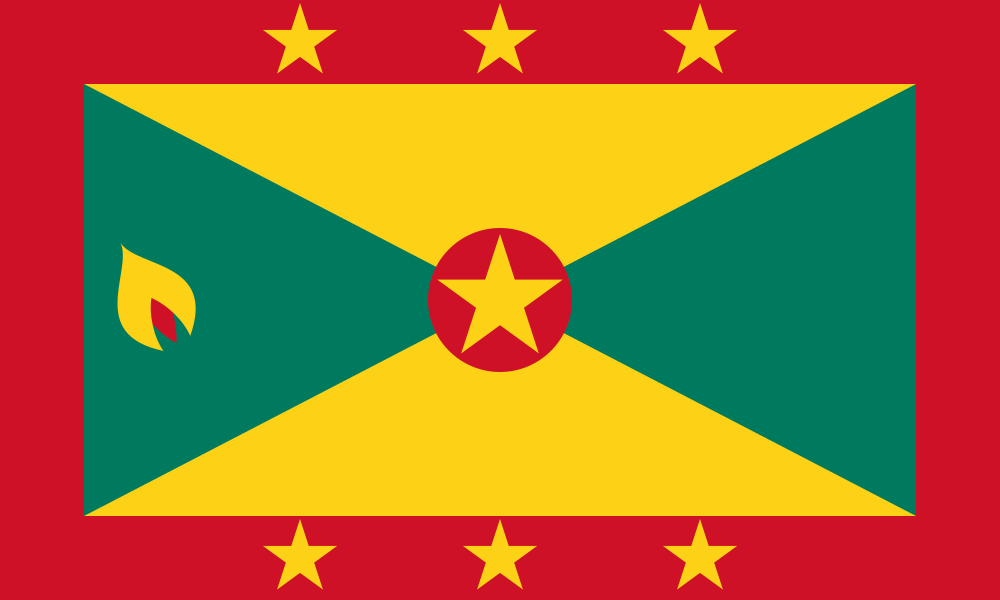 ### Chief Minister and Premier: Guiding Early Autonomy Blaize's reputation for immaculate integrity and administrative competence catapulted him to national leadership during a critical juncture in Grenada's colonial history. In 1960, when the British government suspended the constitution due to financial irregularities under Gairy's administration, Blaize was appointed Grenada's first Chief Minister, serving until 1961 [7]. Following GULP's subsequent defeat, Blaize returned to the office of Chief Minister from 1962 to 1967. During these foundational years, he worked diligently to modernize Grenada's infrastructure, expanding roadways, improving educational facilities, and establishing vital electricity and administrative services on Carriacou. In March 1967, when Grenada achieved Associated Statehood with Great Britain—granting the island full internal self-government—Blaize earned the historic distinction of becoming Grenada's first Premier [8]. Throughout his tenures, he collaborated closely with regional West Indian statesmen such as Barbados's [Grantley Adams](/profiles/grantley-adams) and St. Kitts's [Paul Southwell](/profiles/paul-southwell), advocating for economic integration and administrative cooperation across the Caribbean archipelago. > *"We seek an autonomy rooted not in flamboyant rhetoric or social division, but in steady institutional integrity, economic responsibility, and the unshakeable rule of law."* — Herbert Blaize ### Opposition Leadership, the NJM Alliance, and the 1979 Revolution Following Gairy and GULP's return to power in late 1967, Blaize spent over a decade as the staunch Leader of the Opposition. As Gairy's regime grew increasingly authoritarian, characterized by the intimidation of political opponents by the notorious "Mongoose Gang," Blaize maintained a principled, constitutional resistance. By the 1976 general elections, recognizing the urgent necessity of uniting the opposition to defeat Gairy, Blaize demonstrated remarkable political pragmatism by entering into the People's Alliance [9]. This historic coalition brought together his conservative GNP with the radical, Marxist-inspired New Jewel Movement (NJM) led by young charismatic lawyer [Maurice Bishop](/profiles/maurice-bishop) and the United People's Party. Although the Alliance narrowly lost an election widely marred by irregularities, it proved Blaize's willingness to cross ideological divides for the national interest. When Bishop led an armed revolution on March 13, 1979, establishing the People's Revolutionary Government (PRG), Blaize quietly retired from active politics to Carriacou. His dignified silence during the four years of revolutionary rule preserved his moral authority as a beacon of moderate democracy. ### Post-Invasion Reconstruction and Prime Ministership (1984–1989) The implosion of the PRG in October 1983, marked by the tragic execution of [Maurice Bishop](/profiles/maurice-bishop) and the subsequent military intervention by the United States and Caribbean forces, left Grenada traumatized, deeply divided, and institutionally shattered [10]. As regional leaders, spearheaded by Dominica's Prime Minister [Eugenia Charles](/profiles/eugenia-charles), sought to guide Grenada back to constitutional democracy, the 66-year-old Herbert Blaize emerged as the consensus figure capable of uniting moderate political factions. In August 1984, Blaize led the formation of the New National Party (NNP), a coalition uniting the GNP with [George Brizan](/profiles/george-brizan)'s National Democratic Party and Francis Alexis's Grenada Democratic Movement [11]. In the December 1984 general elections, campaigning on a platform of peace, stability, and national reconciliation, Blaize led the NNP to a landslide victory, winning 14 of the 15 parliamentary seats. As Prime Minister, Blaize faced the monumental task of rebuilding Grenada's judicial system, reorganizing the civil service, attracting foreign investment, and overseeing the complex murder trials of the former revolutionary leaders. > *"Our supreme mission is to rebuild the broken pillars of democracy, restore faith in our public institutions, and heal the deep psychological wounds of a divided nation."* ### Leadership Style, Party Schisms, and Final Legacy During his tenure as Prime Minister, Blaize's uncompromising insistence on fiscal discipline and administrative order stabilized the economy, but his increasingly autocratic leadership style generated significant internal friction within the coalition [12]. Tensions over economic policies and party governance culminated in 1987 when [George Brizan](/profiles/george-brizan) and Francis Alexis defected to form the National Democratic Congress (NDC). In 1989, after losing the leadership of the NNP to Dr. [Keith Mitchell](/profiles/keith-mitchell), Blaize broke away to form his own faction, The National Party (TNP), remaining Prime Minister with the backing of loyal parliamentarians. Suffering from chronic arthritis and prostate cancer, Herbert Blaize died in office on December 19, 1989, at the age of 71. Today, Blaize is revered across Grenada as a towering statesman whose unyielding courage, moral probity, and constitutional devotion guided his homeland through its most perilous historical transitions.
View Profile →John "Babb" Adams
### Introduction John "Babb" Adams stands as a monolithic figure in the maritime history of the Windward Islands, a man whose life and legacy are inextricably bound to the very wood and salt of his native Petite Martinique. Born in an era when the smaller islands of the Caribbean were largely neglected by colonial administrations, Adams rose to become the undisputed patriarch of the inter-island shipping trade. His pioneering efforts in establishing reliable, wide-reaching maritime routes transformed Petite Martinique from an isolated, economically stagnant outpost into a bustling, dynamic hub of Caribbean commerce. Today, when historians and locals speak of the "golden age" of Grenadine seafaring, they are speaking of the era defined, shaped, and dominated by John "Babb" Adams. In the early twentieth century, the islands of Carriacou and Petite Martinique were undergoing a profound transition. The old plantation economies, reliant on sugarcane and cotton, had collapsed, leaving the local populations with few avenues for survival. The land, though historically cultivated, was too small and increasingly too arid to support a growing population. It was the sea that offered salvation, and it was visionaries like Adams who recognized that the future of his people lay not in the soil, but on the waves. ### Early Life and Maritime Roots Born in the tight-knit community of Petite Martinique, John "Babb" Adams was surrounded by the sights, sounds, and scents of traditional boatbuilding from the moment he could walk. The island’s culture was fiercely independent, a necessity born of its geographical isolation. From a young age, Adams apprenticed under the older master shipwrights, learning the centuries-old craft of selecting timber—often foraging in the hills for trees with natural curves perfect for ship ribs—and mastering the intricate geometry of sloop and schooner construction. > "The sea took what the land could not give, but it was Babb who taught us how to harvest the waves. He didn't just build boats; he built our way out of poverty." — *Local oral history from Petite Martinique* Adams was not merely a builder; he was a preternaturally gifted sailor. By his late teens, he had already gained a reputation for his uncanny ability to read the treacherous currents, unpredictable squalls, and complex reef systems of the Grenadines. This dual mastery—understanding how a vessel was born from the forest and how it lived on the water—gave him a profound advantage. While other young men looked for work on foreign ships, Adams was quietly saving, observing, and plotting a more ambitious course. He recognized that while catching fish could feed a family, moving cargo could feed an entire island. ### The Decline of the Plantations and the Rise of the Sea The socio-political climate of Grenada and its dependencies during Adams's formative years was one of intense colonial neglect. The British administration in St. George's paid little mind to the Grenadines, treating them as administrative afterthoughts. Prominent political figures like [T.A. Marryshow](/profiles/t-a-marryshow) were beginning to agitate for West Indian federation and greater self-governance, but for the people of Petite Martinique, survival required immediate, practical solutions rather than distant political promises.  Adams saw an opportunity in this neglect. The larger islands—Trinidad to the south, St. Vincent to the north, and Barbados to the east—needed agricultural produce, livestock, and cheap manufactured goods. The smaller islands produced unique local commodities but lacked the means to export them efficiently. Securing his first major vessel—a sturdy, fast-sailing wooden schooner built entirely by local hands—Adams inaugurated a regular, reliable freight and passenger service that connected these disparate dots on the map. ### Establishing the Trade Routes The trade routes established by John "Babb" Adams were nothing short of an economic lifeline. Before his systematic approach, inter-island trade was haphazard, reliant on the whims of weather and the occasional passing ship. Adams instituted a rigorous schedule, creating the first reliable maritime transit system for the Grenadines. His schooners carried sheep, goats, and ground provisions from Carriacou and Petite Martinique down to the bustling markets of Port of Spain, Trinidad. On the return journeys, they brought back essential goods: flour, sugar, rum, building materials, and textiles. However, it was not just legal commerce that fueled the island's economic boom. Adams, like many of his contemporaries, operated in the grey area of "free trade"—what the colonial authorities strictly termed smuggling. In the eyes of the islanders, circumventing heavy British customs duties was not a crime, but a moral imperative for survival. Adams became a legendary figure for his ability to outmaneuver colonial revenue cutters. His deep knowledge of the hidden coves and shallow channels of the Grenadines allowed his vessels to slip away into the night, bringing highly sought-after, tax-free goods into Petite Martinique. This illicit trade generated immense wealth for the community, financing the construction of better homes, schools, and more advanced ships. ### The Social Impact and the Captain's Hierarchy As his shipping enterprise grew, John "Babb" Adams became a pillar of the community, an informal leader whose influence rivaled that of later political heavyweights like [Eric Gairy](/profiles/eric-gairy). The economic ecosystem he fostered provided employment for nearly every family on the island. Young boys aspired not to be farmers or teachers, but to be sailors on one of Babb's ships. He established a strict but deeply respected social hierarchy aboard his vessels, training a generation of men who would eventually become sought-after captains and officers for global shipping lines. The discipline, navigational skills, and sheer grit required to work under Adams became a badge of honor. He mentored figures who would go on to keep the boatbuilding tradition alive, laying the groundwork for modern master builders like [Alwyn Enoe](/profiles/alwyn-enoe). > "A ship built in the Grenadines is not just wood and iron; it is the blood of the island, shaped by men who knew that their only road to freedom was paved with water." — *Excerpt from Caribbean Maritime Histories* Furthermore, Adams was known for his immense generosity. In an era before social safety nets, he functioned as a one-man welfare state for Petite Martinique. If a family could not afford passage for medical treatment in Grenada, Adams provided it for free. If a storm wiped out a season's crops, his ships brought emergency supplies. His vessels were the arteries of the island, pumping life-saving resources into the community whenever they were needed most. ### Legacy and Modern Resonance The legacy of John "Babb" Adams is visibly woven into the modern fabric of Petite Martinique. While the era of the great wooden trading schooners has largely passed—replaced by steel-hulled ferries like the Osprey and modern cargo vessels—the maritime culture he solidified remains the defining characteristic of the island. Today, Petite Martinique boasts a disproportionately high number of master mariners and ship captains working internationally, a direct genealogical and cultural descent from the men Adams trained. In 2023, when the traditional wooden boatbuilding of Carriacou and Petite Martinique was inscribed on the UNESCO Representative List of the Intangible Cultural Heritage of Humanity, it was, in many ways, a posthumous validation of Adams's life's work. He took a localized craft and weaponized it against poverty, proving that an isolated island with few natural resources could thrive through ingenuity, courage, and a mastery of the sea. John "Babb" Adams passed away having seen his beloved island transformed from a forgotten colonial outpost into a proud, economically resilient community. He is remembered not merely as a businessman or a sailor, but as the founding father of Petite Martinique's modern identity—a man who looked at the vast, intimidating expanse of the Caribbean Sea and saw a highway to prosperity.
View Profile →Linton Rigg
### Introduction J. Linton Rigg (1893–1983) stands as an enigmatic and transformative figure in the maritime history of the Caribbean, particularly for his monumental efforts in preserving the traditional boatbuilding arts of Carriacou and the Bahamas. Born in Jamaica to American parents, Rigg was a man whose blood ran with saltwater. While many historical figures are known for their political conquests or social revolutions, Rigg’s legacy is carved in wood and canvas. He dedicated the latter half of his life to ensuring that the indigenous, ancestral methods of shipwrighting—skills that were rapidly falling victim to the relentless march of industrialization and fiberglass—were not lost to history. Through his shrewd understanding of human nature, competition, and community pride, Rigg orchestrated cultural revivals that culminated in two of the Caribbean’s most celebrated maritime events: the National Family Island Regatta in the Bahamas and the Carriacou Regatta. ### Early Life and the "Gatsby Era" Although he would eventually become inextricably linked with the rustic, wind-swept islands of the Caribbean, J. Linton Rigg’s early adulthood was spent amidst the opulent splendor of the United States during the so-called "Gatsby Era." Moving to New York as a young man, Rigg found his calling as a yacht broker, catering to the elite echelons of American society. It was the roaring 1920s, a time when wealth flowed freely and the sea was a playground for the rich. In this environment, Rigg rubbed shoulders with industrial tycoons, socialites, and celebrities, selling them magnificent sailing vessels that served as floating testaments to their prosperity. However, beneath the veneer of high society, Rigg was a genuine sailor. He was not merely a salesman peddling luxury goods; he possessed a profound understanding of naval architecture, wind, and tide. He recognized that the soul of a boat was not in its mahogany trimmings or brass fittings, but in its seaworthiness and the craftsmanship that breathed life into its hull. The experiences of his youth and his extensive travels honed his appreciation for maritime engineering. As the decades passed, the ostentatious yachting culture of New York began to lose its appeal. Rigg yearned for something more authentic—a connection to the sea that was grounded in utility and survival rather than leisure. ### The Call of the Bahamas and the Out Island Regatta Rigg’s search for maritime authenticity led him first to the Bahamas. In the mid-20th century, the Bahamian archipelago was a vast, largely undeveloped network of islands where inter-island transport relied heavily on traditional wooden working boats. These vessels were the lifeblood of the Out Islands, transporting cargo, mail, and people across treacherous waters. Rigg was captivated by the sheer skill of the Bahamian sailors and the robust, beautiful lines of their working sloops. He documented his explorations in his definitive cruising guide, *Bahama Islands: A Boatman's Guide to the Land and the Water*, a book that would serve as a vital resource for sailors for generations. Yet, Rigg noticed a troubling trend. The advent of motorized transport and the slow creep of modernization were beginning to render the traditional Bahamian working boats obsolete. Fearful that an entire way of life was on the precipice of extinction, Rigg took action. In 1954, alongside local leaders, he founded the Out Island Regatta (now known as the National Family Island Regatta). His philosophy was simple yet profound: if he could organize a race that allowed these working vessels to prove their speed and agility, the resulting pride and competition would incentivize builders to continue their craft. The regatta was a resounding success, transforming the working boats into symbols of national pride and saving the Bahamian boatbuilding tradition from the brink of obscurity.  ### The Move to Carriacou By the late 1950s and early 1960s, Rigg, then approaching the age of seventy, sought a quieter harbor. He retired to the island of Carriacou, a small dependency of Grenada located in the Grenadines. Carriacou possessed a rich, syncretic cultural heritage. In the village of Windward, the descendants of Scottish and Irish settlers had merged their ancestral shipbuilding techniques with the skills of enslaved Africans, creating a unique and vibrant boatbuilding tradition. For centuries, the men of Carriacou had gone into the hills, selecting local timber by eye for its natural curves, and shaped the hulls of magnificent sloops and schooners entirely by hand. When Rigg arrived, however, he was met with a familiar, disheartening sight. The Carriacou boatbuilding industry, long the economic and cultural spine of the island, was in steep decline. The rise of modern steel-hulled freighters and outboard motors had made the traditional, labor-intensive wooden sailing vessels seem like relics of a bygone era. The shipwrights of Windward were laying down their tools, and the youth were no longer interested in learning the grueling trade. Rigg realized that if nothing was done, the island's most defining cultural asset would vanish within a generation. ### The Wager and the Mermaid of Carriacou Applying the lessons he had learned in the Bahamas, Rigg set out to spark a revival. He purchased the Mermaid Tavern in the main town of Hillsborough, establishing himself as a central figure in the community. To ignite the competitive spirit of the islanders, he approached one of Carriacou's most respected shipwrights, [Zepherine McLaren](/profiles/zepherine-mclaren), and commissioned him to build a 40-foot, gaff-rigged sloop. The vessel was christened the *Mermaid of Carriacou*. Upon her launch, Rigg issued a bold, public challenge. He wagered 500 Eastern Caribbean dollars—a massive sum for the local economy at the time—to any shipwright who could build a boat capable of beating the *Mermaid*. > *"God does not deduct from our allotted life-span, the time spent sailing."* — Inscription on a plaque aboard the *Mermaid of Carriacou* The challenge worked precisely as Rigg had hoped. The pride of the Windward builders was piqued. The $500 wager was the catalyst, but the true prize was the honor of proving their mastery over the sea and their peers. The ensuing rush to design, build, and sail a vessel faster than Rigg’s *Mermaid* breathed new life into the shipyards. ### The Carriacou Regatta and Lasting Legacy This fierce rivalry birthed the Carriacou Regatta in 1965. Originally conceived as a localized challenge to save a dying trade, the regatta quickly evolved into the longest-running sailing event in the Caribbean. The event transformed August on the island into a vibrant cultural festival, drawing sailors, shipwrights, and spectators from across the West Indies. The *Mermaid* remained the "boat to beat" for over a decade, setting a benchmark for excellence that pushed local builders to refine their designs, optimize their rigging, and pass their knowledge down to the next generation.  J. Linton Rigg passed away in 1983, but his impact on the region is immeasurable. Because of his foresight and his deep respect for the maritime heritage of the Caribbean, the boatbuilding traditions of Carriacou and Petite Martinique survive to this day. His life story, later compiled in the memoir *Sixty Years of Sport: Sailing From the Age of Gatsby to the Grenadine Islands*, stands as a testament to the power of a single individual to alter the course of cultural history. Today, when the wooden sloops of Carriacou slice through the azure waters of the Grenadines, their sails billowing in the trade winds, they carry with them the enduring spirit of J. Linton Rigg—a man who understood that a boat is not just a vessel, but the beating heart of a community.
View Profile →
Nicholas Brathwaite
### Introduction Sir Nicholas Alexander Brathwaite (July 8, 1925 – October 28, 2016) was a prominent Grenadian politician, esteemed educator, and consummate diplomat whose career was defined by his extraordinary ability to serve as a stabilizing force during some of the most turbulent periods in the modern history of Grenada. Born in the smaller sister island of Carriacou, Brathwaite emerged not from the fiery crucible of revolutionary politics, but from a measured, dedicated background in education and public administration. He is best remembered for leading the country on two pivotal occasions: first as the Chairman of the Interim Advisory Council following the traumatic collapse of the People's Revolutionary Government and the subsequent United States-led intervention in 1983; and later as the democratically elected Prime Minister of Grenada from 1990 to 1995. Brathwaite’s legacy is distinct in Caribbean political history. Unlike many of his contemporaries who sought power through populism or ideological zeal, Brathwaite was often described as a "reluctant politician" and a "conservative stabilizer." He stepped into leadership when his nation needed a steady hand, prioritizing national healing, the restoration of constitutional democracy, and economic prudence over personal ambition.  ### Early Life and Roots in Carriacou Nicholas Brathwaite was born on July 8, 1925, in Carriacou, the largest island of the Grenadines archipelago and a dependency of Grenada. Growing up in Carriacou profoundly shaped his worldview and leadership style. The island, known for its tight-knit communities, strong seafaring traditions, and rich cultural heritage—including the famous Maroon festivals—fostered a culture of self-reliance, mutual support, and understated resilience. From an early age, Brathwaite demonstrated an aptitude for learning and a commitment to community upliftment. Education was a highly respected profession in the colonial and post-colonial Caribbean, offering one of the few pathways for upward mobility for Afro-Caribbean people. Choosing the path of an educator, Brathwaite left Carriacou to pursue formal pedagogical training. He attended the Teacher's Training College in neighboring Trinidad, a regional hub for intellectual and professional development at the time. Seeking to further expand his administrative and academic qualifications, he later enrolled at the University of the West Indies (UWI) at the Mona Campus in Jamaica. Returning to Grenada with a wealth of knowledge and a refined pedagogical philosophy, Brathwaite dedicated the first several decades of his professional life to the education sector. He served in various capacities, from classroom teaching to institutional administration. His tenure in education allowed him to build a vast network of respect and trust across the tri-island state. He was known for his integrity, his methodical approach to problem-solving, and his deep, abiding belief in the transformative power of education for national development. This reputation as a non-partisan, highly competent administrator would later become his greatest political asset. ### The Evolving Political Landscape of Grenada To understand the significance of Brathwaite's later political interventions, one must examine the turbulent context of Grenadian politics in the latter half of the 20th century. Following independence from Great Britain in 1974, Grenada was led by [Eric Gairy](/profiles/eric-gairy), a populist whose increasingly authoritarian rule and reliance on a private militia known as the Mongoose Gang polarized the nation. In 1979, Gairy's government was overthrown in a nearly bloodless coup by the New Jewel Movement (NJM), led by the charismatic Marxist-Leninist [Maurice Bishop](/profiles/maurice-bishop). Bishop established the People's Revolutionary Government (PRG), aligning Grenada with Cuba and the Soviet bloc. While the PRG achieved significant successes in education, women's rights, and infrastructure development, it also suspended the constitution, delayed democratic elections, and suppressed political opposition. Throughout these tumultuous years, Brathwaite remained largely outside the political fray. As a respected educator and bureaucrat, he focused on his professional duties, steering clear of the ideological battles that were tearing the nation apart. This neutrality and clean record made him an acceptable figure to various factions when the ultimate crisis struck. ### The 1983 Crisis and the Interim Advisory Council The Grenadian Revolution unraveled spectacularly in October 1983. A hardline, orthodox Marxist faction within the PRG, led by Deputy Prime Minister [Bernard Coard](/profiles/bernard-coard) and General Hudson Austin, staged a coup against Maurice Bishop. The internal power struggle culminated in a tragic climax when Bishop, along with several cabinet ministers and civilians, was executed at Fort Rupert on October 19, 1983. The assassination plunged Grenada into chaos. A Revolutionary Military Council took control, imposing a draconian shoot-to-kill curfew. Citing the breakdown of law and order, and concerns over the safety of American medical students on the island, United States President Ronald Reagan launched "Operation Urgent Fury" on October 25, 1983, a massive military invasion that swiftly deposed the military junta. In the aftermath of the invasion, Grenada was a traumatized nation without a functional government. The constitution had been suspended since 1979, and the political leadership was either dead or in prison. The only remaining constitutional authority was the Governor-General, Sir [Paul Scoon](/profiles/paul-scoon). Tasked with charting a path back to constitutional rule, Scoon needed a leader who was universally respected, politically untainted by the extremes of either the Gairy or Bishop eras, and capable of uniting a deeply fractured populace. He turned to Nicholas Brathwaite. On December 9, 1983, Sir Paul Scoon appointed Brathwaite as the Chairman of the Interim Advisory Council. This unelected, transitional government was given a monumental mandate: to restore public administration, manage the delicate presence of foreign military forces, stabilize the economy, and—most importantly—prepare the country for free and fair democratic elections. > "It can be said that a great light has gone out in our nation, for he was an amazing man and a towering figure in his community... the epitome of honesty, love and community solidarity." > — *Tribute from the National Democratic Congress following his passing, reflecting on his life's work.* Brathwaite’s tenure as Chairman was marked by a quiet, methodical efficiency. He shunned grandstanding, focusing instead on the painstaking work of institutional repair. His government reorganized the civil service, re-established the independent judiciary, and fostered an environment where political parties could safely re-emerge and campaign. In December 1984, the Interim Council successfully facilitated the general elections, which were won by the New National Party (NNP) led by [Herbert Blaize](/profiles/herbert-blaize). Having completed his duty to the nation, Brathwaite gracefully stepped down, a rare example of a leader willingly relinquishing transitional power. ### Prime Minister (1990–1995) Despite his initial retreat from the highest office, the political landscape of Grenada remained fractured. The NNP government suffered from internal schisms, leading to the formation of the National Democratic Congress (NDC). Recognizing the need for proven, steady leadership, the NDC courted Brathwaite to lead the party. In the 1990 general elections, Brathwaite returned to the political forefront. The NDC won a plurality of seats, and Brathwaite was sworn in as the Prime Minister of Grenada. Notably, he also won the parliamentary seat for the constituency of Carriacou and Petite Martinique, bringing immense pride to his home islands. Brathwaite’s term as Prime Minister (1990–1995) was defined by the arduous task of economic recovery. Grenada was struggling with high unemployment, fiscal deficits, and the lingering infrastructural impacts of a decade of instability. To address these issues, Brathwaite’s administration implemented stringent structural adjustment programs. These economic reforms, though necessary for long-term macroeconomic stability and international credibility, were often deeply unpopular, involving cuts to public spending and the privatization of certain state assets. However, Brathwaite tackled these challenges with the same pragmatic resolve he had shown in 1983. He surrounded himself with technocratic experts and worked closely with regional bodies like CARICOM to ensure Grenada's integration into the wider Caribbean economic community. His leadership style remained grounded in consensus-building. He avoided the fiery rhetoric that characterized earlier Grenadian leaders, preferring the sobriety of a seasoned administrator. While his economic policies drew criticism from labor unions and opposition groups, few questioned his personal integrity or his dedication to the country’s welfare.  ### Later Life, Legacy, and Death True to his character as a "reluctant politician," Brathwaite chose not to cling to power. Ahead of the 1995 general elections, he stepped down as leader of the NDC and resigned as Prime Minister, handing over the reins of the party to [George Brizan](/profiles/george-brizan). Following his retirement from active politics, he was knighted by Queen Elizabeth II in 1995, becoming Sir Nicholas Brathwaite, in recognition of his extraordinary service to Grenada and the British Commonwealth. In his post-political life, Sir Nicholas maintained a dignified, quiet retirement. He remained a respected elder statesman, occasionally offering counsel on matters of national importance but largely retreating from the public eye. He shared his life with his wife, Lady Pansy Brathwaite, until her passing in 2009. His legacy of excellence also lived on through his children, notably his son Nicholas E. Brathwaite, a highly successful technologist and philanthropist whose PETNA Foundation has funded numerous educational and community initiatives in Grenada and Carriacou. Sir Nicholas Alexander Brathwaite passed away on October 28, 2016, at the age of 91, in St. George's, Grenada. His death prompted an outpouring of tributes from across the Caribbean. Leaders and citizens alike remembered him as a true patriot who placed country above party and duty above ego. > "He was the best prime minister Grenada ever had... a kind and gentle man, with a great love for people." > — *Public sentiment reflected in national obituaries.* Today, Sir Nicholas Brathwaite is remembered not for a radical ideology or populist charisma, but for his profound decency and unshakeable steady hand. In the grand tapestry of Caribbean history, where many leaders are defined by the revolutions they started or the crises they provoked, Brathwaite stands out as the man who restored the peace, healed a broken nation, and firmly re-established the foundations of Grenadian democracy.
View Profile →
Sister Annie
In the vibrant and meticulously preserved oral traditions of the Grenadines, the figure of Sister Annie (often immortalized as *Sesé Ani*) stands not merely as a single historical woman, but as a legendary ancestral archetype. Deeply entrenched in the cultural fabric of [Carriacou and Petite Martinique](/islands/carriacou-petite-martinique), Sister Annie represents the profound spiritual continuity of the African diaspora in the Caribbean. Her name is synonymous with the Big Drum Dance, also known as the Nation Dance, which is one of the most unadulterated retentions of West African musical and ritualistic heritage found anywhere in the Americas. While conventional colonial archives, such as plantation ledgers or parish registries, may not offer a standard birth-to-death biography for a single definitive "Sister Annie," her life and legacy have been vividly documented through the island's indigenous musical records. She is the eponymous subject of one of the most famous and reverently performed ancestral songs in the Carriacouan repertoire. To understand Sister Annie is to understand the matriarchal power, the spiritual devotion, and the unyielding cultural memory of the people of Carriacou. ### The Legend of Sesé Ani and the 1962 Recordings Much of what the outside world knows of Sister Annie stems from the groundbreaking ethnomusicological field recordings made by [Alan Lomax](/profiles/alan-lomax) and his daughter [Anna Lomax Wood](/profiles/anna-lomax-wood) in 1962. When Lomax traveled to Carriacou, he discovered an island that had functioned in profound geographic and cultural isolation. This unique historical circumstance allowed its people to preserve the languages, drum rhythms, and rituals of their African forebears with astonishing clarity, long after such traditions had been suppressed or syncretized on larger neighboring islands. During these recording sessions, a prominent Big Drum lead singer—or *chantwell*—named [May Fortune](/profiles/may-fortune) performed the traditional song dedicated to Sister Annie. Accompanied by [Sugar Adams](/profiles/sugar-adams) playing the lead *cutter* drum, and [Daniel Aikens](/profiles/daniel-aikens) alongside [Caddy Lazarus John](/profiles/caddy-lazarus-john) playing the supporting *boula* drums, May Fortune’s commanding voice cut through the Caribbean night, etching the legend of Sister Annie into the permanent global archive of human culture. > "Sesé Ani-o, leve-o, Sesé Ani-o, leve-o, Sesé Ani-o, leve-o. No u ka wulé." > *(Sister Annie, wake up. Your name is ringing.)* This chorus is far more than a simple melody; it is a direct invocation of the ancestors. In the cosmology of the Big Drum, the dead are never truly gone; they remain active participants in the affairs of the living, requiring sustenance, respect, and remembrance. The phrase "leve-o" (wake up) is a plea for Sister Annie's spirit to rise, cross the waters from the ancestral realm, and join the community. The song is categorized as a song of migration, tying Sister Annie's spiritual presence to specific locations in Grenada, such as L'Abbe (modern-day Grenville) and Barcolet. Through these lyrics, Sister Annie becomes the ultimate symbol of the enduring bond between the living Carriacouans and their ancestors.  ### The Big Drum (Nation Dance) Tradition To fully grasp the significance of Sister Annie, one must delve deeply into the tradition that keeps her name alive: the Big Drum, or *Gwa Tambu*. Originating during the era of transatlantic slavery, the Big Drum is a ritualistic complex of drumming, singing, and dancing that honors the specific ethnic "nations" from which the enslaved population of Carriacou was drawn. When Africans were brought to the island to work on sugar and cotton plantations, they were intentionally separated from their kin to prevent uprisings. However, on Carriacou, these diverse groups—including the Kromanti (Coromantee), Igbo, Manding, Arada, Temne, and Chamba—managed to forge a shared cultural identity while meticulously preserving the distinct rhythmic cycles of their specific nations. The Big Drum is played on three drums traditionally made from wooden rum kegs. The construction of the drums themselves is an act of historical continuity and defiance. The rum kegs were obtained from the colonial sugar trade, effectively repurposing the very tools of their exploitation into vessels of cultural liberation. The drum skins—usually from a mature male goat for the *cutter* drum to provide a sharp, resonant snap, and female goats for the *boulas* to produce a deeper, rounder tone—are cured, stretched, and secured with intricate rope tunings. The *cutter* drum sits in the center, dictating the rhythm and "conversing" directly with the dancers who enter the ring. The two *boula* drums provide a steady, hypnotic baseline. When the chantwell begins the song for Sister Annie, the drummers lay down a specific national rhythm, and the dancers, dressed in traditional billowing skirts and petticoats, interpret the beat through highly stylized, rhythmic footwork. Sister Annie's song belongs to this sacred repertoire, ensuring that the memory of the matriarchs is physically embodied by each new generation of dancers in the ring. ### Saraca Feasts and the Maroon Festivals The invocation of Sister Annie typically occurs during highly sacred community gatherings, most notably the Tombstone Feasts and the Maroon Festivals. In Carriacou, a person’s death is not the end of their social obligation. Several years after a loved one passes, the family holds a "Tombstone Feast" or "Stone Laying" to permanently secure the ancestor's resting place and elevate their spirit to the status of a revered "old parent." These events are centered around the *Saraca*, a sacrificial feast with deep West African origins. Each aspect of the Saraca is highly codified. The cooking is done communally, usually outdoors in massive iron pots over open wood fires. The community prepares large quantities of traditional foods, such as rolled rice, stewed meats, coo-coo (cornmeal), and ground provisions. The sacrifice of animals, typically sheep, goats, or fowls, is handled with utmost reverence, ensuring that blood is offered to the earth to satisfy the ancestral thirst before the meat is prepared for the living. A "parents' plate"—an unseasoned portion of the finest cuts of meat and first grains—is placed under a sacred tree or at the crossroads to feed the spirits. It is in this spiritually charged environment, often under the light of the moon, that the Big Drum begins to play. When May Fortune and other chantwells sing *"Sesé Ani-o, leve-o,"* they are literally calling Sister Annie and the other old parents to come and partake in the Saraca. The community relies on the satisfaction of these ancestors to bring rain, ensure a bountiful harvest, and bless the launching of new locally built boats. The Maroon Festivals, which are community-wide celebrations held at crossroads or village centers, similarly rely on the presence of ancestral matriarchs like Sister Annie. These festivals are deeply rooted in communal sharing and the appeasement of the spirits. If the ancestors are forgotten, it is believed that hardship, drought, or misfortune will befall the island. Therefore, singing the name of Sister Annie is an act of communal survival and spiritual insurance. > "The Big Drum is not just music; it is the archive of our bloodline. When we sing for Sister Annie, we are proving that the chains of slavery could not erase our memory." ### The Matriarchal Role in Carriacouan Oral History The figure of Sister Annie also highlights the deeply matriarchal nature of cultural preservation in Carriacou. Throughout the island's post-emancipation history, men often left the island to seek work as sailors, shipwrights, or laborers on neighboring islands and in the Panama Canal Zone. This long-standing migratory pattern left the women of Carriacou as the primary heads of households, the spiritual leaders of the community, and the uncontested keepers of the oral tradition. Women like Sister Annie—and later, women like May Fortune who sang her praises—were the *chantwells*. The chantwell is the ultimate authority in the Big Drum ring. She memorizes hundreds of songs in patois and various African linguistic fragments, knows exactly which drum rhythms belong to which local families (based on their ancestral "nation"), and controls the pacing of the ritual. The chantwell uses her voice to discipline the community, mourn the dead, and negotiate with the spiritual realm. Sister Annie, therefore, is the archetype of the Carriacouan matriarch. She is the "old parent" who watches over the island, the grandmother whose name must be "rung" to maintain cosmic balance. The transmission of her song from grandmothers to granddaughters over centuries represents one of the most successful acts of cultural resistance in the Western Hemisphere. ### A Lasting Legacy of Cultural Resistance Today, the name Sister Annie remains synonymous with the unyielding pride of [Carriacou and Petite Martinique](/islands/carriacou-petite-martinique). While the modern world has introduced new technologies and shifting cultural dynamics to the Caribbean, the Big Drum Dance continues to thrive, protected by a new generation of musicians and dancers who refuse to let the traditional nation rhythms die. Organizations like the Association for Cultural Equity continue to study and promote the recordings that brought Sister Annie to the world's attention. The legacy of Sister Annie—immortalized in the grooves of Alan Lomax's 1962 recordings and kept alive in the dusty dance rings of Carriacou—proves that history is not only written in colonial books; it is sung, drummed, and danced by the people who lived it. She is a testament to the fact that the enslaved Africans of the Caribbean did not arrive as blank slates, but as people bearing complex cosmologies, profound spiritual wisdom, and an unbreakable connection to their ancestry. Whenever the rum is poured upon the earth for the Saraca, and whenever the chantwell cries out, *"Sesé Ani-o, leve-o,"* Sister Annie wakes up, and her name rings eternally across the Grenadines. ### References 1. [Association for Cultural Equity: Big Drum Music of Carriacou](https://culturalequity.org/) 2. [Wikipedia: Big Drum](https://en.wikipedia.org/wiki/Big_Drum)
View Profile →
Sugar Adams
## Introduction: The Heartbeat of the Grenadines In the maritime world of the Caribbean, the island of [Carriacou and Petite Martinique](/islands/carriacou-petite-martinique) holds a distinct, almost mythological status. It is a place where traditional wooden sloops are still built by hand on the beach, and where the rhythmic pounding of the sea is matched only by the beating of the ancestral drum. At the center of this cultural nexus stood Ferguson "Sugar" Adams (c. 1890–1983), a legendary master of the Big Drum (also known as the Nation Dance). While the master shipwrights of the island shaped the physical vessels that navigated the inter-island trading routes, it was Sugar Adams who gave these ships their soul. Though not a shipwright himself, Adams was the spiritual anchor of Carriacou's boatbuilding heritage. In the villages of Windward and L'Esterre, no vessel was deemed seaworthy until it had been properly blessed through the rituals of the Big Drum. As the preeminent "cut" drummer of the 20th century, Adams commanded the ceremonies that married Carriacou’s Scottish maritime techniques with its profound African spiritual traditions, ensuring that the legacy of the island remained unbroken for generations.  ### Early Life and the African Roots of Carriacou Born in the late 19th century on the island of Carriacou—a small dependency of [Grenada](/islands/grenada)—Ferguson Adams grew up in a society deeply defined by isolation and historical retention. Following the abolition of slavery and the subsequent decline of the sugar and cotton plantations, many of the Scottish and English landowners abandoned the island. The formerly enslaved African population, left to govern their own social and cultural lives, fiercely preserved their heritage. Because Carriacou was small and somewhat neglected by colonial authorities, the African nations from which the population originated—Kromanti, Igbo, Manding, Arada, and Temne—maintained their distinct identities. From a young age, Adams was immersed in the "Nation Dance" or Big Drum tradition. This ceremonial music was not merely entertainment; it was a sacred liturgy used to honor the "Old Parents" (ancestors), seek blessings for the harvest, heal the sick, and launch ships. The instrumentation consisted of three drums, typically crafted from small rum kegs inherited from the island’s inter-island smuggling and trading networks. The kegs were tightly bound with goatskin (the *lapo-kabwit*). Two smaller "boula" drums provided a steady, foundational rhythm, while the larger "cut" drum (or *cot*) was used for complex improvisation, dictating the movements of the dancers. Sugar Adams displayed an extraordinary, almost preternatural affinity for the cut drum. To master this instrument required not only immense physical stamina and technical dexterity but also an encyclopedic knowledge of the specific rhythms, chants, and linguistic fragments associated with each African nation. Adams became a living archive of these rhythms, memorizing the subtle polyrhythmic shifts that distinguished a Kromanti war dance from an Igbo social dance. ### The Boatbuilding Heritage of Windward To understand the vital importance of Sugar Adams’s role, one must understand the economic and cultural lifeblood of Carriacou: boatbuilding. In the eastern village of Windward, descendants of Scottish shipwrights and African craftsmen blended their skills to create the legendary Carriacou sloop. Built entirely by eye and oral tradition, without the use of blueprints, these wooden sailing vessels were constructed on the open beach under the shade of manchineel trees. These boats were essential for survival. They formed the backbone of the inter-island trading network stretching from Trinidad to Martinique, carrying provisions, livestock, smuggled goods, and the famous "Jack Iron" overproof rum. But in the minds of the Carriacouans, a boat was not merely a construction of white cedar and pitch pine. It was a living entity that would face the wrath of the sea, the unpredictable trade winds, and the treacherous currents of the Kick 'em Jenny submarine volcano. Therefore, a ship could not simply be pushed into the water. It required a baptism. It required the Big Drum. > "The shipwright shapes the timber with adze and saw, but it is the master drummer who breathes life into the vessel. Without the rhythm of the Big Drum, the sloop has no spirit to navigate the treacherous currents of the Grenadines." ### The Sacred Launching Ceremony The boat launching ceremonies of Carriacou are massive, multi-day community festivals, and during his prime, Sugar Adams was the undisputed master of ceremonies. When a prominent shipwright like Zephaniah McLaren or a member of the Enoe family finished a vessel, Adams and his troupe of drummers and *chantwells* (lead singers, often elderly women who knew the ancestral songs) would be summoned to the shoreline. The ritual began with the "Saraca"—a sacrificial feast. A sheep or goat would be slaughtered, and its blood, mixed with holy water and Jack Iron rum, was sprinkled over the bow of the new ship to appease the ancestors and bless the vessel. "Parents' Plates" filled with unseasoned food were laid out for the spirits. Then, Adams would take his place at the cut drum. Straddling the wooden keg, he would strike the goatskin with his bare hands, calling the community to order. The drumming would begin with the solemn, majestic Kromanti rhythms—the music of the ancestors. As Adams played, he entered a state of deep spiritual flow, his hands moving in a blur as the rhythm resonated through the humid Caribbean air and bounced off the wooden hull of the new sloop. As the time for the launch approached, the tempo would increase. Hundreds of villagers would line up along heavy ropes attached to the ship, waiting to pull the massive vessel over wooden rollers into the sea. Adams’s drumming served as the metronome for this grueling physical labor. He played the "Juba" and the "Hallecord," rhythms designed to synchronize the pulling and inject the workers with adrenaline. When the boat finally crested the sand and splashed into the turquoise waters of the Caribbean Sea, the drumming would reach a triumphant, feverish climax, followed by days of dancing, drinking, and celebration. ### Documenting the Master: Alan Lomax and Global Recognition For decades, Adams performed these duties in relative obscurity, known only to the people of the Grenadines. However, in the mid-20th century, ethnomusicologists and anthropologists began to recognize the incredible historical value of Carriacou's well-preserved African traditions. In 1962, the legendary American folklorist [Alan Lomax](/profiles/alan-lomax) traveled to Carriacou with a heavy reel-to-reel tape recorder. Lomax was astounded by what he found: a community that had retained the music of West Africa more faithfully than almost anywhere else in the Americas. At the center of Lomax's recordings was Sugar Adams. Lomax captured Adams's masterful playing on the cut drum, documenting the intricate rhythms of the Nation Dance for the Library of Congress and international archives. These recordings brought Adams international acclaim. He was recognized as one of the most important traditional musicians in the Caribbean. In 1966, when Queen Elizabeth II and Prince Philip visited the region, Sugar Adams and his troupe were chosen to perform the Big Drum for the royal couple, showcasing the pride and heritage of Carriacou on a global stage. > "To hear Sugar Adams play the 'cut' drum was to hear the voices of the ancestors calling out across the Middle Passage, ensuring that no Carriacouan would ever forget their Nation." ### Legacy and Passing the Torch As Adams grew older, he became acutely aware of the need to pass on his knowledge. The modern world was encroaching on Carriacou; radios, outboard motors, and migration threatened to erode the old ways. Adams took on apprentices, most notably [Winston Fleary](/profiles/winston-fleary), who would go on to become a tireless cultural ambassador for Carriacou, bringing the Big Drum to audiences in North America and Europe. Ferguson "Sugar" Adams passed away in 1983, leaving behind an island forever shaped by his hands. Today, the tradition of traditional wooden boatbuilding continues in Carriacou, celebrated annually at the Carriacou Regatta. And while modern tools have made their way into the shipyards, the launching of a vessel remains a sacred act. When a new sloop rolls down the beach at Windward and splashes into the sea, it does so to the rhythm of the Big Drum—a rhythm that Sugar Adams protected, perfected, and passed into eternity.  ### References 1. [The Big Drum Dance of Carriacou - Cultural Equity](https://culturalequity.org) 2. [Carriacou’s Boat Building & Big Drum Tradition](https://puregrenada.com) 3. [Sugar Adams and the Nation Dance](https://nowgrenada.com)
View Profile →