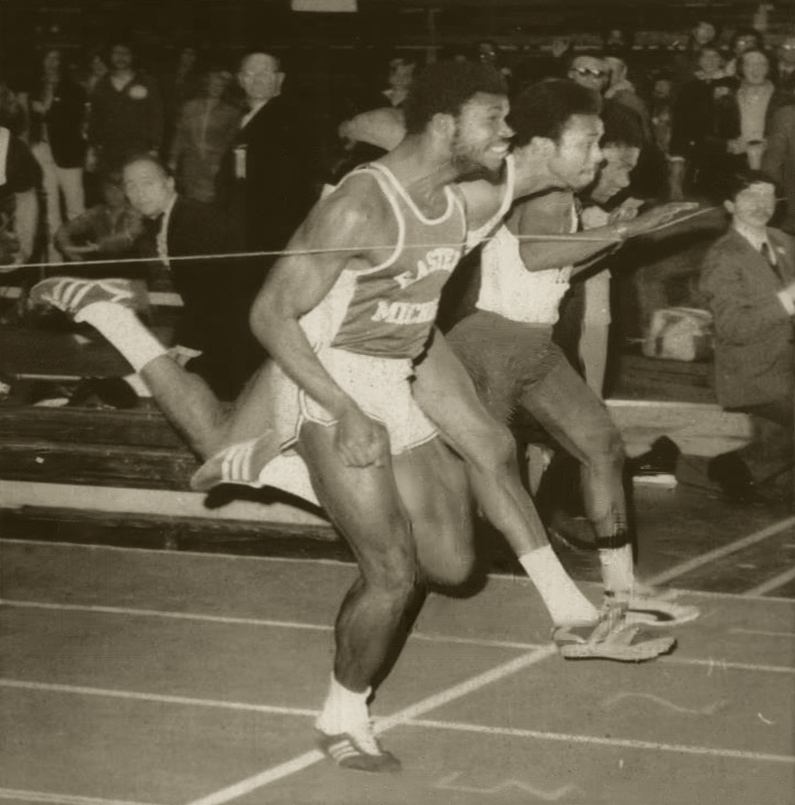
Hasely Crawford

Hasely Crawford
Biography
Early Life and Roots in San Fernando
Born on August 16, 1950, in the bustling southern city of San Fernando, Trinidad, Hasely Joachim Crawford grew up in a newly independent nation that was desperately searching for its identity on the world stage. Trinidad and Tobago achieved its independence from British rule in 1962 under the leadership of Eric Williams, a pivotal political moment that filled the nation with a sense of immense pride, optimism, and possibility. The youngest of a large working-class family, Crawford’s early life was deeply embedded in the everyday struggles and vibrancy of Trinbagonian culture. The 1950s and 1960s in Trinidad were an era characterized by the rise of the steelpan, the golden age of calypso, and a burgeoning sense of national self-determination. Amidst this cultural renaissance, young Hasely was finding his footing.
Athletics was not his first or only calling. Like many young boys in the Caribbean, he spent his formative years playing cricket and football, taking advantage of the open savannahs and community fields that dotted San Fernando. However, his extraordinary speed became undeniably evident as a teenager. Competing barefoot in local school sports and regional meets, Crawford would consistently outpace his peers with an unrefined but explosive natural gait. He formally began his athletic journey at the age of 17, relatively late for a future world champion. Under the guidance of local coaches who quickly recognized his raw, unbridled talent, he began to transition from a casual runner to a dedicated track athlete.
The Ascent to the Global Stage
The early 1970s marked a significant transition for Crawford as he began to refine his technique and endurance. His international debut occurred at the 1970 Commonwealth Games in Edinburgh, Scotland. Despite lacking the extensive resources, state-of-the-art facilities, and international exposure of his British or American counterparts, the twenty-year-old Trinidadian stunned spectators by securing a bronze medal in the 100-meter sprint. This victory was a clarion call; Crawford was no longer just a local talent—he was a rising star in global athletics, putting the Caribbean on notice.
Two years later, Crawford qualified for the 1972 Olympic Games in Munich, Germany. The Munich Games were historically fraught and tragic, overshadowed by the massacre of Israeli athletes, but for Crawford, they represented his first foray into the ultimate theater of athletic competition. He blazed through the preliminary heats, reaching the 100-meter final as a formidable contender and raising the hopes of his entire nation. However, heartbreak struck at the worst possible moment. Midway through the highly anticipated final, Crawford suffered a severe hamstring injury, forcing him to pull up in agony and watch as Soviet sprinter Valeriy Borzov claimed the gold medal.
"It wasn't just my hamstring that snapped in Munich; it was my heart. But the pain taught me that raw speed wasn't enough—I needed absolute resilience and preparation if I was going to conquer the world."
The profound disappointment in Munich could have easily derailed a lesser athlete, but for Crawford, it served as a crucible. He spent the next four years undergoing a grueling, obsessive regimen of physical and mental preparation. Recognizing the limitations of training facilities in Trinidad, Crawford made the difficult decision to relocate to the United States, studying and training at Eastern Michigan University under the legendary track coach Bob Parks. There, he relentlessly honed his explosive start, improved his biomechanics, and developed a formidable psychological toughness. He ran alongside other elite athletes, studying their techniques and fortifying his own weaknesses.
Montreal 1976: The Defining 10.06 Seconds
The 1976 Olympic Games in Montreal, Canada, took place against a complex geopolitical backdrop, marked notably by a massive boycott from numerous African nations protesting the participation of New Zealand, whose rugby team had recently toured apartheid South Africa. For the athletes who did compete, the pressure was immense, and the spotlight was brighter than ever.
Crawford arrived in Montreal in the absolute prime of his athletic life. Standing 6 feet 3 inches (1.90 meters) tall and weighing nearly 90 kilograms, his imposing physical stature was matched only by his intense, tunnel-vision focus. The men's 100-meter final, held on July 24, 1976, featured a stellar lineup. It included the defending Olympic champion Valeriy Borzov, the American favorite Harvey Glance, and the legendary Jamaican sprinter Don Quarrie. The rivalry between Crawford and Quarrie added a distinctly Caribbean flavor to the ultimate showdown.
When the starting gun fired, Crawford's execution was nothing short of flawless. He exploded out of the blocks, his long, powerful strides eating up the synthetic track with mechanical precision. At the 60-meter mark, he began to pull ahead of the fiercely competitive pack. Pushing through the pain barrier and maintaining his top speed, Crawford crossed the finish line in a blistering 10.06 seconds. He narrowly edged out Don Quarrie by a fraction of a second, with Borzov taking the bronze.
In that fleeting 10.06 seconds, Hasely Crawford achieved immortality. He became the first athlete from Trinidad and Tobago to win an Olympic gold medal. The image of Crawford crossing the line, his arms raised in exhausted, triumphant joy, was instantly seared into the national consciousness of his homeland.
A Nation Transformed
The news of Crawford's victory ignited unprecedented, euphoric celebrations across Trinidad and Tobago. A nation of roughly one million people literally brought traffic to a standstill. Calypsonians spontaneously composed and performed songs in his honor, capturing the mood of the moment, and the steelpan yards rang out in jubilation late into the night. The victory was far more than a sporting achievement; it was a profound assertion of Trinbagonian excellence on the global stage. It validated the post-independence identity of the country, proving that they could stand shoulder-to-shoulder with global superpowers.
Crawford returned home to a hero's welcome that is still talked about decades later. The government, recognizing the historical magnitude of his achievement, awarded him the Trinity Cross, the highest national honor available in the country at the time. His triumph inspired an entire generation of Caribbean athletes, irrevocably proving that individuals from small island developing states could dominate in the most fiercely contested and widely watched sports in the world.
"He showed us that our smallness on the map did not mean a smallness of spirit or capability. Hasely taught an entire newly independent generation exactly how to win."
Later Career and Ongoing Challenges
Following his Montreal triumph, Crawford continued to compete at the highest international levels. He remained a formidable force in sprinting, capturing another bronze medal at the 1978 Commonwealth Games in Edmonton, Canada. However, sustaining the absolute peak physical condition required for the 100-meter sprint, coupled with the natural aging process, eventually took its toll. He proudly represented Trinidad and Tobago by qualifying for the 1980 Moscow Olympics and the 1984 Los Angeles Olympics. Although he was unable to replicate his 1976 success—eventually failing to advance past the quarter-finals in his final Olympic appearance—his mere presence on the track continued to inspire.
Despite these later competitive setbacks, Crawford's status as a revered sporting icon remained unassailable. He officially retired from professional athletics shortly after the 1984 Games, leaving behind a track record that set the gold standard for Caribbean sprinters.
Lasting Legacy and Civic Impact
Crawford's transition from elite athlete to civic leader perfectly demonstrated his enduring, deep-seated commitment to his country. Instead of retreating from public life or moving abroad permanently, he dedicated his post-athletics career to community development, sports administration, and youth mentorship in Trinidad and Tobago. For many years, he served as the Head of Community Relations at the National Gas Company of Trinidad and Tobago (NGC). In this influential corporate role, he spearheaded numerous initiatives to fund local sports clubs, upgrade dilapidated athletic facilities, and provide vital scholarships to disadvantaged youths.
In 2001, the Trinidad and Tobago government made a massive, lasting tribute to their first Olympic champion by officially renaming the National Stadium in the capital city of Port of Spain to the Hasely Crawford Stadium. This sprawling sporting complex serves as the epicenter for national athletics, football matches, and cultural events, standing as a permanent physical monument to his legacy.
Furthermore, Crawford’s immense influence paved the way for future Trinidadian track and field stars. From Ato Boldon to Richard Thompson, and javelin thrower Keshorn Walcott, subsequent Olympic medalists trace their lineage of belief back to Montreal in 1976. By shattering the psychological barrier of what was possible for a Trinbagonian athlete, Hasely Crawford fundamentally altered the trajectory of the nation's sporting history. Today, he is celebrated not only as a phenomenal, world-beating sprinter but as a unifying national father figure whose 10.06 seconds of brilliance continues to echo loudly through the Caribbean and the world.
Major Contributions
- Hasely Crawford's most monumental contribution was becoming the first athlete from Trinidad and Tobago to win an Olympic gold medal, achieving this feat in the 100-meter sprint at the 1976 Montreal Olympics.
- His victory fundamentally shifted the sporting landscape of the Caribbean, proving that athletes from small island nations could dominate the world's most prestigious sporting events.
- Beyond his athletic achievements, Crawford contributed significantly to national development through his decades of work in community relations, youth mentorship, and sports administration, ensuring that subsequent generations of Trinbagonian athletes had the resources and inspiration needed to succeed globally.