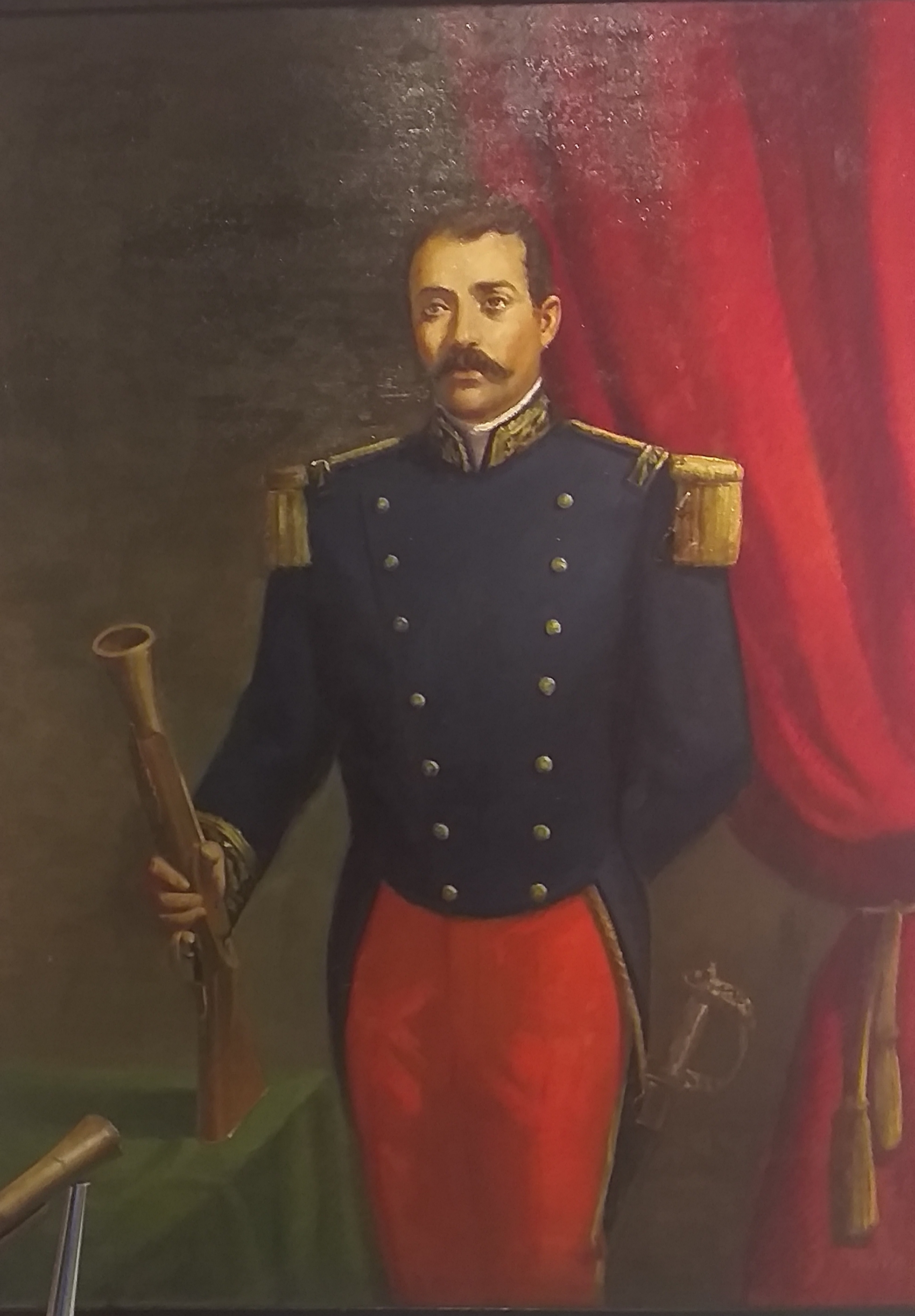
Matías Ramón Mella

Matías Ramón Mella
Biography
A Nation Born From a Single Shot
In the long and turbulent history of the Caribbean, few moments carry the electric charge of the night of February 27, 1844. As the clock ticked past midnight in the colonial city of Santo Domingo, a single blast from a blunderbuss — a trabucazo — shattered the silence and ignited a revolution. The man who pulled that trigger was Matías Ramón Mella Castillo, a soldier, statesman, and unflinching patriot who would spend his entire life in service to the nation that shot announced. He is remembered today as one of the three Padres de la Patria — the Founding Fathers of the Dominican Republic — and his name is spoken in the same reverent breath as Juan Pablo Duarte and Francisco del Rosario Sánchez.
Early Life in a Divided Island
Matías Ramón Mella was born on February 25, 1816, in the city of Santo Domingo, in the eastern portion of the island of Hispaniola. He was the son of Antonio Mella Álvarez and Francisca Javier Castillo Álvarez, a family of modest colonial standing. The world into which he was born was one already scarred by upheaval. Just twelve years earlier, the western third of the island — the former French colony of Saint-Domingue — had exploded in the most successful slave revolution in human history, giving birth to the Republic of Haiti under the fierce leadership of men like Jean-Jacques Dessalines and Henri Christophe.
Mella grew up watching the eastern half of the island be absorbed completely into Haitian rule. In February 1822, Haitian President Jean-Pierre Boyer marched his army eastward and unified all of Hispaniola under the Haitian flag — without a single shot being fired. For the Dominicans, this unification — referred to in Dominican historiography as the occupation — would last twenty-two years. While Boyer's government did bring the formal abolition of slavery to the east and introduced republican ideals, his administration also imposed Haitian law, suppressed the influence of the Catholic Church, redistributed lands to Haitian officials, and centralized all political authority in Port-au-Prince. For many Dominicans — especially those of the creole elite and the devout Catholic majority — the experience fostered a deep, festering sense of cultural alienation and national longing.
It was in this charged atmosphere that Mella came of age. From his youth, he was known for a fiery, decisive temperament — a man of action rather than mere theory. He received a basic education and, like many ambitious young men of his era, looked toward military and civic life as the paths to dignity and change.
La Trinitaria: The Secret Society That Changed History
By the late 1830s, a quiet but determined conspiracy was taking shape in the backstreets of Santo Domingo. Its architect was Juan Pablo Duarte, a young idealist recently returned from Europe, burning with liberal Enlightenment ideals and a profound vision of Dominican nationhood. On July 16, 1838, Duarte founded La Trinitaria — a clandestine society whose name honored the Holy Trinity and whose organizational genius lay in its cellular structure: each member was responsible for recruiting exactly three others, and members of different cells did not know each other's identities, protecting the whole from infiltration.
Matías Ramón Mella was among the original founding members of La Trinitaria, joining the circle that also included Francisco del Rosario Sánchez. Within the society, each man brought something different. Duarte provided the ideological vision — a sovereign Dominican Republic built on liberal democratic principles. Sánchez brought charisma and organizational energy. Mella brought the warrior's soul. He was the man of militant conviction, unafraid of confrontation, who understood that ideas alone could not birth a nation — that at some point, someone would have to act.
La Trinitaria operated not only as a political cell but also through cultural fronts. The group used theater troupes — La Filantrópica and La Dramática — to spread ideals of independence and representative government to ordinary Dominicans, building a broad base of nationalist sentiment under the nose of the Haitian authorities.
By 1843, the moment of opportunity arrived. Haiti itself was convulsed by internal rebellion. A popular uprising known as the Reforma toppled Boyer from power, plunging the country into instability. The Trinitarios saw their window and began planning in earnest.
The Night of the Trabucazo: February 27, 1844
"The shot fired by Mella at the Puerta de la Misericordia was not merely the signal for an uprising — it was the sound of a people declaring themselves free."
The plan was meticulously organized. On the night of February 27, 1844, Mella and a band of patriots gathered near the Puerta de la Misericordia — the Gate of Mercy — one of the ancient gateways in Santo Domingo's colonial walls. Francisco del Rosario Sánchez led the conspirators assembled at the Puerta del Conde — the Gate of the Count — which would serve as the formal site of the proclamation. Juan Pablo Duarte, whose health had been deteriorating and who faced personal danger from Haitian authorities, was not present in the capital that night.
At the appointed hour, Mella raised his blunderbuss — the trabuco — and fired into the night air. The trabucazo rang out like a thunderclap across the sleeping city. It was the signal. Patriots at the Puerta del Conde and across the city sprang into action. The Haitian garrison in Santo Domingo, caught off guard, offered little coordinated resistance. Within hours, the conspirators had seized control of key points in the capital. At the Puerta del Conde, in the earliest minutes of February 27, 1844, Francisco del Rosario Sánchez proclaimed the independence of the Dominican Republic.
After twenty-two years of Haitian rule, the eastern part of Hispaniola was free — announced to the world by a single, courageous blast from Matías Ramón Mella's blunderbuss.
Defender of the New Republic: Military Campaigns Against Haiti
Independence declared was not independence secured. The new Dominican Republic immediately faced existential military pressure. Haitian President Charles Rivière-Hérard, who had himself come to power on the wave of the 1843 revolt, was enraged by the Dominican declaration and moved to reconquer the east. Haitian forces marched on the new republic from both the north and the south.
Mella threw himself into the defense of the nation with the same passion he had shown in its founding. Appointed a member of the Central Government Junta and dispatched to the critical Cibao region in the country's interior, he became the supreme political and military authority of that vital agricultural heartland. Though he was not personally on the battlefield at the decisive Battle of Santiago (March 30, 1844), he was the strategic mind behind the region's defense. It was Mella who summoned and empowered José María Imbert to take command of the troops, providing the instructions and resources that led to a stunning Dominican victory against the Haitian northern force.
The war continued in the south as well, where Dominican forces under Francisco del Rosario Sánchez and others repelled Rivière-Hérard's main thrust. Haiti would launch multiple invasions over the coming years, but each time, the young republic held firm. Mella later served with distinction at the Battle of Las Carreras (1849), fighting alongside General Pedro Santana against the forces of Haitian Emperor Faustin Soulouque, who had launched a major campaign to retake the Dominican territories.
Political Turbulence: Imprisonment and Exile
The very victories that secured the Dominican Republic's survival also ushered in a new era of internal strife. By the summer of 1844, the powerful landowning general Pedro Santana had eclipsed the idealistic Trinitarios and seized control of the provisional government. Santana was a caudillo in the classic Caribbean mold — a strongman who prioritized order and personal power over the democratic ideals that Duarte, Sánchez, and Mella had fought to establish.
Mella, who had championed Duarte for the presidency, found himself on the wrong side of Santana's consolidating power. Santana moved swiftly against the Trinitarios. Juan Pablo Duarte was arrested and sent into permanent exile. Francisco del Rosario Sánchez was also expelled. And Matías Ramón Mella — the man who had fired the shot that made it all possible — was imprisoned and subsequently exiled from the country he had helped create.
He would remain in exile until 1848, when a general amnesty allowed him to return. His years abroad were marked by hardship and frustration, yet they did not break his commitment to the Dominican cause. Upon his return, Mella re-entered public life, serving in various governmental capacities. He held the post of Secretary (Minister) of Finance from 1849 to 1850, demonstrating that his contributions were not limited to the battlefield but extended into the administrative machinery of the state.
A Nation Surrendered: The Spanish Annexation
The Dominican Republic's first two decades were a turbulent cycle of Haitian invasions, political coups, and strongman rule. In one of the most shocking and controversial decisions in Dominican history, Pedro Santana — having returned to power — negotiated the annexation of the Dominican Republic to Spain on March 18, 1861. Santana, fearing further Haitian aggression and internal instability, chose to hand sovereignty back to the former colonial master rather than risk losing it to Haiti.
For Matías Ramón Mella, a man who had risked his life to declare independence and endured exile for defending that independence, the annexation was an unconscionable betrayal. He adamantly opposed the Spanish takeover, viewing it as a complete negation of everything the founding generation had sacrificed to build. He was not alone — across the country, a new generation of patriots began organizing resistance. The annexation that Santana had hoped would bring stability instead ignited one of the Caribbean's most remarkable guerrilla wars.
The Final Campaign: The War of Restoration
On August 16, 1863, a group of Dominican patriots crossed from Haiti and raised the Dominican flag on Capotillo Hill in the Cibao mountains — an event known as the Grito de Capotillo. The Dominican Restoration War had begun. It would prove to be a brutal, two-year guerrilla conflict in which Dominican fighters, intimately familiar with the jungle terrain, wore down the Spanish military forces despite being vastly outgunned. Young commanders like Gregorio Luperón of Puerto Plata emerged as the fierce new faces of Dominican nationalism.
Matías Ramón Mella, now in his late forties and suffering from serious illness — dysentery had wracked his body — nonetheless refused to stand aside. The man who had fired the first shot of Dominican independence rose from his sickbed to take part in one final campaign. He joined the restoration movement, served as Minister of War, and on September 14, 1863, was elevated to serve as the 7th Vice President of the Dominican Republic in the provisional Restoration Government — the patriot government-in-arms fighting to expel the Spanish.
It was a fitting, if heartbreaking, capstone to a life of service. Mella served as Vice President while the war raged around him, his health deteriorating even as Dominican forces scored victory after victory against the Spanish colonial army.
"Aún hay patria, viva la República Dominicana." ("There is still a fatherland, long live the Dominican Republic.") — Matías Ramón Mella's last recorded words
On June 4, 1864, Matías Ramón Mella died in Santiago de los Caballeros, in a small house near the Fortaleza San Luis, without the comfort of wealth or power — he died in reported extreme poverty. Before his death, he requested that his body be wrapped in the Dominican flag. He did not live to see the final Spanish withdrawal in 1865, but the war he had joined was won. The Dominican Republic he had announced with a gunshot twenty years earlier survived, free and sovereign.
Legacy: The Shot Heard Across the Caribbean
The historical verdict on Matías Ramón Mella is clear and unambiguous: he was a man of extraordinary courage who placed the birth and survival of his nation above every personal consideration — his freedom, his comfort, and ultimately his life. He was exiled by the government of the republic he helped found. He was sidelined, imprisoned, and marginalized by rival political forces. Yet he returned again and again, each time answering the call of a country that did not always treat him well.
Today, Mella's remains rest alongside those of Juan Pablo Duarte and Francisco del Rosario Sánchez in the Altar de la Patria — the Altar of the Fatherland — in the Parque Independencia in Santo Domingo, steps away from the very Puerta del Conde where Dominican independence was proclaimed. He is honored in the Order of Merit of Duarte, Sánchez, and Mella, the Dominican Republic's highest state honor. His birthday, February 25, is observed nationally. Streets, schools, neighborhoods, and public institutions across the country bear his name.
The trabucazo — that single shot fired into the night air at the Puerta de la Misericordia — has become one of the most powerful symbols in Dominican national memory. It represents the moment when a people, long suppressed under foreign rule, chose action over resignation. And the man who fired it, Matías Ramón Mella Castillo, stands forever as proof that history can turn on the courage of a single individual willing to act when the moment demands it.
References
- Matías Ramón Mella - Wikipedia
- Matías Ramón Mella - Kiddle Encyclopedia
- Dominican Independence Day: The trabucazo that changed history - Casa de Campo Living
- La Trinitaria - Wikipedia
- Dominican Restoration War - Wikipedia
- Haitian occupation of Santo Domingo - Wikipedia
- Matías Ramón Mella - Encyclopedia.com
- Dominican Republic Independence - History.com
- Gregorio Luperón - Wikipedia
- Category: Matías Ramón Mella - Wikimedia Commons
Major Contributions
- Matías Ramón Mella's most singular contribution to Dominican and Caribbean history is the act that announced a nation's birth: the *trabucazo*, the blunderbuss shot he fired at the Puerta de la Misericordia on the night of February 27, 1844, serving as the agreed-upon signal for the declaration of Dominican independence from twenty-two years of Haitian rule.
- As a founding member of *La Trinitaria* alongside Juan Pablo Duarte and Francisco del Rosario Sánchez, Mella helped build and sustain the secret network that made independence possible, and in the days and months after the proclamation, he served as the supreme political and military authority in the vital Cibao region, organizing the successful defense against Haitian counter-invasions that sought to crush the newborn republic in its cradle.
- Beyond the founding moment, Mella's contributions spanned two decades of national service across both military and civilian roles — as a battle commander at Las Carreras (1849), as Minister of Finance (1849–1850), and ultimately as Vice President of the Restoration Government (1863–1864), dying in office while fighting to expel Spain's re-annexation of the Dominican Republic.
- His life is a testament to an unwavering patriotism that survived imprisonment, exile, political betrayal, and physical illness.
- He is enshrined as one of the three *Padres de la Patria* — the Founding Fathers of the Dominican Republic — and his remains rest in the Altar de la Patria in Santo Domingo, a permanent symbol of the sacrifice upon which the Dominican nation was built.

