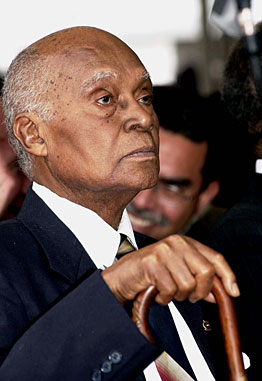
Sir Gerald Cash

Sir Gerald Cash
Biography
Introduction
Sir Gerald Christopher Cash stands as a titan of Bahamian history, a statesman whose steady hand, brilliant legal mind, and unwavering dedication to public service helped shape the modern Commonwealth of The Bahamas. Born into an era of colonial rule and deep social stratifications, Cash rose to become a widely respected barrister, an independent and principled politician, and ultimately the longest-serving Governor-General of an independent Bahamas. His life story is inextricably linked to the peaceful but profound transformation of his island nation, from a British colony to a sovereign, democratic state. Over a career spanning more than half a century, Sir Gerald embodied the quiet dignity and steadfast resolve required to bridge the deep divides of race and class in the 20th-century Bahamas, earning him knighthoods and the enduring affection of his people.
Early Life and Precocious Intellect
Gerald Christopher Cash was born in Nassau, The Bahamas, on May 28, 1917, to Wilfred Gladstone Cash and Lillian Cash. The Nassau of his youth was a profoundly different place than the bustling tourist hub it is today. It was a deeply segregated society where economic and political power was concentrated in the hands of a small white merchant elite, often referred to as the "Bay Street Boys." For a young Black Bahamian, opportunities for advancement were fiercely limited, often requiring extraordinary talent, unyielding discipline, and the support of a dedicated family.
Cash possessed all three. From a young age, he exhibited a precocious intellect that set him apart from his peers. He began his formal education at Eastern Senior High School before advancing to the prestigious Government High School in Nassau. At the time, Government High School was the premier educational institution for Black Bahamians, serving as a crucible for the future leaders of the nation. Cash's academic brilliance culminated in an extraordinary achievement: at the tender age of 15, he graduated with the Cambridge Senior School Certificate. This accomplishment not only underscored his remarkable intellectual capacity but also signaled the arrival of a young man destined for greatness.
A Trailblazer in the Legal Profession
Following his graduation, Cash set his sights on the legal profession, recognizing the law as a powerful tool for social mobility and advocacy. In 1940, at the age of 23, he was called to the Bahamas Bar as a counsel and attorney of the Supreme Court. He practiced law in Nassau for five years, gaining invaluable experience and establishing a reputation for his meticulous preparation and courtroom eloquence.
However, Cash's ambition extended beyond the shores of his island home. In 1945, seeking to further his legal education and formalize his credentials on an international stage, he traveled to London to study at the Society of the Middle Temple, one of the four Inns of Court exclusively entitled to call members to the English Bar.
"In the hallowed halls of the Middle Temple, young Cash demonstrated that the intellectual rigor nurtured in the Caribbean was more than a match for the institutions of the Empire, returning home not just as a lawyer, but as a symbol of Bahamian potential."
His time in the United Kingdom was marked by rigorous study and academic excellence. He passed his bar examinations with class-two honors, a significant achievement for a student from the colonies, and was called to the English Bar as a barrister-at-law on November 17, 1948. Later that same year, he returned to Nassau, resuming his private practice with the added prestige and authority of a London-trained barrister.
Entry into Politics and the Fight for Equality
Cash’s return to Nassau coincided with a period of growing political awakening in The Bahamas. The post-war era brought with it a rising demand for civil rights, democratic representation, and an end to systemic discrimination. In 1949, Cash entered the political fray, running for the House of Assembly as an independent candidate. He was elected as the Senior Representative for the Western District of New Providence.
As a Member of Parliament, Cash distinguished himself through his independent thinking and his commitment to justice. Unlike many politicians of his era who aligned themselves strictly with the established oligarchy or the emerging progressive movements like those led by figures such as Sir Lynden Pindling, Cash maintained an independent stance that allowed him to serve as a crucial bridge between opposing factions. He was re-elected in 1956 as the Junior Representative for the same district, serving a total of 14 years in the House of Assembly.
One of the defining moments of his early political career was his involvement in the 1956 Resolution, a landmark legislative effort aimed at ending racial discrimination in public places in The Bahamas. Cash’s legal expertise and his measured, persuasive arguments were instrumental in this fight for equality, helping to dismantle the institutionalized segregation that had long plagued Bahamian society.
His competence and integrity were recognized by the colonial administration as well, leading to his appointment as a member of the Executive Council, where he served from 1958 to 1962. In this role, Cash gained crucial executive experience, navigating the complex administrative machinery of the colony during a time of intense political transition.
The Road to Independence and the Senate
The 1960s brought sweeping changes to The Bahamas, culminating in the attainment of internal self-government in 1964 and the historic election of the Progressive Liberal Party (PLP) in 1967, which broke the stranglehold of the Bay Street Boys. Through these turbulent years, Cash’s reputation as an elder statesman and an impartial arbiter of the law continued to grow.
In 1969, he was appointed to the Senate, the upper house of the Bahamian Parliament. His leadership qualities quickly came to the fore. He served as Vice-President of the Senate from 1970 to 1972, and in 1972, on the eve of Bahamian independence, he was elevated to the position of President of the Senate. It was in this capacity that Cash presided over the crucial legislative sessions that paved the way for the birth of a new, sovereign nation on July 10, 1973. His steady hand at the helm of the Senate ensured that the transition to independence was orderly, dignified, and rooted in the rule of law.
The Highest Office: Governor-General
Following independence, the role of Governor-General—the representative of the British monarch and the de facto head of state—became a powerful symbol of the new nation's sovereignty and its enduring ties to the Commonwealth. The first Bahamian to hold this office was Sir Milo Butler, a fiery and beloved champion of the people.
Between 1973 and 1976, Sir Gerald Cash served as Deputy to Governor-General Sir Milo Butler on five separate occasions, filling in during periods of illness or absence. When Sir Milo passed away in 1979 after a prolonged illness, Cash, who had been acting in the role since 1976, was naturally and substantively appointed as the second Governor-General of The Bahamas.
"As Governor-General, Sir Gerald Cash was the embodiment of grace and neutrality. In an era marked by intense political partisanship, his office remained a sanctuary of national unity."
Sir Gerald's tenure as Governor-General, which lasted from 1979 until his retirement in 1988, is widely regarded as a golden era for the office. He brought to Government House a profound sense of decorum, an encyclopedic knowledge of the constitution, and an unwavering commitment to impartiality. During the 1980s, a period occasionally marked by domestic political controversies and the challenges of nation-building, Cash served as a unifying figure. He hosted numerous foreign dignitaries, including Queen Elizabeth II, and carried out his constitutional duties with a flawless precision that set the standard for all who would follow him.
A Champion of Bahamian Sports
While Sir Gerald's legacy in law and politics is monumental, his contributions to the cultural and social life of The Bahamas were equally significant, particularly in the realm of sports. He was not just an armchair enthusiast but a dedicated administrator who believed passionately in the power of athletics to build character and foster national pride.
Cash was instrumental in the formation of both the Bahamas Amateur Athletic Association (BAAA) and the Bahamas Olympic Association. He worked tirelessly to ensure that Bahamian athletes had the resources, training, and international recognition they deserved. He served as Chef de Mission for Bahamian teams at various prestigious international events, including the 1968 Olympic Games in Mexico City. His dedication to the Olympic movement was internationally recognized in 1982 when he was awarded the prestigious Silver Medal of the Olympic Order.
Knighthoods, Family, and Final Years
Throughout his illustrious career, Sir Gerald was repeatedly recognized by the British Crown for his extraordinary service. He was appointed an Officer of the Order of the British Empire (OBE) in 1964. This was followed by a series of high honors: Knight Commander of the Royal Victorian Order (KCVO) in 1977, Knight Grand Cross of the Order of St Michael and St George (GCMG) in 1980, and finally, Knight Grand Cross of the Royal Victorian Order (GCVO) in 1985, bestowed personally by Queen Elizabeth II.
Behind the public figure was a devoted family man. Sir Gerald was married to Dorothy Long, and together they raised three children: a daughter, Sharon, and two sons, Gordon and Gerald Jr. His family was a source of great strength and grounding throughout his demanding public life.
After retiring from the office of Governor-General in 1988, Sir Gerald remained a revered elder statesman in The Bahamas. In 1996, in a fitting tribute to his lifelong commitment to education and national development, the Flamingo Gardens Primary School was officially renamed the Gerald C. Cash Primary School.
Sir Gerald Christopher Cash passed away on January 6, 2003, at the age of 85, following a massive stroke. His death was mourned across the nation, with political leaders from all sides praising his integrity, his intellect, and his monumental contributions to the Bahamian state. He left behind a legacy that continues to inspire. From the courtrooms of Nassau to the halls of the Middle Temple, from the contentious debates of the House of Assembly to the dignified corridors of Government House, Sir Gerald Cash devoted his life to the pursuit of justice, equality, and the sovereign dignity of The Bahamas.
References
Major Contributions
- Sir Gerald Cash’s major contributions span the legal, political, and social landscapes of The Bahamas.
- As a trailblazing barrister, he brought international legal rigor back to Nassau, paving the way for future generations of Bahamian legal professionals.
- In politics, his 14-year tenure as an independent Member of Parliament and his instrumental role in passing the 1956 Resolution were pivotal in dismantling racial segregation in public spaces.
- Furthermore, his leadership as President of the Senate during the 1973 transition to independence ensured a stable and legally sound birth for the new nation.
- Beyond governance, Sir Gerald's legacy is cemented in his role as a foundational figure in Bahamian sports and as the longest-serving Governor-General of an independent Bahamas.
- He was a driving force behind the creation of the Bahamas Olympic Association and the Bahamas Amateur Athletic Association, securing an international platform for Bahamian athletes.
- As Governor-General from 1979 to 1988, he provided a steady, unifying presence during a transformative decade, elevating the office to a symbol of impeccable integrity and national cohesion.