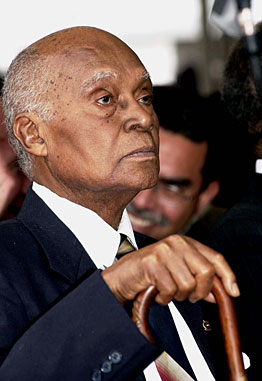
Sir Charles Carter

Sir Charles Carter
Biography
Early Life and Abaco Roots
Sir Charles Carter’s life and legacy are inextricably linked to the pine forests, turquoise waters, and fiercely independent spirit of Abaco. Born in the early 1930s in the bustling settlement of Marsh Harbour, Carter grew up in a period when the Family Islands of The Bahamas were largely marginalized by the central authorities in Nassau. At the time, Abaco was a rugged frontier, deeply reliant on traditional boatbuilding, artisanal fishing, and the booming but often exploitative timber industry.
Carter’s early years were shaped by this demanding environment. His father was a master boatbuilder whose vessels navigated the treacherous reefs of the Bahamian archipelago, and his mother was a dedicated local schoolteacher who instilled in him a profound belief in the transformative power of education. In a community where formal schooling was often cut short to accommodate the grueling demands of maritime and agricultural labor, Carter’s parents were resolute. They ensured he received the best education available, emphasizing that knowledge was the true currency of freedom. This foundational emphasis on learning would later define his approach to civic leadership, public policy, and political empowerment.
The Abaco of Carter’s youth was a place of stark economic contrasts. While the island possessed immense natural wealth, its people often saw little of the financial benefits. The timber companies, predominantly foreign-owned and operated, extracted vast quantities of the prized Abaco pine, but the local workforce labored under harsh conditions with limited prospects for upward mobility or land ownership. Observing these systemic inequities firsthand, a young Charles Carter began to cultivate a deep-seated commitment to social justice and economic self-determination for his fellow Abaconians.
The Awakening: Social Activism and Civic Leadership
Carter's transition from a perceptive youth to a vocal civic leader occurred during the late 1950s and early 1960s, a transformative and highly volatile era in Bahamian history. As the winds of change swept through the Caribbean, bringing decolonization and civil rights to the forefront, the political landscape in Nassau was beginning to shift radically with the rise of the progressive movement and the push toward majority rule.
However, politics in Abaco were exceptionally complex and often conservative. The island had a significant population that remained loyal to the old guard and was deeply suspicious of the political machinery operating in the capital. Carter recognized that if Abaco was to thrive in a modernizing Bahamas, its people needed a unified, progressive voice that could articulate their unique concerns without succumbing to the isolationism that had historically held the island back.
He began his civic career by organizing local cooperatives for fishermen and farmers, aiming to circumvent the predatory middlemen who dictated market prices in Nassau. These early grassroots initiatives required immense organizational skill and patience. By pooling their resources, local producers were able to negotiate better prices and secure equipment, which not only improved the economic standing of many Abaconian families but also established Carter as a trusted, pragmatic leader. He was recognized as a man who understood the sea and the soil, yet possessed the intellectual rigor to negotiate effectively with government bureaucrats and foreign investors alike.
"To build Abaco is to build The Bahamas. Our strength lies not just in Nassau, but in the resilient, fiercely independent islands that form the true backbone of this archipelagic nation."
Entering Politics: The Road to Independence
As the 1960s progressed, Carter’s expanding influence inevitably drew him into the national political arena. He aligned himself with the progressive forces pushing for majority rule, a stance that required immense personal and political courage in Abaco, where political loyalties were fiercely divided along racial and class lines.
The monumental achievement of Majority Rule in 1967, spearheaded by figures like Lynden Pindling, was a watershed moment for The Bahamas. However, the subsequent push for full national independence from Great Britain in 1973 created significant turbulence, particularly in Abaco. A vocal and well-funded faction known as the Abaco Independence Movement (AIM) emerged, aggressively advocating for the island to secede from The Bahamas and remain a British Crown Colony. The AIM movement was fueled by a potent mix of genuine economic anxiety, racial tension, and political maneuvering, threatening to fracture the nascent nation before it even began.
It was during this precarious period that Charles Carter truly distinguished himself as a national statesman. He vigorously opposed secession, undertaking a tireless, often dangerous campaign across Abaco’s scattered and remote settlements to argue for national unity. Carter eloquently made the case that Abaco’s future lay in a united, independent Bahamas, provided that the island was given a fair, constitutionally protected seat at the national table. His unparalleled credibility as a native son of Abaco, coupled with his proven track record of fighting for local economic rights, helped to calm fears, dismantle misinformation, and ultimately marginalize the separatist rhetoric.
Championing Abaco's Development
Following the peaceful achievement of independence in 1973, Carter was elected to the Bahamas House of Assembly, representing his beloved Abaco. His tenure in the legislature was marked by a relentless, laser-focused dedication to infrastructure, healthcare, and education, which he viewed as the essential pillars of sustainable development.
Carter was instrumental in securing unprecedented government funding for the electrification of remote Abaco settlements, many of which had relied on kerosene and generators for generations. He pushed through legislation for the expansion of the island's road network, connecting isolated farming communities to the main ports, and oversaw the modernization of the docks to facilitate better inter-island trade. He argued passionately on the floor of the House of Assembly that the Family Islands could not merely serve as weekend retreats or raw material outposts for Nassau’s elite; they had to become self-sustaining economic engines in their own right.
Furthermore, he championed the expansion of secondary and vocational education on the island. Remembering his mother’s unwavering dedication to teaching, Carter spearheaded the construction of new schools and modern vocational training centers. He understood that as the Bahamian economy diversified into tourism and financial services, the youth of Abaco needed modern skills. By bringing these institutions to the island, he ensured that the next generation of Abaconians would not be forced into the internal migration to Nassau that had depleted the Family Islands of their brightest minds for decades.
Relationship with Hubert Ingraham and the Post-Independence Era
Carter’s influence extended far beyond his own direct political achievements; he served as a crucial mentor and a towering inspirational figure for younger politicians emerging from Abaco, most notably Hubert Ingraham. Ingraham, who would later rise to become Prime Minister of The Bahamas, shared Carter’s deep, authentic roots in the Abaconian working class and his unyielding commitment to Family Island empowerment.
While Carter and Ingraham occasionally found themselves on different sides of the political aisle—especially as the political landscape evolved and the Free National Movement (FNM) gained national prominence—their mutual respect was undeniable and highly public. Carter’s pioneering work in demanding equitable treatment for Abaco laid the structural, infrastructural, and ideological groundwork that Ingraham would later build upon on a national scale. Together, their intertwined legacies cemented Abaco’s reputation as a crucible for strong, fiercely independent-minded Bahamian leaders who consistently challenged and reformed Nassau-centric policies.
"He taught a generation of leaders that true political power is not about shouting the loudest in the capital, but about remembering and resolving the quiet struggles of the people back home."
Knighthood and Later Years
In profound recognition of his extraordinary lifetime contributions to national unity, infrastructural development, and unwavering public service, Charles Carter was knighted by Queen Elizabeth II, officially becoming Sir Charles Carter. The honor was widely celebrated across The Bahamas, but nowhere was the jubilation more intense than in Abaco, where he was revered as a hometown hero who had elevated the island’s stature and dignity on the national and international stage.
Even after retiring from active, frontline political life, Sir Charles remained a formidable and highly respected presence in Abaco’s civic affairs. He transitioned into the role of elder statesman, serving on numerous corporate and philanthropic boards, advising local government councils, and mentoring young entrepreneurs. Furthermore, he became a passionate and early advocate for environmental conservation. Recognizing that Abaco’s pristine environment—its coral reefs, pine forests, and mangroves—was its most valuable and vulnerable asset, he frequently spoke out against unchecked foreign development that threatened the ecological balance of the island's delicate marine habitats.
Legacy
Sir Charles Carter’s legacy is permanently woven into the very fabric of modern Abaco and the broader Bahamas. He is remembered by historians as the principal architect of the island’s successful integration into an independent Bahamian state, a leader who navigated the treacherous waters of secessionist sentiment with unparalleled wisdom, courage, and grace.
His life’s work fundamentally altered the deeply ingrained dynamic between Nassau and the Family Islands, proving that political power, economic vitality, and cultural significance did not have to be monopolized by the capital. Today, the thriving, diverse economy of Abaco—driven by high-end tourism, resilient agriculture, and a robust local business sector—stands as a living testament to his enduring vision. Sir Charles Carter was infinitely more than just a politician; he was the definitive champion of the Abaconian spirit, a man who ensured that his island home would forever be recognized, respected, and celebrated as a vital, indispensable pillar of The Bahamas.
References
Major Contributions
- Sir Charles Carter's major contributions fundamentally reshaped the political and economic landscape of Abaco and The Bahamas.
- He was instrumental in defusing the Abaco Independence Movement (AIM) during the critical 1970s, ensuring that the island remained a unified part of the newly independent Bahamian nation.
- By tirelessly advocating for national unity, he prevented a potential political crisis that could have fractured the archipelagic state.
- Beyond his role in national integration, Sir Charles pioneered the infrastructural and economic modernization of Abaco.
- He secured vital funding for electrification, road networks, and educational facilities, transforming the island from a marginalized outpost into a self-sustaining economic powerhouse.
- His mentorship of future national leaders, including Prime Minister Hubert Ingraham, established Abaco as a central force in Bahamian politics, permanently shifting the balance of power away from the capital and empowering the Family Islands.