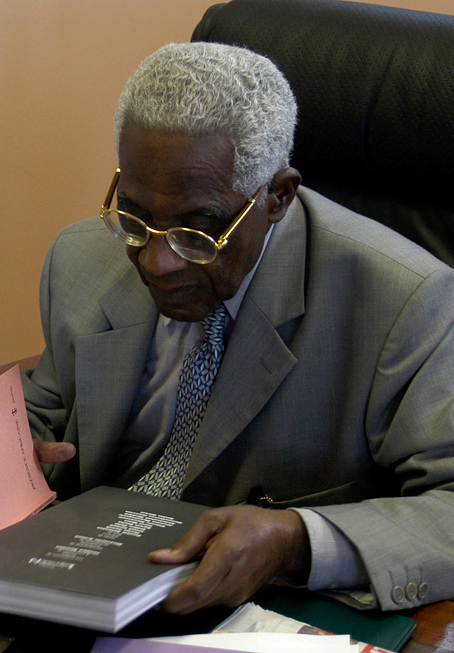
Sir Stafford Sands
Sir Stafford Sands
Biography
Introduction
Sir Stafford Lofthouse Sands (September 23, 1913 – January 25, 1972) was a transformative, brilliant, and controversial Bahamian lawyer, politician, and businessman who is widely regarded as the "Father of Tourism" in The Bahamas. As a dominant leader of the United Bahamian Party (UBP) and a key member of the "Bay Street Boys"—the white merchant elite who controlled Bahamian commerce and politics for decades—Sands played a primary role in shaping the modern Bahamian economy. He is credited with establishing the two primary pillars of the nation's prosperity: tourism and international financial services. He was the chief negotiator behind the Hawksbill Creek Agreement of 1955, which created the industrial and tourism free-port city of Freeport on Grand Bahama. Yet, his legacy is deeply stained by corruption, systemic conflict of interest, and ties to American organized crime syndicates seeking casino gambling concessions. The political fall of Sands and the UBP in 1967 marked the end of minority rule in The Bahamas and paved the way for majority rule under Sir Lynden Pindling.
The national flag of The Bahamas. Sir Stafford Sands played an instrumental role in shaping the commercial identity of the nation in the decades leading to independence.
Early Life, Family, and Educational Foundation
Stafford Lofthouse Sands was born in Nassau on September 23, 1913. He was the only child of Stafford Sands (1888–1965) and Enid Rosalie (née Lofthouse) Sands. His father was a successful entrepreneur who founded the City Meat Markets, a dominant grocery chain in New Providence, while his mother belonged to the prominent Lofthouse merchant family. Growing up in Nassau, Sands was part of the white minority population that held disproportionate economic power in the colony.
Unlike many of his wealthy contemporary peers who attended elite private schools like Queen's College, Sands was educated at the public Government High School in Nassau. He was a highly intelligent, intensely focused student. In the late 1920s, he traveled to England to complete his secondary education at Brighton College. He then began his legal training as a student of the Middle Temple in London, qualifying as a barrister in 1937. He returned to Nassau and was admitted to the Bahamas Bar in 1935 (having completed early clerkships). Sands quickly established a lucrative corporate law practice, specializing in representing foreign investors, wealthy expatriates, and land developers.
The "Bay Street Boys" and the United Bahamian Party
In 1937, at the age of 24, Sands was elected to the House of Assembly representing the City District of Nassau, launching a political career that would span three decades. During this era, The Bahamas was governed by an oligarchy of white merchants, lawyers, and businessmen known colloquially as the "Bay Street Boys". This group controlled both the legislative assembly and the commercial life of Nassau. The political system was rigged to maintain their dominance through property qualifications for voting, open voting, plural voting (where individuals could vote in multiple districts depending on land ownership), and gerrymandered boundaries that disenfranchised the majority Black population.
Sands emerged as the chief strategist and intellectual force of this group. In 1958, in response to the growing organization of the Progressive Liberal Party (PLP) and the historic general strike led by labor activist Randol Fawkes, Sands and his allies formed the United Bahamian Party (UBP). The UBP brought together the white business elite and conservative elements under a single banner, with Sir Roland Symonette serving as the public leader and Sands working behind the scenes as the party’s primary architect. Sands defended the existing socio-political hierarchy, arguing that white minority rule ensured economic stability and investor confidence.
The Architect of Year-Round Tourism
Sands’ greatest contribution to the Bahamian economy came through his leadership of the Bahamas Development Board, which he took control of in 1950. Before Sands, tourism in the Bahamas was a small, seasonal affair, operating only during the winter months for the ultra-wealthy. Sands envisioned a modern, year-round industry that could serve as the primary engine of the colony’s growth.
Sands secured an unprecedented budget of £150,000 to promote tourism, launching aggressive marketing campaigns across North America and Europe. He established Bahamas tourism offices in Miami, New York, Chicago, Toronto, and London, and pioneered the "Bahamas: Island of June" branding. Under his leadership, the Development Board focused on expanding airline connections, improving Nassau’s port facilities, and encouraging hotel construction through tax incentives. Sands' strategies were incredibly successful: visitor numbers grew from 45,000 in 1949 to over 800,000 by 1967, transforming the Bahamas into one of the world's premier tourism destinations.
Freeport and the Hawksbill Creek Agreement
In the early 1950s, American developer Wallace Groves approached the Bahamian government with a proposal to construct an industrial free port and residential city on Grand Bahama, an island then dominated by pine forests and small fishing villages. Sands served as Groves' personal attorney while simultaneously sitting as a member of the government's Executive Council.
In 1955, Sands negotiated the landmark Hawksbill Creek Agreement. The agreement granted Groves' Grand Bahama Port Authority 50,000 acres of crown land, duty-free status, and administrative control over the new city of Freeport. In return, the Port Authority was responsible for building a deepwater harbor, an airport, and municipal infrastructure. Sands received a massive legal fee of $200,000 for drafting the agreement, plus a $40,000 annual retainer for his law firm. The Hawksbill Creek Agreement successfully catalyzed the development of Freeport into a major industrial and tourism hub, but it also created a virtual "state within a state" that operated outside the direct control of the Bahamian government.
Tax Haven Development and the Casino Scandal
In addition to tourism, Sands worked to establish Nassau as a global tax haven and offshore banking center. He drafted laws that protected bank secrecy, exempted foreign companies from income taxes, and simplified trust administration. Within a decade, hundreds of international banks and trust companies set up operations in Nassau, creating a high-paying financial services sector.
However, Sands’ drive to develop Grand Bahama led to his political downfall. In 1963, Groves wanted to introduce casino gambling in Freeport to attract more tourists. Since gambling was illegal in the Bahamas, Sands helped secure "Certificates of Exemption" from the government for the Monte Carlo casino. Investigations later revealed that Sands’ law firm had received over $1.8 million in "consulting fees" from Groves’ companies to secure the licenses.
Furthermore, reports emerged linking the casino operations to American mobster Meyer Lansky, who sent experienced casino managers to run the operations. The casino scandal became a national issue, with the opposition PLP, led by Sir Lynden Pindling, accusing the UBP of selling out the country to foreign gangsters and lining their own pockets.
"Black Tuesday" (April 27, 1965) had already seen Pindling throw the speaker’s mace out of the House of Assembly window to protest gerrymandering and UBP corruption.
A detailed geographical map of The Bahamas, showing the islands of Grand Bahama (Freeport) and New Providence (Nassau) where Sands concentrated his economic planning.
Political Fall, Exile, and Death
The growing resentment against UBP corruption culminated in the historic general election of January 10, 1967. The PLP ran an aggressive campaign focused on Sands’ financial dealings and the UBP’s resistance to racial equality.
The election resulted in a historic tie: the UBP and PLP each won 18 seats. Independent member Alvin Braynen and Labour member Randol Fawkes threw their support to the PLP, allowing Sir Lynden Pindling to form the first majority rule government.
Following the PLP victory, a Royal Commission of Inquiry, led by Sir Ranulph Bacon, was appointed to investigate the casino concessions. The commission’s report was highly critical of Sands, finding that the payments he received were "enormous" and represented a flagrant conflict of interest.
Faced with public disgrace, legal pressure, and the loss of political power, Sands resigned his seat in the House of Assembly, declared himself a non-resident of the Bahamas, and went into voluntary exile in Spain. He spent his final years in exile, detached from the country he had built. Sir Stafford Sands died of cancer in London on January 25, 1972, at the age of 58.
Legacy and Controversy
Stafford Sands remains one of the most polarizing figures in Bahamian history. In 2001, the FNM government under Hubert Ingraham placed Sands’ portrait on the new $10 banknote, sparking intense public debate. Critics argued that a man who had defended minority rule and been implicated in corruption should not be honored on national currency, while supporters pointed to his role as the architect of the tourism and financial sectors that sustain the nation. Sir Stafford Sands’ life exemplifies the complex, often contradictory forces that shaped the post-colonial Caribbean.
Major Contributions
- Sir Stafford Sands was a dominant Bahamian politician and lawyer who served as Minister of Finance and Tourism from 1964 to 1967.
- Known as the 'Father of Tourism,' Sands modernized the Bahamian economy by transforming tourism from a seasonal luxury into a year-round mass industry.
- He was also the chief architect of the Bahamas as an offshore financial tax haven and corporate center.
- Sands negotiated the landmark 1955 Hawksbill Creek Agreement, establishing the free-trade city of Freeport on Grand Bahama.
- His legacy remains highly polarized; while he laid the foundation for the modern Bahamian economy, his political career with the minority-ruled United Bahamian Party was marred by major corruption scandals and casino-licensing exemptions linked to US organized crime, which led to his voluntary exile in 1967.