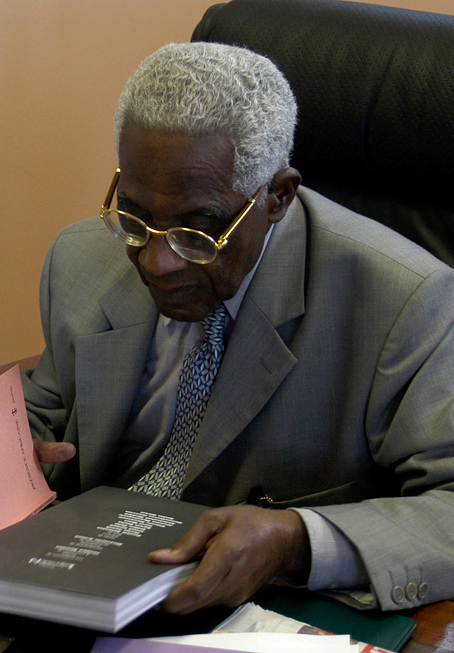
Aimé Césaire

Biographical Details
Aimé Césaire
Biography
The Island That Made a Poet
To understand Aimé Césaire — the poet, the philosopher, the politician — one must first understand Martinique. When Césaire was born on 26 June 1913 in the village of Basse-Pointe, on the northern tip of Martinique, the island had been a French possession for nearly three centuries. Its population, overwhelmingly of African descent, lived under a system that officially recognised them as French citizens after the abolition of slavery in 1848, yet denied them equal dignity, economic opportunity, or cultural recognition in practice.
Basse-Pointe sat in the shadow of Mount Pelée, the volcano that had devastated the island's former capital Saint-Pierre just eleven years before Césaire's birth — a catastrophic reminder of the island's precariousness and power. It was a landscape of extraordinary beauty and historical violence: lush sugarcane fields worked, not long before, by enslaved hands; a people carrying the weight of colonialism in their very names, language, and aspirations.
Aimé Fernand David Césaire was born into a family of modest means but extraordinary intellectual aspiration. His father, Fernand Césaire, worked as a tax inspector, and his mother, Marie Elléanore Hermine, was a seamstress. There were six children in the household. From his earliest years, the young Aimé demonstrated a ferocious academic brilliance that set him apart from his peers. He excelled at the local school in Basse-Pointe before earning a scholarship to attend the prestigious Lycée Schoelcher in Fort-de-France — named after the French abolitionist Victor Schoelcher — where he began to develop the intellectual foundations that would define his life's work.
Paris and the Birth of Négritude
In 1931, at the age of eighteen, Césaire won a scholarship to continue his studies in France, entering the elite Lycée Louis-le-Grand in Paris and later gaining admission to the even more prestigious École Normale Supérieure — one of France's grandes écoles that has produced generations of the nation's intellectual and political leaders. It was a remarkable achievement for a young Black man from a French Caribbean colony in the early twentieth century, and it placed him at the centre of one of the most intellectually fertile moments in modern history.
Paris in the early 1930s was alive with intellectual ferment. Surrealism was reshaping European art and literature. The Harlem Renaissance had sent waves of Black American cultural confidence across the Atlantic. Anti-colonial movements were gathering force across Africa and Asia. Into this ferment stepped Césaire, who quickly became part of a generation of Black students from across the French colonial world studying in Paris and confronting, for the first time, the full weight of their shared condition.
The most transformative encounter of his young life was with Léopold Sédar Senghor, a student from Senegal who would go on to become that country's first president and one of Africa's most celebrated poets. Together, and alongside Léon-Gontran Damas from French Guiana, Césaire and Senghor became the founding triumvirate of what they called Négritude — a term Césaire himself coined.
In 1934, the three co-founded the student journal L'Étudiant noir (The Black Student), which became the incubator for Négritude thought. The movement was, at its core, a philosophical and literary revolt against the French colonial policy of assimilation — the idea that colonial subjects could only achieve full humanity by shedding their African identities and becoming French in culture, language, and aspiration. Négritude rejected this premise entirely. It insisted that African cultural heritage, history, and identity were not burdens to be discarded but treasures to be reclaimed, celebrated, and placed proudly at the centre of a new Black consciousness.
"My mouth shall be the mouth of those calamities that have no mouth, my voice the freedom of those who break down in the prison holes of despair." — Aimé Césaire, Notebook of a Return to the Native Land (1939)
Cahier d'un retour au pays natal: A Masterpiece of the 20th Century
The work that would secure Césaire's place in the literary canon was composed during his student years and first published in 1939 in the Parisian journal Volontés. Cahier d'un retour au pays natal — translated into English as Notebook of a Return to the Native Land — is a long, torrential poem of extraordinary ambition and power.
The Cahier traces the journey of a narrator — clearly autobiographical — who returns to his native Martinique after years of study in France. What he finds is a people ground down by poverty, colonialism, and self-contempt: a society that has internalised its own degradation. The poem moves through waves of despair, anger, and ultimately a fierce, defiant affirmation of Black identity and humanity. Césaire employed the techniques of Surrealism — which he had encountered and transformed in Paris — to fracture conventional poetic logic and release a torrent of images, myths, and ancestral memories that European colonialism had suppressed.
The great French poet André Breton, the leader of the Surrealist movement, encountered the poem in Martinique during his wartime exile in 1941 and was overwhelmed by it, calling it "the greatest lyrical monument of this time." Breton helped bring the poem to a wider readership, and it was subsequently published in a bilingual edition with an introduction by Breton — though Césaire was always careful to assert his independence from European Surrealism, insisting that his use of its techniques was in service of an African and Caribbean consciousness, not a European one.
The Cahier was revised and expanded several times, reaching its definitive form in 1956. It has since been translated into dozens of languages and is considered one of the foundational texts of postcolonial literature worldwide.
Discours sur le colonialisme: A Declaration of War on Colonial Ideology
In 1950 (published in expanded form in 1955), Césaire published Discours sur le colonialisme (Discourse on Colonialism), a searing polemical essay that remains one of the most important documents of anticolonial thought ever written.
The Discours opens with a stark provocation: European civilisation, Césaire argues, is neither civilised nor universal — it is a barbaric system that has revealed its true nature through the colonial enterprise. His central argument is that colonialism does not merely dehumanise the colonised; it also de-civilises the coloniser. The violence, racism, and exploitation deployed against colonial peoples do not remain contained in the colonies — they return, transformed, to the heart of Europe itself.
In one of the essay's most prophetic passages, Césaire draws a direct line between European colonialism and the rise of Nazism: the techniques of terror, racial hierarchy, and industrial murder that horrified Europeans when deployed by Hitler against other Europeans were, he argued, simply the colonial boomerang returning home — methods that Europe had long practised in Africa, Asia, and the Caribbean, now turned against itself.
The Discours was an immediate sensation in anticolonial circles and has only grown in influence. Frantz Fanon, Césaire's most famous student and a fellow Martinican, would develop and extend many of its ideas in his own landmark works. Today, the Discours is assigned in universities across the world and remains essential reading for anyone seeking to understand the moral and intellectual architecture of colonialism.
Mayor of Fort-de-France: Five Decades of Public Service
Césaire returned to Martinique in 1939, and despite having composed one of the most incendiary anticolonial poems in literary history, he channelled much of his revolutionary energy into the conventional structures of democratic politics — with remarkable results.
In 1945, he was elected both Mayor of Fort-de-France, Martinique's capital, and Deputy for Martinique in the French National Assembly in Paris — a dual role he would hold for decades, commuting between the Caribbean and the French parliament. At this stage of his political life, he was a member of the French Communist Party, which he saw as the political vehicle most committed to anti-colonialism and racial justice.
In 1946, Césaire successfully championed the landmark legislation that transformed Martinique, Guadeloupe, French Guiana, and Réunion from colonies into Overseas Departments of France (départements d'outre-mer) — giving their citizens full, formal equality with metropolitan French citizens and access to French social services, education, and welfare provisions. This was a complex political achievement that has been debated ever since: some critics argue that departmentalisation merely replaced one form of colonial dependency with another; defenders argue that it secured genuine material improvements in living standards and political rights for Martinicans.
In 1956, Césaire publicly and dramatically resigned from the French Communist Party, publishing an Open Letter to Maurice Thorez (the party's leader) in which he explained that the party's Eurocentrism made it incapable of understanding or truly championing the specific conditions of colonised peoples. He argued that the liberation of Black people could not be merely a sub-chapter in a European class struggle — it demanded its own political consciousness and its own leadership.
In 1958, he founded the Martinican Progressive Party (Parti progressiste martiniquais, PPM), a social-democratic party that remained a major force in Martinican politics for decades. He served as Mayor of Fort-de-France until 2001 — a tenure of over fifty years — transforming the city through investments in culture, education, and infrastructure. He served in the National Assembly until 1993, making his combined political career one of the longest and most consequential in French Caribbean history.
Theatre of Decolonisation
In the 1960s, as the drama of African decolonisation unfolded around him, Césaire turned to theatre as a new vehicle for his ideas. His plays engage directly with the turbulent history of the postcolonial world:
- La Tragédie du Roi Christophe (1963) tells the story of Henri Christophe, the Haitian revolutionary who declared himself king after independence. The play explores the painful ironies of self-rule: the danger that the liberated colonised might reproduce the very structures of oppression they fought to destroy.
- Une Saison au Congo (1966) dramatises the assassination of Patrice Lumumba, the Congolese independence leader murdered in 1961 with the complicity of Western powers — a searing indictment of neo-colonialism.
- Une Tempête (1969), his radical reworking of Shakespeare's The Tempest, recasts Caliban as a Caribbean Black man resisting his enslavement by the European coloniser Prospero — one of the most celebrated instances of postcolonial literature "writing back" to the European canon.
Legacy and Death
In his final decades, Césaire became a living monument — fêted by presidents and intellectuals alike, the subject of documentaries and academic conferences, his face on postage stamps and murals across Martinique. When he died on 17 April 2008 in Fort-de-France, at the age of ninety-four, French President Nicolas Sarkozy flew to Martinique for the state funeral. Thousands lined the streets of the capital he had governed for over half a century.
His influence on Caribbean, African, and global intellectual life is incalculable. He provided the philosophical vocabulary for a generation of anticolonial thinkers and activists. His insistence that Black identity was a source of pride, beauty, and power — at a time when the entire weight of European civilisation was arrayed to argue the opposite — was an act of extraordinary intellectual and moral courage.
Major Contributions
- Aimé Césaire's contributions operate simultaneously on the literary, philosophical, and political planes, making him one of the most consequential Caribbean figures of the twentieth century.
- As co-founder of the Négritude movement, he provided the intellectual and poetic framework through which generations of African and Caribbean peoples reclaimed their dignity from the wreckage of colonialism — a contribution whose influence extends through Frantz Fanon, the Black Power movement, postcolonial theory, and contemporary movements for racial justice.
- His *Notebook of a Return to the Native Land* (1939) and *Discourse on Colonialism* (1950/1955) are cornerstones of world literature and essential texts in any serious engagement with the history of racism and empire.
- His political career was no less significant: as Mayor of Fort-de-France for over fifty years and Deputy in the French National Assembly for nearly the same period, Césaire secured the departmentalisation of Martinique (1946), bringing legal equality and social protections to Martinicans; championed Caribbean cultural institutions; and reshaped the city of Fort-de-France as a centre of Antillean culture and education.
- His 1956 resignation from the French Communist Party, and his subsequent founding of the Martinican Progressive Party, helped define an autonomous Caribbean political consciousness that refused to subordinate regional struggles to European political frameworks.
