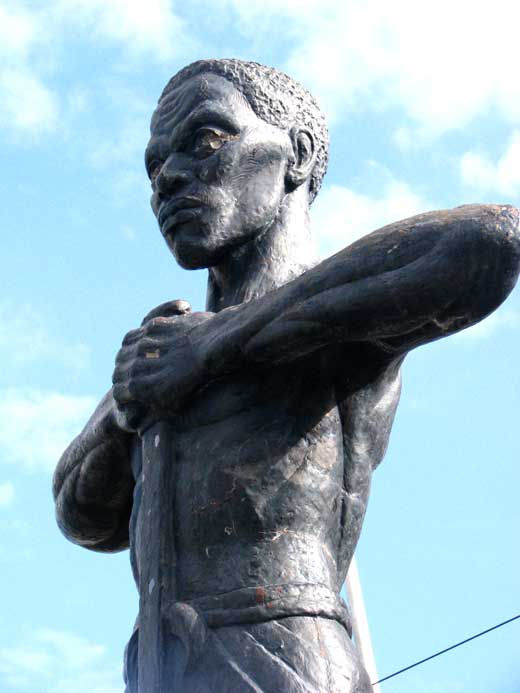
Marcus Garvey

Marcus Garvey
Biography
Marcus Garvey: The Pan-African Visionary
Early Life in Jamaica
Marcus Mosiah Garvey Jr. was born on August 17, 1887, in the coastal town of St. Ann's Bay, Jamaica. He was the youngest of eleven children born to Marcus Mosiah Garvey Sr., a stonemason, and Sarah Jane Richards, a domestic worker. His father was known to be a stern, well-read man who possessed an extensive personal library, which instilled in young Marcus a voracious appetite for reading and a deep respect for intellectual pursuit. Despite this early exposure to literature, the Garvey family faced severe economic hardships, forcing Marcus to leave school at the age of fourteen. He became an apprentice in a printing shop in Kingston, a trade that would inadvertently become the foundation of his future as a global communicator and propagandist. In the bustling capital, Garvey was exposed to the stark realities of racial and class inequalities that plagued colonial Jamaica. His involvement in the printer's union and his participation in a strike in 1908 marked his first foray into political activism, awakening a lifelong commitment to advocating for the rights of the marginalized.
Travels and the Awakening of Pan-Africanism
Driven by a restless intellect and a desire to understand the broader condition of Black people, Garvey embarked on a series of travels across Central and South America between 1910 and 1912. Working as a timekeeper and a newspaper editor in Costa Rica and Panama, he witnessed firsthand the exploitation of Black migrant workers on the banana plantations and the construction of the Panama Canal. These experiences solidified his growing conviction that the suffering of Black people was a global phenomenon, rooted in systemic racism and economic disenfranchisement.
In 1912, Garvey traveled to London, the heart of the British Empire. There, he worked for the African Times and Orient Review, a journal published by the prominent Egyptian nationalist Dusé Mohamed Ali. This environment was crucial for Garvey's ideological development. He was introduced to a vibrant community of African and Caribbean intellectuals, and he immersed himself in the study of African history. It was during this period that he read Booker T. Washington's autobiography, Up From Slavery, a book that profoundly influenced his views on self-reliance and economic independence.
The Founding of the UNIA
Armed with a clear vision and a burning sense of purpose, Garvey returned to Jamaica in 1914 and founded the Universal Negro Improvement Association (UNIA). The organization's motto, "One God! One Aim! One Destiny!" encapsulated its mission to unite the African diaspora and foster a sense of racial pride, economic self-sufficiency, and political empowerment. Initially, the UNIA struggled to gain traction among the Jamaican elite, who were wary of Garvey's radical message. Seeking a more receptive audience, and hoping to meet his intellectual hero Booker T. Washington, Garvey relocated to the United States in 1916.
The Harlem Renaissance and the Rise of a Global Movement
Establishing the UNIA's headquarters in Harlem, New York, Garvey found himself in the epicenter of Black cultural and political life in America. He proved to be a masterful orator, possessing an unparalleled ability to captivate audiences with his booming voice, dramatic flair, and empowering rhetoric.
"A people without the knowledge of their past history, origin and culture is like a tree without roots. Up, you mighty race, accomplish what you will!"
Garvey's message resonated deeply with African Americans facing the brutal realities of Jim Crow segregation, racial violence, and economic exclusion. The UNIA grew at an astonishing rate, establishing hundreds of branches across the United States, the Caribbean, Central America, and Africa. At its zenith, the organization claimed millions of members, making it the largest mass movement in African American history. Garvey established the Negro World newspaper, which became a powerful tool for disseminating his Pan-Africanist ideology, featuring articles in English, French, and Spanish to reach a global audience.
The Black Star Line and Economic Nationalism
Central to Garvey's philosophy was the belief that political equality could only be achieved through economic strength. To realize this vision, he launched a series of ambitious business ventures under the UNIA umbrella, including restaurants, grocery stores, and a publishing house. His most famous and audacious enterprise, however, was the Black Star Line, a steamship corporation established in 1919.
The Black Star Line was designed to facilitate trade and travel among the global Black community, challenging the dominance of white-owned shipping companies. More than a business venture, the shipping line served as a powerful symbol of Black capability and independence. Thousands of working-class Black people bought shares in the company, investing their meager savings in Garvey's vision of self-determination. The sight of a ship owned and operated entirely by Black people navigating international waters was a source of immense pride and inspiration.
Opposition, Downfall, and Legacy
Garvey's meteoric rise and his unapologetic Black nationalism inevitably drew the ire of the establishment. He faced fierce opposition from white supremacists, colonial governments, and even some integrationist Black leaders, notably W. E. B. Du Bois, who viewed Garvey's separatist philosophy as dangerous and impractical.
More significantly, Garvey attracted the attention of the United States government, particularly J. Edgar Hoover and the Bureau of Investigation (the precursor to the FBI). Hoover launched a relentless campaign to infiltrate the UNIA and discredit its leader. The Black Star Line, plagued by mismanagement, sabotage, and the purchase of unseaworthy vessels, provided the government with the ammunition it needed. In 1922, Garvey and several associates were indicted for mail fraud related to the sale of Black Star Line stock. Following a controversial trial, Garvey was convicted in 1923 and sentenced to five years in prison.
After serving a portion of his sentence, his sentence was commuted by President Calvin Coolidge in 1927, on the condition of his immediate deportation to Jamaica. Although he continued his political activism in Jamaica and later in London, where he moved in 1935, he never regained the massive global influence he wielded in Harlem. Marcus Garvey died in London in 1940, relatively impoverished and isolated.
Yet, his physical death did not mark the end of his influence. Garveyism laid the ideological groundwork for the civil rights movement, the Black Power movement, and the Rastafari religion, which reveres him as a prophet. His unwavering belief in the beauty, dignity, and potential of Black people transformed the consciousness of the African diaspora. He taught a displaced people to look to Africa with pride, not shame, and his powerful exhortation—"Up, you mighty race"—continues to inspire generations of activists, artists, and leaders striving for liberation and equality across the globe. His legacy is a testament to the enduring power of a visionary idea in the face of insurmountable odds.
Major Contributions
- Marcus Garvey founded the Universal Negro Improvement Association (UNIA), creating the largest mass movement in African American and Pan-African history.
- He pioneered Black economic independence through ventures like the Black Star Line and instilled a profound sense of racial pride that laid the foundation for future civil rights and independence movements across the global diaspora.