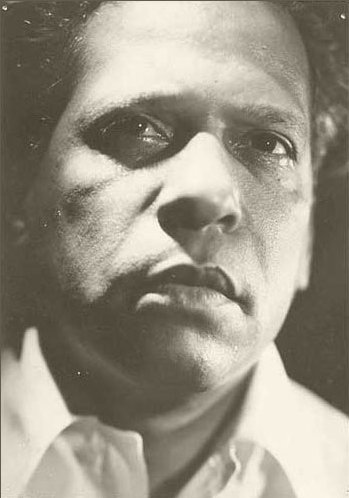
Nicolás Guillén

Nicolás Guillén
Biography
Early Life in Camagüey
Nicolás Cristóbal Guillén Batista was born on July 10, 1902, in the provincial city of Camagüey, Cuba — a place steeped in colonial architecture, racial hierarchy, and the lingering wounds of the independence wars. Cuba at the dawn of the twentieth century was a nation technically free from Spain but caught in the suffocating embrace of North American economic imperialism and its own deeply entrenched racial stratification. The island's Afro-descendant population, though numerically significant and culturally vital, was largely consigned to poverty, denied political representation, and subjected to the everyday humiliations of a social order that continued to prize European ancestry above all else.
Nicolás Guillén was born into this charged environment as the son of Argelia Batista and Nicolás Guillén Urra, a journalist and liberal senator who was a man of mixed African and European heritage. His father's prominence in civic life gave young Nicolás an early exposure to the world of ideas, journalism, and political struggle — but also to its brutal consequences. In 1917, when Guillén was just fifteen years old, his father was murdered by government forces, a political assassination that left the family in economic precarity and emotionally devastated. This loss was, by Guillén's own account, an "emotional catastrophe" that would permanently shape the urgency and grief woven into his poetry.
Nicolás Guillén, photographed in 1942. Public domain, via Wikimedia Commons.
From Typesetter to Poet
In the aftermath of his father's death, Guillén took on work as a typesetter to help support his family — a role that placed him directly in the world of the printed word, with ink on his hands even before he found his own literary voice. He enrolled at the University of Havana in 1921 to study law, following a path that seemed to promise respectability and stability, but he abandoned his studies after only a single year. The pull of journalism and literature was too strong. Throughout the 1920s, he contributed articles and poems to local Camagüey publications, finding his footing as a writer while developing his acute social conscience.
Havana in the 1920s was a city in ferment — politically volatile, culturally experimental, and racially divided. The negrismo movement, a literary and artistic trend that celebrated Afro-Hispanic cultural expressions, was sweeping through Cuba and the broader Caribbean. Poets and intellectuals were grappling with questions of national identity: what did it mean to be Cuban, and could that identity honestly be constructed while ignoring the African roots of so much of the island's music, language, religion, and labor?
The Birth of a Distinctive Voice: Motivos de son (1930)
Guillén's answer came in 1930 with the publication of Motivos de son, a slender but explosive debut collection that sent shockwaves through Cuban literary culture. The book drew its form and spirit from the son — the Afro-Cuban music and dance tradition that blended African percussion and rhythm with Spanish melody and verse. Guillén translated the son's syncopated pulse directly into poetry, capturing the vernacular speech, the humor, the tragedy, and the dignity of Black life in Havana's working-class neighborhoods.
Poems such as "Negro bembón" and "Mulata" were neither exoticizing nor sentimental — they were precise, rhythmically alive, and politically pointed. Guillén did not write about Afro-Cubans as objects of curiosity; he wrote from within that world, with full knowledge of its textures. The collection was celebrated and debated in equal measure, signaling the arrival of a writer who refused to confine Cuban literature to the Eurocentric palate.
Sóngoro cosongo (1931) and the Creole Manifesto
A year later, Guillén published Sóngoro cosongo (1931), a collection whose very title was drawn from an onomatopoeic phrase evoking the rhythms of Afro-Cuban drumming. In its famous prologue, Guillén issued what amounted to a literary manifesto: he argued forcefully that any authentic Cuban national poetry must incorporate the African element — that to pretend otherwise was to falsify the nation's very soul. He wrote of the need for a poetry that reflected the "criollo" spirit, one that synthesized Spain and Africa into something entirely new.
The book marked a decisive shift. Guillén's poetry was no longer content to celebrate Afro-Cuban culture in isolation; it was now insisting on that culture's central place in the definition of Cuban nationhood. This was a radical claim in 1931, and it established Guillén as the pre-eminent voice of the Afro-Cuban literary movement.
"Cuba is not European, nor is it African. It is something original, something unto itself, born from the encounter of two worlds." — Nicolás Guillén, reflecting on Cuban cultural identity
Toward Social Protest: West Indies, Ltd. (1934)
By 1934, Guillén's lens had widened from Cuba to the entire Caribbean basin. West Indies, Ltd. was his most explicitly anti-imperialist collection to date, indicting the entire colonial and neo-colonial apparatus that kept the Caribbean poor, racially stratified, and economically dependent on foreign capital. The title itself was a bitter irony — the Caribbean rendered as a corporate entity, its peoples reduced to labor costs on a balance sheet.
This work established Guillén's international credentials as a poet of the Third World avant la lettre — a voice for the colonized and dispossessed wherever they existed. His poetry began to be translated into multiple languages and read across Latin America, Africa, and Europe.
The Spanish Civil War and Communist Commitment
In 1937, Guillén formally joined the Communist Party of Cuba (at the time organized as the Popular Socialist Party) and traveled to Spain, where he participated in the Congress of Anti-Fascist Writers in Valencia and reported from the front lines of the Spanish Civil War, supporting the Republican cause against Franco's nationalist forces. The experience profoundly deepened his political commitments and inspired his collection España: Poema en cuatro angustias y una esperanza (1937), a searing elegiac tribute to the Republic's struggle and to the international community of writers and fighters who rallied to its defense.
Back in Cuba, Guillén continued to write and agitate, producing Cantos para soldados y sones para turistas (1937) and El son entero (1947), which cemented his reputation as the singular voice of Cuban poetry. He ran for political office as a communist candidate in 1940 and was a constant thorn in the side of successive Cuban governments.
Exile and Return
Under the authoritarian rule of Fulgencio Batista, Guillén's political activities made him a marked man. In 1953, upon returning from a trip to Chile, he was denied re-entry into Cuba and spent the next several years in exile, moving between Latin American countries and Europe, maintaining his literary output and his political solidarity with leftist and anti-colonial movements worldwide.
The triumph of the Cuban Revolution in January 1959 brought him home. Guillén returned to Cuba as a celebrated figure, his decades of struggle now aligned with the revolutionary government. In 1961, he was a founding force behind the Unión Nacional de Escritores y Artistas de Cuba (UNEAC) — the National Union of Writers and Artists of Cuba — and served as its president for over 25 years, until his death, shaping Cuba's entire cultural apparatus and its relationship to world literature.
The province of Camagüey, Cuba — birthplace of Nicolás Guillén.
Awards and International Recognition
Guillén received some of the highest honors available to a poet and intellectual of the twentieth century. In 1954, he was awarded the Stalin Peace Prize (later renamed the Lenin Peace Prize) by the Soviet Union in recognition of his contributions to the international peace and anti-fascist movements. In 1976, he received the International Botev Prize from Bulgaria. And in 1983, he became the inaugural recipient of Cuba's own National Prize for Literature, recognizing his foundational role in shaping Cuban letters.
His poetry was translated into dozens of languages and was read, recited, and sung across Africa, Asia, and Latin America. In the Spanish-speaking world, he became synonymous with the idea that poetry could be both artistically sophisticated and politically engaged — that the rhythms of the street and the concert hall could carry the weight of history.
Death and Legacy
Nicolás Guillén died on July 16, 1989, in Havana, just six days after his 87th birthday. He was mourned across the Spanish-speaking world and honored in Cuba as the nation's Poeta Nacional — National Poet. His body of work, spanning more than sixty years, had transformed Latin American literature and given the African diaspora one of its most powerful poetic voices.
His legacy endures not only in the study of literature but in the ongoing conversations about race, identity, and decolonization in Cuba and across the Caribbean. He demonstrated that son, the most vernacular of cultural forms, could become a vehicle for profound historical witness — and that the voices of the dispossessed, rendered with artistry and precision, could resonate across continents and generations.
Major Contributions
- Nicolás Guillén's contributions to Caribbean culture and literature are immeasurable.
- As the architect of the Afro-Cuban literary movement, he synthesized the rhythms and linguistic textures of the *son* with formal poetic craft to create a body of work that placed Afro-Cuban identity at the center of Cuban national literature.
- His landmark collections — *Motivos de son* (1930), *Sóngoro cosongo* (1931), and *West Indies, Ltd.
- * (1934) — challenged the Eurocentric assumptions of Cuban intellectual culture and established an enduring framework for thinking about race, class, and cultural hybridity in the Caribbean.
- He was among the first major poets in the Spanish-speaking world to articulate a fully decolonized aesthetic rooted in African diaspora experience.
- Beyond literature, Guillén's contributions extended into political and institutional life.
- As a founding president of UNEAC (1961–1989), he shaped the institutional infrastructure of Cuban cultural life for nearly three decades, championing a model in which art and social justice were inseparable.
- His anti-fascist work during the Spanish Civil War, his anti-imperialist poetry addressing the entire Caribbean, and his consistent advocacy for the rights of working-class and Afro-descendant communities made him one of the most important political voices in twentieth-century Latin American letters.
- He was awarded the Stalin Peace Prize (1954), the International Botev Prize (1976), and Cuba's inaugural National Prize for Literature (1983), cementing his place as one of the hemisphere's most celebrated writer-activists.

