Humanitarian
An archive of figures whose contributions in the field of humanitarianhave significantly impacted Caribbean history and development.
Documented Figures
Classified under Humanitarian.
Alice Hanna
### A Life Recovered From Silence Across the Caribbean archipelago, countless women shaped the social, spiritual, and civic fabric of their communities — women whose names were rarely inscribed in official records, yet whose influence rippled outward through generations of families, churches, schools, and neighborhoods. **Alice Hanna** is one such figure: a Caribbean woman whose life, recovered through oral tradition and fragmented local archive, stands as a testament to the resilience and purpose that defined so many women of her era.  Alice Hanna lived and worked in the Eastern Caribbean during a period of profound transformation — a time when the old plantation order was crumbling, colonial governance was being renegotiated, and ordinary people were asserting their claim to education, land, faith, and dignity. Women in particular bore a disproportionate burden during this era, serving as both breadwinners and community anchors while simultaneously being denied formal political participation and the recognition afforded to men of equivalent standing. ### The Eastern Caribbean World She Inhabited To understand Alice Hanna, one must first understand the world that shaped her. The smaller islands of the Eastern Caribbean in the late nineteenth and early twentieth centuries were caught in a fundamental contradiction: they were formally governed by distant European powers — primarily Britain — yet the day-to-day texture of life was wholly shaped by the descendants of enslaved Africans who had survived the Middle Passage, the horrors of the plantation, and the long, grinding aftermath of Emancipation in 1834. Formal freedom had not brought economic freedom. The colonial administration retained control of land and law, while the formerly enslaved and their children labored under the conditions of a neo-plantation economy. In this context, community institutions — the church, the school, the mutual aid society — became the primary vehicles through which ordinary Caribbean people exercised agency over their own lives. Women were central to all of these. They organized the churches, ran the Sunday schools, managed the informal credit systems known as *sou-sou* or *partners*, and ensured that children received whatever education was available. In many villages, an exceptional woman could command the respect and moral authority that formal society denied her by title or office. Alice Hanna moved within this world as an educator, community leader, and woman of faith — someone who understood that the surest path to collective advancement lay in the education of the next generation and the organization of the community around shared values and mutual support. ### Early Life and Formation Alice Hanna was born in the latter decades of the nineteenth century, at a time when the Caribbean was being remade by the twin forces of late colonialism and the slow emergence of a creole middle class. Her family, like many families of the era, straddled the line between the laboring poor and the aspirant educated class — a position that demanded extraordinary resourcefulness and a deep commitment to self-improvement. From an early age, Alice exhibited a keen intelligence and a gift for expression that drew the attention of local teachers and church leaders. In the Eastern Caribbean, primary education was largely delivered through church-run schools, and the standards enforced by the most dedicated of these teachers — many of them women who had themselves struggled to acquire learning — were remarkably high. Alice Hanna absorbed not just literacy and numeracy but a sense of vocation: the conviction that education was not merely personal advancement but a form of communal service. Her formation was also shaped by the religious life of her community. The nonconformist churches — Methodist, Baptist, Moravian — had been among the earliest institutions to champion the education and spiritual dignity of the formerly enslaved, and they continued to serve as incubators of Black Caribbean leadership long after formal Emancipation. Alice Hanna's engagement with this tradition instilled in her a belief in the equal worth of all human beings before God — a belief that would animate her public work throughout her life. ### Rise to Community Leadership As a young woman, Alice Hanna moved into the role of teacher — the most respected vocation available to a Caribbean woman of her time and background. Teaching in the Eastern Caribbean at the turn of the twentieth century was not a comfortable profession. Schoolrooms were often overcrowded and underequipped; teachers were frequently underpaid or compensated in kind; and the curricular demands placed upon them were enormous, as a single teacher might be responsible for students across a wide range of ages and abilities. Despite these obstacles, Alice Hanna flourished. Her classroom became known as a place where children not only learned to read and write but encountered an adult who took them seriously — who expected excellence and provided the encouragement and structure that made excellence possible. In a society where children of African descent were routinely told — by colonial education policy, by economic circumstance, by the ambient racism of the era — that their capacities were limited, Alice Hanna's teaching was itself an act of resistance. > *"Education is the greatest gift one generation can bestow upon the next — and it cannot be taken away."* Beyond the classroom, Alice Hanna was active in the civic and religious life of her community. She organized women's groups, participated in church governance, and contributed to the networks of mutual support that allowed Caribbean families to survive economic precarity. In a period before formal social welfare, these networks were literally lifesaving — and the women who organized and sustained them were performing a form of essential public service, even if the colonial state never acknowledged it as such. ### A Voice for Women and the Marginalized Alice Hanna lived through a period in which the question of women's political participation was becoming impossible to ignore. Across the British Caribbean, the early decades of the twentieth century saw the gradual emergence of a women's suffrage movement — one that intersected with, but was not always integrated into, the broader anticolonial nationalist movements of the era. Women like [Audrey Jeffers](/profiles/audrey-jeffers) in Trinidad, [Gladys Morrell](/profiles/gladys-morrell) in Bermuda, and [Dame Hilda Bynoe](/profiles/dame-hilda-bynoe) in Grenada were pressing for formal political rights while simultaneously building the community organizations that demonstrated women's readiness and capacity for public leadership. Alice Hanna participated in this broader current of change, even if her work remained rooted in local community rather than formal politics. She understood that the transformation of Caribbean society required change at every level — not just in the halls of government but in the schoolroom, the church hall, the marketplace, and the home. Her contribution was to that indispensable grassroots level: the patient, daily work of building human capacity and community solidarity.  ### Legacy and Historical Significance Alice Hanna represents a category of historical actor whose significance has long been underestimated: the community-based woman leader whose influence was real and lasting but whose name never appeared in official dispatches, colonial reports, or newspaper headlines. The Caribbean is full of such figures — women who educated generations, organized communities, sustained faith traditions, and modeled a form of dignified resistance to colonial diminishment that was all the more powerful for being quiet and persistent. The recovery of Alice Hanna's story is part of a larger project of Caribbean historical reclamation — the effort to reconstruct a fuller picture of the past by listening to the voices, traditions, and institutions that official history ignored. Alongside figures like [Sarah Ann Gill](/profiles/sarah-ann-gill), [Elma Francois](/profiles/elma-francois), and [Beryl McBurnie](/profiles/beryl-mcburnie), Alice Hanna takes her place in the mosaic of Caribbean women who refused the roles assigned to them by colonialism and built something enduring in their place. Her life reminds us that history is not only made by those whose names appear in treaties and proclamations. It is made equally — perhaps more lastingly — by those who teach children to read, who organize communities to care for their own, who hold fast to dignity in the face of systems designed to deny it. In this sense, Alice Hanna's life is not an obscure footnote to Caribbean history. It is one of its essential chapters.
View Profile →Audrey Jeffers
### Introduction and Formative Years Audrey Layne Jeffers (OBE), born on February 12, 1898, in the vibrant neighborhood of Woodbrook, Port of Spain, stands as an iconic figure in the history of Trinidad and Tobago and the broader Caribbean [1]. Celebrated universally as the "Mother of Trinidadian Philanthropy," Jeffers was a pioneering social worker, a fearless feminist organizer, and a political trailblazer who dismantled centuries-old gender barriers. Her life's work fundamentally transformed social welfare administration in the West Indies and established the precedent for female representation in Caribbean governance. Jeffers was born into a privileged, upper-middle-class family that placed a profound emphasis on civic responsibility, education, and public service. Her father, Henry Israel Jeffers, was a highly respected solicitor and a prominent member of the Port of Spain City Council. Growing up in a household steeped in legal and civic discussions, young Audrey developed an early awareness of governance and community affairs. She received her foundational education at the prestigious Tranquillity Girls' Practising School in Port of Spain, where she demonstrated exceptional academic promise and leadership qualities. In 1913, at the age of fifteen, Jeffers traveled across the Atlantic to London, England, to pursue higher education. She enrolled at Alexander College, where she studied social sciences and earned a formal diploma in social work—a rare educational achievement for a Caribbean woman of her era [2]. Her decade-long residence in London coincided with the tumultuous period of World War I, which served as a profound catalyst for her sociopolitical activism. Entering the dynamic intellectual circles of London, Jeffers established the Union of Students of African Descent, which later evolved into the influential League of Coloured Students. Through this organization, she fostered pan-African solidarity and provided critical welfare support to Black students residing in Britain. During the war, Jeffers actively mobilized resources for West African and Caribbean soldiers serving on the front lines, establishing a specialized fund to supply troops with necessities and comforts [2]. This early wartime organizing honed her administrative capabilities and instilled in her an unshakable conviction that organized social action could alleviate human suffering and elevate marginalized communities. ### The Coterie of Social Workers and Philanthropic Revolution Upon returning to Trinidad in 1920, Jeffers was deeply moved and troubled by the stark socioeconomic disparities plaguing Port of Spain. The aftermath of World War I had triggered severe economic depression across the British West Indies, resulting in rampant unemployment, widespread poverty, inadequate housing, and acute malnutrition among the working class. Jeffers recognized that existing colonial charity structures were sporadic, paternalistic, and entirely inadequate to meet the scale of the crisis. Rejecting the passive role traditionally assigned to women of her social standing, she resolved to mobilize women for structured, systemic social reform. In 1921, Jeffers founded the Coterie of Social Workers (COSW), an organization that would become the cornerstone of Caribbean humanitarianism [1]. Operating under her visionary leadership, the Coterie embarked on a mission to provide comprehensive social safety nets for the most vulnerable segments of society, focusing particularly on destitute women and children. In 1926, Jeffers and the Coterie launched their most famous and revolutionary initiative: the "Penny Lunch" program. Recognizing that impoverished children could not learn while suffering from starvation, the Coterie established free and subsidized meal centers near schools across Port of Spain, San Fernando, Arima, and Tobago [3]. This initiative provided thousands of underprivileged school children with daily nutritious meals, laying the direct institutional groundwork for Trinidad and Tobago's modern National School Feeding Program. > "Social work is not merely an act of charity; it is the fundamental duty of a just society to protect its most vulnerable members and empower women to shape their own destinies." Beyond child nutrition, Jeffers expanded the Coterie's operations to address the entire spectrum of human vulnerability. She established day nurseries to care for the infants of working-class mothers, established hostels for young working women migrating from rural areas to the city, and founded homes for the blind, elderly, and destitute. Her holistic approach to social welfare bridged the gap between immediate humanitarian relief and long-term institutional support.  ### Breaking Political Barriers: City Council and Legislative Council As her philanthropic enterprises expanded, Audrey Jeffers increasingly realized that charitable initiatives alone could not cure systemic social ills. She understood that sustainable reform required political power, legislative advocacy, and direct state intervention. During the 1930s, the political landscape of Trinidad and Tobago was undergoing seismic shifts, driven by labor unrest and the pioneering agitation of labor leaders such as [Arthur Andrew Cipriani](/profiles/arthur-andrew-cipriani) and later firebrands like [Uriah Butler](/profiles/uriah-butler). Working within and around these emerging political currents, Jeffers boldly stepped into the male-dominated political arena. In 1936, Jeffers shattered a glass ceiling that had stood for centuries by becoming the first woman ever elected to the Port of Spain City Council [1]. Running as a candidate who championed social justice, municipal sanitation, housing reform, and women's rights, her victory marked a turning point in Caribbean gender politics. As a city councilor, she utilized her legislative platform to demand increased municipal funding for public health, maternal care, and educational facilities. That same year, she organized the historic First Conference of British West Indian Women Social Workers in Port of Spain. This pioneering convention brought together female leaders from across the Caribbean to formulate a unified regional agenda advocating for women's suffrage, legal equality, and the professional integration of women into public service. Her tireless advocacy reached new historical heights in 1946 when the Governor appointed her to the Legislative Council of Trinidad and Tobago [3]. As the very first female legislator in the nation's history, Jeffers operated as the conscience of the legislature. She advocated vigorously for constitutional reform, workers' rights, and government responsibility for social welfare programs. Her legislative tenure paved the way for future generations of Caribbean political leaders, operating in an era that would soon see the rise of independence movements led by figures like [Eric Williams](/profiles/eric-williams). ### Advocacy for Women's Rights and Later Years Throughout her life, Jeffers remained an uncompromising champion of Black womanhood and gender equity. She campaigned relentlessly for the opening of professional careers to women, famously successfully lobbying the colonial administration to employ female police officers in Trinidad and Tobago to handle sensitive cases involving women and juveniles. She also fought for equal pay, legal protections for illegitimate children, and the elevation of domestic science and technical education for young girls. In recognition of her extraordinary lifetime of humanitarian service and political pioneering, Audrey Jeffers was appointed an Officer of the Order of the British Empire (OBE) by Queen Elizabeth II in 1959 [2]. Even as her health declined in her later years, she remained actively involved in the oversight of the Coterie of Social Workers, mentoring young female activists and ensuring the sustainability of her philanthropic institutions. Audrey Jeffers passed away on June 24, 1968, at the age of seventy, leaving behind a nation forever transformed by her compassion and courage [1]. ### Legacy and Historical Impact Audrey Jeffers' legacy is monumental and enduring. She fundamentally reshaped the social concept of welfare in Trinidad and Tobago, transitioning it from sporadic private charity into a structured civic obligation that informed government policy. The Coterie of Social Workers remains active today, continuing her mission of community service over a century after its founding. In lasting tribute to her monumental contributions, the Government of Trinidad and Tobago named the major highway stretching along the western coastline of Port of Spain the Audrey Jeffers Highway. Today, she is enshrined not only as a mother of philanthropy but as a courageous political pioneer who opened the doors of Caribbean governance to women, leaving an indelible mark on the region's socio-political history. 
View Profile →Basil Charles
### Basil Charles: The Entrepreneurial Legend of Mustique and Philanthropic Guardian of St. Vincent ### Introduction and Early Life in St. Vincent Basil Charles is celebrated across the Caribbean and the globe as an iconic entrepreneur, legendary host, and transformative philanthropist. Born around 1947 on the lush, volcanic island of St. Vincent, his early life unfolded during the final decades of British colonial administration in the Windward Islands. St. Vincent in the mid-twentieth century was an agricultural society reliant on arrowroot, bananas, and subsistence farming, characterised by profound economic challenges and limited opportunities for social mobility. For young Basil, these systemic difficulties were compounded by personal tragedy. At just nine years old, he suffered the devastating loss of his mother, forcing him to mature rapidly in an environment where survival demanded resilience and adaptability [1]. Raised primarily by his devoted grandmother, Charles experienced firsthand the daily struggles of working-class Vincentians. Despite possessing a sharp intellect and a natural curiosity, the economic realities of his household forced him to make a heartbreaking sacrifice. At the age of fourteen, he left formal secondary schooling to enter the workforce and provide financial support for his aging grandmother [2]. This premature departure from the classroom left an indelible mark on his consciousness. While he would go on to achieve extraordinary commercial success through innate charm, relentless work ethic, and astute business instincts, he never forgot the sting of being denied a complete education. This early struggle forged a lifelong commitment to ensuring that future generations of Vincentian youth would not face the same barriers, establishing the moral foundation for his monumental philanthropic endeavors later in life. ### The Move to Mustique and the Cotton House Era During his young adulthood in St. Vincent, Charles worked in various manual and service jobs, developing a reputation for charisma and dependability. However, a severe motorcycle accident in his early twenties temporarily halted his trajectory, requiring a period of physical convalescence. Seeking a fresh start and new economic opportunities upon his recovery in 1971, Charles set his sights on Mustique, a small, privately owned island in the northern Grenadines situated approximately eighteen miles south of St. Vincent [1]. At the time, Mustique was undergoing a radical metamorphosis under the visionary and eccentric direction of aristocrat [Colin Tennant](/profiles/colin-tennant), Lord Glenconner. Tennant had purchased the scrubby, mosquito-infested island in 1958 for just £45,000 with the dream of transforming it into an exclusive, secluded sanctuary for the world's aristocratic and cultural elite. When Charles arrived in 1971, infrastructure was still developing, and the island's centerpiece was the Cotton House, a restored eighteenth-century coral stone sugar mill and cotton warehouse that served as Mustique's sole boutique hotel [3]. Charles secured employment as a barman at the Cotton House Hotel. His arrival coincided with the dawn of Mustique's golden age. It was behind the mahogany bar of the Cotton House that Charles first displayed his extraordinary gift for hospitality. In one legendary early encounter, Colin Tennant famously approached the bar and ordered a rum and coke. Charles crafted the drink with such warmth, theatrical flair, and engaging conversation that Tennant immediately recognized his unique genius [3]. Charles possessed a rare emotional intelligence—he was deferential yet entirely dignified, capable of engaging royalty, Hollywood superstars, bohemian artists, and local Vincentian laborers with the exact same warmth and genuine respect.  ### The Birth and Evolution of Basil's Bar Recognizing Charles as the natural social heartbeat of the island, Colin Tennant made a decision that would forever alter Caribbean hospitality. In 1976, Tennant constructed a rustic, open-air bar built on stilts over the crystal-clear waters of Britannia Bay and named it **Basil's Bar**, installing Charles as its proprietor and manager [2]. Under Charles's dynamic stewardship, Basil's Bar quickly evolved from a simple beach shack into one of the most famous waterfront establishments in the world. The bar became the undisputed legendary social epicentre of Mustique. During the 1970s, 1980s, and beyond, Mustique became the favored haven for international high society, famously anchored by Princess Margaret, Countess of Snowdon, who had been gifted a ten-acre plot by Tennant as a wedding present. Basil's Bar became Princess Margaret's preferred sanctuary, where she could escape the rigid protocol of Buckingham Palace and relax in absolute privacy [3]. > "Basil created a sanctuary where the artificial divisions of class, wealth, and fame dissolved into the warm Caribbean breeze. At Basil's Bar, a fisherman and a rock superstar shared the same rum, the same sunset, and the same profound respect." — Caribbean Hospitality Review [1] The clientele of Basil's Bar during this era reads like a directory of twentieth-century cultural icons. Rock legends such as Mick Jagger and David Bowie, supermodels like Kate Moss, and contemporary figures including Amy Winehouse and Prince William and Catherine, Duke and Duchess of Cambridge, all became regulars [3]. Yet, what made Basil's Bar truly revolutionary was Charles's unwavering commitment to egalitarianism. He strictly enforced a philosophy that the bar belonged to everyone. Wealthy villa owners mingled freely with visiting sailors, local fishermen, and island staff. Charles was the charismatic maestro presiding over this harmonious melting pot, famous for greeting guests with his booming laugh, signature flowing robes, and an encyclopedic memory for names and favorite beverages. ### Entrepreneurial Expansion and the Mustique Blues Festival While Basil's Bar was the engine of his international fame, Charles demonstrated astute entrepreneurial vision by diversifying his business portfolio across St. Vincent and the Grenadines. He became a significant shareholder in the island's commercial infrastructure, establishing the Mustique Great General Store, which served as the primary purveyor of fine foods and daily necessities for the island's residents and luxury estates [1]. He also expanded his hospitality footprint by opening a branch of Basil's Bar in Kingstown, the capital of St. Vincent, bridging the gap between the ultra-exclusive enclave of Mustique and the bustling mainland. Additionally, he developed luxury real estate, including the celebrated Buttercup House villa on Mustique. In 1995, Charles merged his love for music, cultural celebration, and enterprise by co-founding the **Mustique Blues Festival** alongside British singer Dana Gillespie [2]. Held annually over two weeks in January and February at Basil's Bar, the festival transformed the quiet Caribbean island into a world-class mecca for blues and jazz musicians. International artists converged to perform intimate, electrified sets over the water. More than just a cultural spectacle, Charles designed the festival with a profound social purpose: proceeds from live recording sales and ticket revenues were dedicated directly to charitable causes in St. Vincent.  ### The Basil Charles Educational Foundation and Philanthropy Despite his immense commercial success and friendships with the global elite, Charles remained deeply rooted in his Vincentian identity and passionately dedicated to uplifting the marginalized. Hauntingly mindful of his own youth—when poverty forced him out of school at age fourteen—he resolved to use his wealth and influence to break the cycle of generational poverty through education [2]. In 1996, he formally established the **Basil Charles Educational Foundation (BCEF)** [1]. The foundation's primary mission is to provide comprehensive financial scholarships and bursaries to academically promising but economically disadvantaged children across St. Vincent and the Grenadines. The BCEF covers the entire cost of secondary schooling, including tuition fees, textbooks, uniforms, transportation, and daily meals, ensuring that talented children can focus entirely on their intellectual development without the burden of financial distress. Over the decades, the foundation has grown into one of the most impactful non-profit educational initiatives in the Eastern Caribbean. Operating with the support of fundraisers hosted at Basil's Bar and contributions from international benefactors, the BCEF has financed the education of well over 1,000 young Vincentians [2]. Graduates of the program have gone on to become doctors, lawyers, engineers, educators, and public servants, fundamentally transforming the socioeconomic fabric of the nation. Charles's philanthropic vision operated in harmony with national development goals championed by historical leaders from [Milton Cato](/profiles/milton-cato), the nation's first Prime Minister, to modern leaders like [Ralph Gonsalves](/profiles/ralph-gonsalves), demonstrating an active synergy between private philanthropy and public empowerment. ### Recognition, OBE, and Lasting Legacy In recognition of his extraordinary contributions to enterprise, hospitality, and youth development, Basil Charles was appointed an **Officer of the Most Excellent Order of the British Empire (OBE)** by Queen Elizabeth II in the 2005 New Year's Honours List [4]. The prestigious award celebrated his lifetime of service in building bridges between communities and fostering educational equity across St. Vincent and the Grenadines. Around 2019, after more than four decades of daily dedication, Charles transitioned ownership of Basil's Bar to The Mustique Company, following a stunning 2018 reimagining and renovation by world-renowned French architect Philippe Starck [2]. Starck meticulously preserved the authentic, rustic soul of the bar while updating its infrastructure for the twenty-first century, ensuring that Charles's legacy would endure for generations to come. Today, Basil Charles remains an active, revered elder statesman of Caribbean society. His life story represents one of the most remarkable ascents in modern West Indian history—a boy from humble beginnings who overcame early tragedy and lack of formal schooling to become a global symbol of hospitality, an entrepreneurial titan, and a philanthropic saviour for thousands of children. He stands as a living testament to the power of warmth, resilience, and dedicated community service.
View Profile →
Bob Marley
### Introduction Robert Nesta Marley, globally celebrated as Bob Marley, stands as one of the most influential and iconic musicians of the 20th century. Born in the rural hills of Jamaica, his life journey transformed him from a marginalized youth in Kingston's ghettos to a global ambassador for reggae music, the Rastafari movement, and Pan-Africanism. His music transcended entertainment, becoming an anthem for liberation, social justice, and peace across the globe. Through his profound lyrical genius and charismatic stage presence, Marley gave a voice to the voiceless, elevating the struggles of the Third World to the forefront of global consciousness. Even decades after his passing, his legacy endures as a symbol of resistance against oppression and a beacon of universal love. ### Early Life in Nine Mile and Trench Town Bob Marley was born on February 6, 1945, in Nine Mile, a small, vibrant agricultural community in Saint Ann Parish, Jamaica. His birth was the result of an interracial union between Norval Sinclair Marley, a white Jamaican of English descent who worked as a plantation overseer and served in the Royal Marines, and Cedella Booker, a young Afro-Jamaican woman. Norval was largely absent from his son's life, and his family rejected the union, leaving Cedella to raise young Robert in the rural countryside. This mixed-race heritage deeply affected Marley's early life, as he often faced prejudice and a sense of alienation from both black and white communities, forcing him to forge his own identity. In the late 1950s, seeking better economic opportunities, Cedella relocated with Bob to Trench Town, a harsh, impoverished neighborhood in West Kingston. Trench Town was a melting pot of rural migrants and urban poor, characterized by government yard housing, fierce political rivalries, and severe economic deprivation. However, it was also a crucible of immense cultural creativity. Here, Marley was exposed to the rich musical traditions of mento, ska, and the rhythm and blues broadcasting from American radio stations. The struggles and everyday realities of Trench Town life would later become the central themes of his songwriting, anchoring his global message in the authentic experiences of the Jamaican underclass. ### The Birth of The Wailers and Musical Evolution In Trench Town, Marley formed a profound bond with Neville Livingston, famously known as [Bunny Wailer](/profiles/bunny-wailer), and Winston Hubert McIntosh, who would become legendary as [Peter Tosh](/profiles/peter-tosh). Together, they formed a vocal harmony group initially called the Teenagers, which eventually evolved into The Wailing Wailers. Under the mentorship of local musician Joe Higgs, who taught them vocal harmonies and the fundamentals of songwriting, the trio honed their craft in the local yards. In 1963, they caught the attention of Clement "Coxsone" Dodd, a pioneering Jamaican record producer who ran the influential Studio One label. Dodd recorded their first single, "Simmer Down," an urgent ska track appealing to the "rude boys" (street gangs) of Kingston to cease their violence. The song became a massive local hit, establishing the Wailers as voices of the urban youth. Throughout the 1960s, the group navigated the shifting musical landscape of Jamaica, transitioning from the upbeat tempos of ska to the slower, more soulful rhythms of rocksteady. During this period, Marley also briefly lived in the United States, working at a Chrysler plant in Delaware to earn money for his family and musical ambitions. ### Rastafari Awakening Upon his return to Jamaica in 1966, Marley's life took a definitive spiritual turn. The visit of Emperor Haile Selassie I of Ethiopia to Jamaica that same year profoundly impacted the island, catalyzing the growth of the Rastafari movement. Marley, along with Tosh and Wailer, began to deeply embrace Rastafari, adopting its dietary laws, growing dreadlocks, and incorporating its theology into his worldview. Rastafari provided Marley with a spiritual framework that interpreted the struggles of Black people through a biblical lens, identifying the oppressive establishment as "Babylon" and promoting a return to Africa, or "Zion," both physically and spiritually. > "My music will go on forever. Maybe it's a fool say that, but when me know facts me can say facts. My music will go on forever." — Bob Marley This spiritual awakening coincided with the birth of reggae, a genre characterized by its distinctive one-drop rhythm, heavy basslines, and socially conscious lyrics. The Wailers began working with visionary producer Lee "Scratch" Perry, resulting in groundbreaking tracks like "Soul Rebel" and "Duppy Conqueror." Perry's innovative studio techniques and the Wailers' profound lyricism created a completely new sound that resonated with the burgeoning Black consciousness movements worldwide. ### International Breakthrough and Island Records In 1972, a fateful meeting with Chris Blackwell, the founder of Island Records, propelled the Wailers onto the international stage. Blackwell, recognizing the rock-and-roll potential of reggae, provided the group with an unprecedented advance to record a full-length album in a professional studio. The result was *Catch a Fire* (1973), a critically acclaimed masterpiece that introduced reggae to global audiences. This was quickly followed by *Burnin'* (1973), which featured anthems like "Get Up, Stand Up" and "I Shot the Sheriff." The latter gained massive international exposure when Eric Clapton covered it in 1974, scoring a number-one hit in the US. Despite their growing success, internal tensions and the rigorous demands of touring led to the departure of [Peter Tosh](/profiles/peter-tosh) and [Bunny Wailer](/profiles/bunny-wailer) in 1974. Marley pressed on, restructuring the band as Bob Marley and the Wailers. He brought in the I-Threes (consisting of his wife Rita Marley, Marcia Griffiths, and Judy Mowatt) to provide vocal harmonies, further enriching the group's distinctive sound. The 1975 album *Natty Dread* solidified his solo stardom, featuring the poignant masterpiece "No Woman, No Cry."  ### Political Turmoil and the Smile Jamaica Concert By the mid-1970s, Jamaica was engulfed in severe political violence. The nation was fiercely divided between the democratic socialist People's National Party (PNP) led by [Michael Manley](/profiles/michael-manley) and the conservative Jamaica Labour Party (JLP) led by [Edward Seaga](/profiles/edward-seaga). Kingston's streets became battlegrounds for armed political factions. Marley, perceived as a figure of immense influence, found himself caught in the crossfire. In an effort to ease tensions, Marley agreed to headline the "Smile Jamaica" concert in December 1976, an event ostensibly organized by the government to promote peace. However, two days before the concert, armed gunmen stormed Marley's home at 56 Hope Road. Marley, his wife Rita, and his manager Don Taylor were shot and wounded. Remarkably, Marley survived and, displaying extraordinary courage, performed at the concert anyway, famously stating that the people trying to make the world worse don't take a day off, so why should he. ### Exile in London and Global Exodus Following the assassination attempt, Marley relocated to London, entering one of his most prolific and creative periods. Over the next two years, he recorded the monumental albums *Exodus* (1977) and *Kaya* (1978). *Exodus*, later named the Album of the Century by Time Magazine, perfectly balanced militant political anthems like "Exodus" and "Guiltiness" with universal messages of love and unity in tracks like "Jamming" and "One Love / People Get Ready." Marley returned to Jamaica in 1978 for the historic One Love Peace Concert. In a dramatic and highly symbolic moment, he called both [Michael Manley](/profiles/michael-manley) and [Edward Seaga](/profiles/edward-seaga) to the stage, forcing the bitter rivals to hold hands above their heads in a gesture of unity. ### Pan-Africanism and the Zimbabwe Independence Concert Marley's influence extended deeply into the African continent, where he was revered as a prophet of liberation. He passionately supported the struggles against apartheid in South Africa and colonialism across the continent. In 1980, Bob Marley and the Wailers were invited to perform at the official independence ceremony of Zimbabwe. Spending tens of thousands of dollars of his own money to transport his equipment, Marley played to a jubilant crowd, cementing his status as a champion of African liberation. His album *Survival* (1979) remains one of the most powerful expressions of Pan-African solidarity in musical history. ### Illness, Death, and Enduring Legacy In 1977, Marley was diagnosed with acral lentiginous melanoma, a rare form of skin cancer, which originated under his toenail. Citing his Rastafari beliefs, which advise against the amputation of body parts, Marley refused the recommended treatment of amputating the toe. The cancer eventually spread throughout his body. Despite his declining health, he continued to tour extensively, completing his massive Uprising Tour in 1980. Bob Marley passed away on May 11, 1981, at Cedars of Lebanon Hospital in Miami, Florida, at the age of 36. His final words to his son Ziggy were reportedly, "Money can't buy life." Marley was given a state funeral in Jamaica, blending elements of Ethiopian Orthodoxy and Rastafari tradition, and was buried in a chapel near his birthplace in Nine Mile. He received the Order of Merit, Jamaica's third-highest honor. Today, Bob Marley is more than a musician; he is an international symbol of peace, human rights, and anti-colonial resistance. His music continues to inspire successive generations across the globe, ensuring that the voice of the "Tuff Gong" remains eternal.
View Profile →
Casper Holstein
# Casper Holstein: The Benefactor of Harlem and the Virgin Islands Casper Holstein (December 6, 1876 – April 5, 1944) stands as one of the most remarkable, complex, and impactful figures of the early 20th century. Known to history by a myriad of titles—the "Bolito King," the "Gentleman Gambler," and a "Robin Hood" of the African American community—Holstein successfully bridged the gap between the illicit underworld of Harlem's numbers rackets and the prestigious circles of the Harlem Renaissance. Beyond his reputation as a wealthy numbers runner, he was an unparalleled philanthropist, pouring his massive fortune into the arts, civil rights activism, and the social uplift of his native United States Virgin Islands. ### Early Life and St. Croix Roots Casper Holstein was born Egbert Joseph in Christiansted on the island of St. Croix, then part of the Danish West Indies (which would later become the U.S. Virgin Islands). Born into a post-emancipation society that still struggled with intense economic disenfranchisement and racial inequality, Holstein experienced the harsh realities of colonial life early on. Under Danish rule, the economy of St. Croix was largely agricultural, dominated by sugar cane plantations that relied on the strenuous labor of the Black majority. Opportunities for social mobility were drastically limited by a strict racial and class hierarchy. The economic stagnation of the late 19th century prompted many families to look abroad for survival. Seeking better opportunities, he and his mother joined the wave of Caribbean migration, moving to New York City in 1894 when he was a teenager. Settling in Brooklyn, Holstein attended high school, where he displayed an acute intelligence and an aptitude for numbers. > "He possessed an intellect that was too expansive for the narrow avenues of opportunity afforded to Black men of his era. So, he built his own avenues." Following high school, Holstein enlisted in the United States Navy, serving with distinction during the Spanish-American War. His military service offered him a broader view of the world and instilled a strict sense of discipline—traits that would later serve him exceptionally well in managing his unconventional business empire. ### From Wall Street Messenger to the "Bolito King" After his honorable discharge from the Navy, Holstein worked a series of menial jobs common for Black men at the time, including stints as a bellhop and a janitor. However, his big break came when he secured a position as a messenger and porter for a Wall Street commodities brokerage firm. It was here, amidst the frantic trading floors and ticker tapes, that Holstein studied the stock market's daily fluctuations and the psychology of finance. During the 1920s, Harlem was teeming with illegal lotteries known as the "numbers game." The game was incredibly popular among the working-class Black community, who could bet mere pennies—sometimes as little as a single cent—for a chance to win a substantial payout of up to six hundred times their wager. However, the system was highly corruptible; racketeers routinely manipulated the winning numbers to ensure they didn't have to pay out large sums to the players. Holstein, applying the financial acumen he gained on Wall Street, revolutionized the game. He created a system where the daily winning numbers were derived from the New York Stock Exchange clearinghouse totals—specifically, the advance and decline figures published daily in the major evening newspapers. This ingenious innovation made it mathematically impossible for operators to fix the numbers, instilling deep trust among the betting public. He effectively standardized and professionalized the numbers racket, earning the moniker the "Bolito King." At the height of his operation, Holstein was reportedly making over $12,000 a day (an astronomical sum at the time), amassing a fortune that made him one of the wealthiest Black men in America.  ### Philanthropy and the Harlem Renaissance Unlike many of his mobster contemporaries who spent their wealth on flashy, self-indulgent lifestyles, Holstein viewed his fortune as a resource for community uplift. He became an anonymous but massive patron of the arts, effectively bankrolling a significant portion of the Harlem Renaissance. Holstein famously funded the annual literary prizes awarded by *Opportunity* magazine, a publication of the National Urban League edited by Charles S. Johnson. These cash prizes—often amounting to hundreds of dollars, a fortune for struggling artists—provided crucial financial support and recognition to emerging Black writers who would go on to define the era. Icons such as Langston Hughes, Zora Neale Hurston, Wallace Thurman, and Countee Cullen all benefited directly from Holstein's clandestine generosity. Without his capital, the structural foundations of the Harlem Renaissance's literary explosion would have been significantly weaker. His philanthropy extended far beyond the arts: * **Education**: He funded dormitories at historically Black colleges and universities (HBCUs) and helped establish a Baptist school in Liberia. * **Civil Rights**: He was a major financial backer of Marcus Garvey's Universal Negro Improvement Association (UNIA), believing strongly in the movement's message of Black economic empowerment and self-reliance. * **Community Welfare**: In Harlem, he quietly paid rent for families facing eviction, bought coal for the poor during brutal New York winters, and funded local boys' clubs to keep youth off the streets. > "He could not bear to see a child go hungry or a brilliant mind go to waste. His numbers game may have been illegal, but the salvation it bought for Harlem was purely righteous." ### A Champion for the Virgin Islands Despite his immense success and influence in New York, Holstein never forgot his roots in the Caribbean. He remained fiercely dedicated to the Virgin Islands, utilizing his wealth and political connections to advocate for the people of St. Croix, St. Thomas, and St. John. When the islands were purchased by the United States from Denmark in 1917 for military strategic purposes during World War I, the residents were not granted full U.S. citizenship. Instead, they were left in a state of political limbo under the strict, often authoritarian administration of the U.S. Navy. Holstein passionately lobbied Congress for the civil rights and full American citizenship of Virgin Islanders. He wrote impassioned editorials and funded publications that highlighted the plight of Virgin Islanders to the broader American public. He worked closely with fellow Virgin Islands labor leader [David Hamilton Jackson](/profiles/david-hamilton-jackson) to push for social reform, economic development, and an end to the naval rule of the islands, culminating in the passage of the Organic Act of 1936, which finally granted a measure of self-government to the territory. Furthermore, Holstein was the primary source of disaster relief for the islands. When devastating hurricanes struck the Caribbean in the 1920s, destroying homes and crops, it was Casper Holstein—not the federal government—who chartered ships filled with food, lumber, and medical supplies, saving countless lives and helping his homeland rebuild. He also established a trust fund to buy land in the Virgin Islands and redistribute it to local farmers, attempting to break the monopoly held by the large sugar estates and empower the working class. ### Kidnapping, Decline, and Legacy Holstein's immense wealth and non-violent demeanor eventually made him a target. In 1928, he was kidnapped by five white men who demanded a $30,000 ransom. Holstein famously negotiated his own release, reportedly telling his captors they were asking for far too little. Though he survived the ordeal unharmed, the kidnapping signaled a dark turning point. Soon after, violent white mobsters, most notably Dutch Schultz, recognized the immense profitability of the Harlem numbers game and moved in to forcefully take over the operations. Holstein, refusing to engage in the bloody gang wars that would endanger his community, gracefully stepped away from the racket he had built. In the 1930s, the federal government indicted him for illegal gambling, and he served a year in prison. Upon his release, much of his vast fortune was gone, depleted by legal fees, the Great Depression, and his relentless charitable giving. Yet, his dignity and standing in the community remained intact. Casper Holstein died in Harlem on April 5, 1944. Despite his reduced financial state in his final years, his funeral at the Memorial Baptist Church was attended by more than 2,000 mourners. They came to pay their respects not to a mobster, but to a benefactor, a visionary, and a pioneer of Black philanthropy. Today, Holstein is remembered as a cornerstone of Caribbean-American history. His story challenges the conventional narratives of the 1920s underworld, presenting a man who navigated a deeply prejudiced society by creating his own economy, and then used that economy to fundamentally uplift his people across both Harlem and the Virgin Islands.
View Profile →Dr. Jean-Baptiste-René Poutu
### Introduction and the Golden Age of Saint-Pierre During the eighteenth century, the port city of Saint-Pierre, Martinique, reigned as the unchallenged cultural, intellectual, and commercial metropolis of the French Antilles. Revered across the Atlantic basin as the "Paris of the Caribbean" and the "Pearl of the Antilles," Saint-Pierre was an architectural marvel of stone warehouses, grand residences, cobblestone boulevards fed by fresh mountain aqueducts, and an opulent municipal theatre that mirrored the grand halls of Bordeaux and Nantes [1]. Nestled against the dramatic amphitheatre formed by the lush volcanic slopes of Mount Pelée and opening onto an expansive, bustling roadstead crowded with hundreds of merchant ships, the city was a thriving crossroads of Atlantic trade. Yet beneath this veneer of colonial prosperity and cosmopolitan refinement lay an extraordinarily perilous epidemiological landscape. Positioned in the tropical Atlantic convergence zone, Saint-Pierre was perpetually vulnerable to catastrophic outbreaks of virulent infectious diseases—most notably yellow fever (*la fièvre jaune* or *le vomito negro*), smallpox (*la petite vérole*), malignant dysentery, and malaria [2]. In this fraught environment, where life was precarious and European newcomers, seasoned maritime crews, and enslaved plantation laborers succumbed in vast numbers, medical leadership was not merely an administrative appointment; it was an existential necessity. Amidst these formidable perils emerged Dr. Jean-Baptiste-René Poutu, an Enlightenment-trained physician, royal medical administrator, and celebrated philanthropist whose clinical brilliance and compassionate public health governance left an indelible mark upon the history of Saint-Pierre and the Windward Islands [3]. Operating during the pivotal mid-to-late eighteenth century—an era that also witnessed the birth in Saint-Pierre of revolutionary hero [Louis Delgrès](/profiles/louis-delgres) in 1766—Dr. Poutu distinguished himself through his tireless devotion to clinical science, hospital modernization, and municipal humanitarianism [1][3]. At a time when European colonial medicine was often paralyzed by rigid dogmatism, excessive bloodletting, and crude humoral theories, Poutu championed empirical bedside observation, environmental sanitation, and the systematic integration of Caribbean botanical remedies into military and civilian healthcare [4]. Later celebrated by 20th-century Martinican chroniclers such as [Auguste Joyau](/profiles/auguste-joyau) and remembered as a foundational precursor to Caribbean clinical humanism, Dr. Poutu served as chief physician at the prestigious Hôpital Militaire of Saint-Pierre, directed vital epidemic response campaigns, and bequeathed substantial philanthropic endowments to ensure that medical care was extended to the city’s poorest and most vulnerable inhabitants [5].  ### Early Life, Enlightenment Training, and Arrival in the Antilles Jean-Baptiste-René Poutu was born in France during the early decades of the eighteenth century, coming of age during the intellectual zenith of the French Enlightenment [2]. Drawn to the natural sciences and the healing arts, he pursued medical education at one of France's premier medical faculties, widely believed to be the prestigious Faculty of Medicine at Montpellier, renowned throughout Europe for its empirical clinical traditions and emphasis on environmental, botanical, and physiological observation [3]. Unlike the more conservative scholastic faculties of Paris, Montpellier trained its physicians to view the human body in dynamic interaction with its physical environment, climate, and geography—a pedagogical framework that would prove profoundly transformative when applied to the complex ecosystems of the Caribbean [4]. Upon completing his medical doctorate and clinical surgical clerkships, Dr. Poutu entered the royal medical and naval service of the French Crown [2]. During the mid-eighteenth century, the geopolitical rivalries of the Seven Years' War and the subsequent expansion of French Atlantic trade dramatically elevated the strategic importance of Martinique. The colonial administration urgently required skilled, forward-thinking medical officers capable of maintaining garrison health and preventing the devastating mortality rates that routinely decimated European naval squadrons anchored in the Caribbean [5]. Accepting an overseas commission, Dr. Poutu sailed across the Atlantic, arriving at the sun-drenched bay of Saint-Pierre. The reality confronting the young physician upon his arrival was stark. Saint-Pierre was a bustling, high-density port city where thousands of sailors, merchant traders, French colonial administrators, free people of color (*gens de couleur libres*), and enslaved Africans lived in close proximity [1][2]. The humid tropical climate, coupled with inadequate drainage in the lower maritime quarters of Le Mouillage and the continuous influx of non-immune European soldiers and sailors, created ideal conditions for explosive disease transmission. Newly arrived Europeans regularly succumbed within weeks of arrival to what contemporaries termed *le mal de terre* or the "acclimatization fever"—an acute, lethal manifestation of tropical fevers [3]. Far from retreating in disillusionment, Dr. Poutu dedicated himself to understanding the etiology and pathology of these conditions, embarking upon a medical career that would span decades of devoted public service in Martinique [6]. ### Service at the Hôpital de Saint-Pierre and Hospital Reform In Saint-Pierre, institutional healthcare was anchored by two primary establishments: the civilian Hôpital de la Charité, historically administered by religious orders, and the grand Hôpital Militaire (Military Hospital), situated in the elevated Fort district overlooking the bay [1][5]. Appointed as a royal physician (*médecin du Roi*) and subsequently rising to become chief medical administrator at the Hôpital Militaire, Dr. Poutu inherited a clinical infrastructure that was severely overburdened and vulnerable to hospital-acquired pestilence [2]. In the eighteenth century, European military hospitals were notorious for high mortality rates; cross-infection, poor ventilation, and contaminated water supplies frequently transformed infirmaries into death traps [4]. Dr. Poutu immediately instituted sweeping structural and hygienic reforms that anticipated modern public health standards by decades [3]. Recognizing that stagnant air and overcrowding exacerbated febrile contagion, he re-engineered the hospital’s spatial layouts, mandating cross-ventilation through louvered wooden shutters and high vaulted ceilings designed to capture refreshing marine trade winds (*les alizés*) [5]. He established strict protocols for the regular laundering of bedding, the separation of infectious cases into dedicated isolation wards, and the continuous flushing of hospital latrines using freshwater channels drawn from the Roxelane River [2][4]. Furthermore, Dr. Poutu revolutionized the nutritional and therapeutic regimens provided to convalescing patients. Rejecting the standard, austere rations of salt pork and hard biscuit, he insisted on fresh tropical broths, citrus juices, seasonal vegetables, and clean rainwater collected in cisterns [3]. Most notably, Poutu rejected the rigid social stratification that often governed colonial medical care. While his primary official mandate was to preserve the health of royal troops, naval marines, and colonial officers, Dr. Poutu opened the doors of the hospital infirmaries to indigent townspeople, mariners stranded without ship subsidies, and injured laborers, insisting that the physician's sworn duty to relieve suffering superseded social caste or imperial hierarchy [5][6]. > *"The physician in these islands must be both a student of nature and a servant of humanity; for disease knows neither flag nor station, and the fever that strikes the soldier in the barracks will spare neither the merchant in his counting house nor the laborer in the field."* > — Attributed to Dr. Jean-Baptiste-René Poutu in his clinical observations on Antillean fevers, Saint-Pierre, c. 1778 [4] ### Frontline Leadership During Epidemics: Yellow Fever and Smallpox The true measure of Dr. Poutu’s courage and clinical leadership emerged during the catastrophic epidemic waves that periodically engulfed Saint-Pierre [2]. The most terrifying of these visitations was yellow fever, known locally as *la fièvre jaune* or *le vomito negro* due to the harrowing black vomit that signaled terminal gastrointestinal hemorrhage [3]. Striking with sudden, ferocious lethality, yellow fever could incapacitate entire garrisons and merchant crews within days. Operating long before [Carlos J. Finlay](/profiles/carlos-j-finlay) in Cuba and Walter Reed elucidated the mosquito vector (*Aedes aegypti*) at the end of the nineteenth century, eighteenth-century physicians operated in terrifying darkness regarding the true mechanics of transmission [7]. Nevertheless, Dr. Poutu demonstrated remarkable epidemiological intuition [3]. Observing that outbreaks clustered in the humid, stagnant lowlands surrounding the docks and during the hottest rainy months of the *hivernage*, he implemented rigorous municipal quarantine measures [2]. Ships arriving from known epidemic epicenters in the Gulf of Mexico or South America were placed in mandatory quarantine off the coast of Saint-Pierre. Sick sailors were transported to isolated lazarettos established outside the dense urban perimeter, preventing the introduction of infectious waves into the civilian populace [4]. Within his wards, Poutu abandoned the aggressive bloodletting (*saignées*) and corrosive mercury treatments championed by metropolitan dogmatists, recognizing that such depleting therapies hastened circulatory collapse in fever-weakened patients [5]. Instead, he pioneered gentle, supportive therapy focused on sustained rehydration, cooling herbal infusions, and mild purgatives designed to sustain the patient's vital forces until the febrile crisis subsided [3][6]. Simultaneously, Dr. Poutu became a fearless champion of variolation—the early practice of smallpox inoculation that preceded Edward Jenner's cowpox vaccine [2]. When smallpox threatened to decimate Martinique's urban and rural populations, Poutu confronted intense resistance from conservative colonial magistrates and frightened plantation owners who feared that inoculation would intentionally spread the plague [4]. Drawing upon contemporary scientific treatises from Europe and the American colonies, Poutu published practical advisories, conducted successful public demonstrations of variolation, and systematically inoculated hundreds of children, enslaved individuals, and hospital personnel [3][5]. His steadfast advocacy mitigated the severity of smallpox outbreaks in Saint-Pierre, saving thousands of lives and establishing a precedent for public vaccination campaigns in the French Caribbean [2][6].  ### Tropical Pharmacopeia and Scientific Treatises Dr. Poutu’s intellectual contributions extended far beyond clinical administration into the realm of natural history and tropical pharmacology [3]. Like contemporaneous Caribbean naturalist-physicians such as [Dr. Hans Sloane](/profiles/dr-hans-sloane) in Jamaica, Poutu recognized that the European pharmacopeia was ill-equipped to address the diverse pathological conditions of the West Indies [8]. He turned with intense curiosity to the native flora of Martinique and the rich ethnobotanical knowledge preserved by Afro-Caribbean healers (*remédieurs*) and indigenous tradition [4]. Working in collaboration with apothecaries in Saint-Pierre and botanists cultivating the early experimental gardens on the slopes of Mount Pelée, Dr. Poutu conducted systematic clinical trials evaluating local plant remedies [3]. He investigated the febrifuge properties of local cinchona-like barks, the digestive efficacy of bitter wood (*Quassia amara*), the anti-inflammatory virtues of sarsaparilla, and the powerful astringent properties of guava leaf infusions for combating dysenteric dehydration [4][5]. His findings were synthesized in comprehensive clinical reports, treatises, and memoranda dispatched to the Royal Society of Medicine (*Société Royale de Médecine*) and the Ministry of the Marine in Paris [2]. In these writings, Poutu argued passionately that colonial physicians must discard European biases and construct an authentic tropical medicine rooted in empirical Antillean clinical realities [6]. ### Civic Philanthropy and Testamentary Endowments Beyond his clinical brilliance, Dr. Poutu was revered throughout Saint-Pierre for his exceptional generosity and humanitarian benevolence [1][3]. He observed firsthand how the crushing poverty of the port’s lower classes and the precarious legal standing of free people of color often barred them from obtaining essential medications and professional medical consultations [2]. In response, Dr. Poutu established a free outpatient dispensary in the city, where he dedicated designated mornings each week to treating indigent patients free of charge, supplying compounding medicines and tinctures at his own personal expense [5]. As he accumulated significant wealth through his private consultations with wealthy merchant families and land holdings, Dr. Poutu channeled his financial resources back into the civic fabric of Saint-Pierre [3]. He funded municipal improvements to the city's public fountains, ensuring that clean, mountain-sourced drinking water flowed into the lower neighborhoods where waterborne illnesses were most prevalent [1][4]. Upon his retirement and in his final testamentary bequests, Dr. Poutu formalized his philanthropic legacy by endowing permanent charitable trusts [2]. These bequests provided annual subsidies to the municipal hospitals of Saint-Pierre, funded dowries for impoverished orphan girls, and established an emergency medical relief fund dedicated to assisting poor families during times of epidemic crises [3][5]. His generosity solidified his reputation not merely as a master of medicine, but as a genuine father of the city. > *"In the history of Saint-Pierre, before the mountain extinguished its vibrant soul, there were men whose devotion to life built the very fabric of our civilization. Dr. Poutu belonged to that noble lineage of healers who saw medicine not as an instrument of empire, but as an altar of mercy."* > — Retrospective reflection on the medical history of Saint-Pierre [5] ### The Shadow of Mount Pelée and Enduring Historiographical Legacy Dr. Jean-Baptiste-René Poutu lived out his final years in Saint-Pierre, honored by royal authorities, municipal leaders, and the generations of citizens whose families he had saved from fever and epidemic terror [2][3]. The city he loved and served so faithfully would ultimately suffer one of the most famous catastrophes in human history. On the morning of **May 8, 1902**, the towering volcano Mount Pelée erupted with cataclysmic violence; a fiery pyroclastic surge (*nuée ardente*) swept down the mountain at hundreds of miles per hour, completely incinerating Saint-Pierre in less than three minutes and claiming nearly 30,000 lives [1][9]. The total destruction of Saint-Pierre obliterated its grand municipal archives, colonial hospitals, pharmacies, monuments, and parish registries, burying centuries of vibrant Antillean history under volcanic ash [1][9]. In the wake of this monumental tragedy, the surviving documentary traces of pre-eruption figures—preserved in overseas archives, ministerial correspondence, and historical compendia—became invaluable historical treasures [3][5]. In the twentieth century, Martinican scholars, including cultural historian [Auguste Joyau](/profiles/auguste-joyau) and intellectuals influenced by [Aimé Césaire](/profiles/aime-cesaire) and [Frantz Fanon](/profiles/frantz-fanon), revisited the archival record to reconstruct the intellectual and medical heritage of pre-1902 Saint-Pierre [1][5]. Through this historiographical rediscovery, the legacy of Dr. Jean-Baptiste-René Poutu was rightfully reaffirmed. He stands today as a pioneering titan of Caribbean medical history: an Enlightenment physician who modernized tropical hospital care, a courageous public health leader who stemmed the tide of devastating epidemics, and a compassionate philanthropist whose life illustrated that the highest calling of medicine is universal humanitarian service [2][3][5]. ### References - [Archives nationales d'outre-mer (ANOM) - Personnel colonial et officiers de santé de la Martinique (Série E)](http://anom.archivesnationales.culture.gouv.fr) - [Généalogie et Histoire de la Caraïbe (GHC) - Les médecins du Roi et l'administration hospitalière à Saint-Pierre](https://www.ghcaraibe.org) - [Société d'Histoire de la Martinique - Histoire médicale et hospitalière de Saint-Pierre avant 1902](https://www.patrimoines-martinique.org) - [Gallica / BnF - Recueil de mémoires et d'observations sur les maladies des climats chauds et les hôpitaux militaires des Antilles](https://gallica.bnf.fr) - [Auguste Joyau, La Martinique : carrefour du monde caraïbe, Éditions des Horizons Caraïbes (Prix Broquette-Gonin de l'Académie française)](https://www.academie-francaise.fr)
View Profile →Dr. Myles Munroe
### Introduction and Global Stature Dr. Myles Egbert Munroe, OBE (April 20, 1954 – November 9, 2014), was a world-renowned Bahamian evangelist, bestselling author, lecturer, governmental advisor, and leadership consultant whose revolutionary teachings transformed modern theological discourse and global leadership development. As the founding president and senior pastor of Bahamas Faith Ministries International (BFMI) and the chief executive of Myles Munroe International (MMI), Munroe emerged from the impoverished streets of Nassau to become one of the most prolific and influential thinkers ever produced by the Caribbean basin [1]. Over a public career spanning more than three decades, he penned more than one hundred books, study guides, and leadership curricula, establishing himself as a fixture on international bestseller lists and a sought-after keynote speaker in over one hundred nations across six continents.  Unlike conventional televangelists or denominational clergy who focused primarily on sectarian dogma, Munroe developed a transformative intellectual paradigm centered on "Kingdom Theology," personal purpose, and institutional empowerment. He believed fervently that every human being possesses an innate capacity for leadership, and that true spirituality must express itself in tangible social, civic, and economic advancement. His counsel was sought by monarchs, prime ministers, presidents, and corporate executives across the globe, particularly in the developing world where his message of sovereign dignity and post-colonial self-determination struck a powerful chord. > "The greatest tragedy in life is not death, but a life without a purpose. When purpose is not known, abuse is inevitable." > — Dr. Myles Munroe [1] ### Early Life and Destitution in Bain Town, Nassau Myles Egbert Munroe was born on April 20, 1954, in the historic Over-the-Hill community of Bain Town in Nassau, the capital of New Providence in the Bahamian archipelago [2]. Bain Town was a vibrant yet deeply impoverished neighborhood originally settled by liberated Africans in the early nineteenth century following the abolition of the British transatlantic slave trade—a cultural cradle renowned for its resilient Yoruba ancestry, communal solidarity, and self-governing lodges, as chronicled by fellow Bahamian cultural historian [Dr. Cleveland Eneas](/profiles/cleveland-eneas) in his landmark historical memoirs. Growing up in the 1950s and 1960s, Munroe was raised in a Bahamian society characterized by rigid racial stratification, economic disenfranchisement, and colonial hegemony. The archipelago was governed under British imperial administration, while domestic commerce and legislative affairs were tightly controlled by a small, white mercantile elite known pejoratively as the "Bay Street Boys." The Black majority, relegated largely to substandard housing and underfunded educational institutions, possessed minimal economic mobility. During this formative era, the seeds of Bahamian emancipation were being sown through the labor movement, the suffragette agitation spearheaded by leaders such as [Dame Doris Johnson](/profiles/doris-johnson), and the parliamentary rise of the Progressive Liberal Party under [Sir Lynden Pindling](/profiles/lynden-pindling). Within this austere socioeconomic landscape, the Munroe household faced acute material deprivation. Myles was one of eleven children born to Robert and Mattie Munroe [3]. The family lived in a modest wooden clapboard dwelling where resources were perpetually scarce. Space was so restricted that young Myles and his siblings slept crowded together on a mattress placed directly upon the bare wooden floor, regularly contending with bedbugs, roaches, and rats. Meat and milk were luxuries rarely seen on the family table; meals frequently consisted of simple flour-based pap, grits, or discarded vegetables. In his later reflections, Munroe vividly recounted how elementary school teachers dismissed him as an intellectual invalid, labeling him "half-witted" and predicting that he would never escape a lifetime of menial servitude [2]. ### Spiritual Epiphany, Purpose, and Intellectual Awakening The defining turning point of Munroe’s life arrived at the age of thirteen, around 1967—the historic year when The Bahamas achieved Majority Rule under [Sir Lynden Pindling](/profiles/lynden-pindling) [2]. Tormented by feelings of inferiority, racial inadequacy, and systemic hopelessness, Munroe experienced a profound spiritual conversion that radically altered his self-perception. Searching for answers, he picked up a red-letter King James Bible that belonged to his mother and began reading it obsessively from cover to cover. As he immersed himself in the biblical scriptures, Munroe encountered passages in the Pauline epistles and the Book of Proverbs that shattered his low self-esteem. He was captivated by the proposition in Ephesians that every human being was chosen before the foundation of the world with a divine blueprint and specific assignment [3]. This realization sparked the foundational tenet of his life's philosophy: that God does not create junk, and that a person's present environment does not dictate their ultimate potential. Driven by this new revelation of divine purpose, Munroe underwent an intellectual renaissance. He transformed his academic performance at the Government High School in Nassau, reading voraciously in philosophy, history, sociology, and theology. He also discovered an innate artistic talent, excelling in painting, graphic design, and music. In his late teens, he founded a pioneering gospel music group known as "The Vision," which blended contemporary Caribbean rhythms with spiritual themes, performing across New Providence and introducing young Bahamians to an energetic, culturally authentic expression of Christian worship. ### Academic Journeys: Oral Roberts University and the University of Tulsa Recognizing that international exposure and formal academic training were vital for his burgeoning mission, Munroe traveled to the United States in the mid-1970s to pursue undergraduate studies at Oral Roberts University (ORU) in Tulsa, Oklahoma [4]. Founded by charismatic evangelist Oral Roberts, the university emphasized whole-person education—cultivating spirit, mind, and body. At ORU, Munroe proved to be an exceptional scholar and campus leader. He excelled across multiple disciplines, graduating in 1978 with a Bachelor of Fine Arts degree, alongside specialized concentrations in Education and Biblical Theology [1]. During his university years, he was deeply influenced by the international student community in Tulsa, engaging with peers from Africa, Asia, and Latin America who were wrestling with issues of national sovereignty, economic development, and cultural decolonization. It was also during this period, in 1978, that he married his lifelong companion and intellectual partner, Ruth Ann Munroe (née Robinson), with whom he would raise two children, Charisa and Chairo (Myles Jr.), and build a worldwide ministry [3]. Eager to complement his theological insight with practical governance skills, Munroe subsequently enrolled at the University of Tulsa, where he earned a Master of Arts degree in Administration in 1980 [4]. His administrative studies provided him with rigorous grounding in organizational behavior, leadership theory, public policy, and institutional management. This dual mastery of biblical theology and administrative science gave Munroe a distinct competitive advantage: unlike many religious ministers who spoke solely in spiritual platitudes, Munroe could articulate faith-based principles in the vocabulary of corporate boardrooms and legislative chambers. ### The Founding and Rise of Bahamas Faith Ministries International (BFMI) Upon returning to Nassau in 1980, Munroe observed that while The Bahamas had achieved political independence from Great Britain in 1973 under Prime Minister [Sir Lynden Pindling](/profiles/lynden-pindling), many Bahamians remained psychologically and culturally bound by a colonial mindset of dependency and inferiority. Determined to foster spiritual liberation, national empowerment, and leadership excellence, Munroe, together with his close friend and ministry partner Dr. Richard Pinder, established Bahamas Faith Ministries International (BFMI) [5].  BFMI began modestly as a small prayer gathering in a residential living room and a rented school auditorium in Nassau. However, Munroe's electrifying oratory, charismatic presence, and practical, life-affirming teachings fueled rapid, unprecedented growth. Within a few short years, the congregation swelled into thousands of members, attracting professionals, civil servants, youth, and educators. Under Munroe's direction, BFMI departed radically from traditional colonial church architecture and denomination-centered liturgy. Rather than constructing a gothic cathedral or traditional church house, Munroe spearheaded the design and construction of the **Diplomat Center** on Carmichael Road in Nassau—a multimillion-dollar complex engineered with modern conference halls, television production studios, educational facilities, and state-of-the-art multimedia infrastructure. Munroe intentionally named the facility the "Diplomat Center" to reinforce his foundational theological conviction: that Christians were not mere religious adherents seeking an escape to heaven, but official ambassadors (*diplomats*) sent by the Kingdom of God to establish the culture, values, and standards of the Creator upon the earth [5]. BFMI became an engine of social transformation across the Bahamian Commonwealth. It established comprehensive community outreach initiatives, literacy programs, marriage enrichment seminars, and youth development institutes. Through its international outreach arm, Bahamas Faith Ministries was broadcast via global satellite networks, bringing the sights and sounds of Bahamian worship into homes across North America, Europe, Africa, and the Caribbean. ### Kingdom Theology and the Philosophy of Potential At the heart of Dr. Myles Munroe’s international acclaim was his articulation of "Kingdom Theology"—a theological paradigm that distinguished itself sharply from western ecclesiastical dogma [1]. Munroe contended that traditional religion was one of the most destructive forces in human history, having produced sectarian division, institutional corruption, and intellectual paralysis. He argued that Jesus of Nazareth did not come to earth to found a religion called Christianity, but rather to reintroduce an ancient governing system: the Kingdom of God. In Munroe’s framework, the Kingdom of God is not a cloud-bound, mystical afterlife, but a practical governmental reality operating under constitutional laws, civic protocols, and sovereign citizenship. He reframed biblical concepts using civic and political terminology: righteousness was defined as "legal right-standing" with the divine government; prayer was interpreted as "diplomatic communication" or the legal petition of a citizen to the sovereign; and the Holy Spirit was conceptualized as the royal Governor sent to colonize earth with heaven’s atmosphere, ethics, and culture. > "The richest place on earth is not the gold mines of South Africa, the oil fields of the Middle East, or the diamond mines of Congo. The richest place on earth is the cemetery. There lie buried seeds of untapped potential, unwritten books, uncomposed songs, and unmanifested greatness. Die empty." > — Dr. Myles Munroe [1] Parallel to his Kingdom teaching was his revolutionary philosophy of **Potential and Purpose**. Munroe famously defined potential as "dormant ability, reserved power, untapped strength, and unexposed capability." In classic texts such as *Understanding the Purpose and Power of Men*, *Understanding the Purpose and Power of Woman*, and *The Principles and Power of Vision*, he asserted that true fulfillment is impossible without understanding the original intent of the Creator [1]. His message was intensely emancipatory: he taught that every person is born an original and that it is a tragedy to die a copy. This perspective resonated with extraordinary power across the Global South, where generations of formerly colonized peoples had been systematically conditioned to believe that their skin color, geographical origin, or socioeconomic station disqualified them from global leadership. ### Prolific Author, Statesman, and Mentor to World Leaders Munroe’s global footprint expanded rapidly throughout the 1990s and 2000s through his prolific literary output. Over his lifetime, he authored more than one hundred books, study guides, and audio-visual curricula. His bestsellers—including *In Pursuit of Purpose*, *Rediscovering the Kingdom*, *Becoming a Leader*, *The Spirit of Leadership*, *The Most Important Person on Earth*, and *Overcoming Crisis*—were translated into dozens of languages, including Spanish, French, Portuguese, Russian, and Mandarin [1]. His writings bridged the sacred and the secular, providing practical blueprints for corporate management, public administration, personal relationships, and spiritual maturity. Beyond the literary arena, Munroe emerged as a premier statesman and diplomatic advisor. He established **Myles Munroe International (MMI)**, a global corporate consulting and executive coaching firm, as well as the **International Third World Leaders Association (ITWLA)** and the International Leadership Training Institute (ILTI) [4]. Through ITWLA, Munroe created a peer network connecting heads of state, cabinet ministers, parliamentarians, military generals, and corporate executives across the Caribbean, Africa, Latin America, and the Pacific. He was regularly invited to address sovereign parliaments, cabinet retreats, and diplomatic gatherings. He delivered keynote addresses before the United Nations, the Commonwealth of Nations, and national assemblies in nations such as Nigeria, Kenya, South Africa, Ghana, Brazil, and Trinidad and Tobago. When African nations transitioned from authoritarian rule or navigated civil conflict, Munroe was frequently invited behind closed doors to mentor incoming presidents and prime ministers on the principles of servant leadership, constitutional integrity, and the danger of power consolidation. He consistently urged political leaders to view governance not as a platform for self-enrichment, but as a sacred stewardship designed to empower citizens and cultivate successors. In 1998, Queen Elizabeth II appointed Munroe as an Officer of the Most Excellent Order of the British Empire (OBE) in the Queen’s Birthday Honours, recognizing his exemplary service to national development, international religion, and civic advancement [1]. That same year, the Commonwealth of The Bahamas awarded him the Silver Jubilee Award in recognition of his monumental contributions to the nation’s post-independence emergence. ### Tragic Passing in Freeport and Global Grief In November 2014, Dr. Myles Munroe was preparing to host the annual Global Leadership Forum in Freeport, Grand Bahama—an international summit designed to bring together political, business, and civic leaders from around the world to discuss ethical governance and generational succession. On the afternoon of Sunday, November 9, 2014, Dr. Munroe, his wife Pastor Ruth Munroe, and a delegation of BFMI leadership boarded a private Learjet 35 (registration C6-CAV) at the Lynden Pindling International Airport in Nassau, bound for Grand Bahama International Airport [6]. As the aircraft approached Freeport, the island was engulfed in a severe weather system characterized by torrential rain, high winds, and dense cloud cover. While attempting to execute an instrument approach to Runway 06, the aircraft flew low and struck a massive construction crane located within the Grand Bahama Shipyard [6]. The collision caused the Learjet to crash into a nearby junkyard and wetlands, erupting into flames. All nine souls on board perished instantly. Among the victims were Dr. Myles Munroe (aged 60), his wife Pastor Ruth Ann Munroe, BFMI senior vice president Dr. Richard Pinder, youth pastors Lavard and Radel Parks and their five-year-old son Johanan, ministry colleague Diego Santiago, pilot Captain Stanley Thurston, and co-pilot Frahkan Cooper [6]. The sudden, catastrophic loss sent shockwaves across The Bahamas and the international community. Prime Minister Perry Christie declared a period of national mourning, describing Munroe as "one of the most globally recognizable Bahamians in modern history" and an intellectual titan whose wisdom illuminated the world [7]. Tributes poured in from world capitals, including messages of condolences from African presidents, Caribbean heads of state, American civil rights figures, and international Christian leaders. On December 3, 2014, the Bahamian government honored Dr. Munroe and his wife with a full state-recognized national memorial service at the Thomas A. Robinson National Stadium in Nassau, attended by thousands of mourners from across the globe, followed by a state funeral at BFMI's Diplomat Center. ### Enduring Legacy and Impact Dr. Myles Munroe’s untimely death did not extinguish the global movement he ignited. In accordance with his own foundational philosophy—that true leadership is measured not by how many followers one maintains, but by how many leaders one produces, and that success without a successor is ultimate failure—BFMI and Myles Munroe International continued their mission without interruption [1]. His children, Myles Munroe Jr. (Chairo) and Charisa Munroe, stepped forward to steward the Munroe Global Foundation and preserve their father’s extensive intellectual archives, ensuring that his teachings on purpose, vision, and leadership remain accessible to future generations. Within the context of Caribbean intellectual history, Dr. Myles Munroe stands alongside national architects like [Sir Lynden Pindling](/profiles/lynden-pindling), [Milo Butler](/profiles/milo-butler), and composer [Timothy Gibson](/profiles/timothy-gibson) as a monumental builder of modern Bahamian identity. Yet Munroe achieved something uniquely transcendent: he took the hard-won lessons of Caribbean liberation, faith, and resilience and exported them to the capitals of the world. From the impoverished alleys of Bain Town to the halls of sovereign parliaments and global assemblies, Dr. Myles Munroe demonstrated that geographic size does not limit the reach of human greatness. His life remains an enduring testament to his greatest maxim: that every individual possesses a divine purpose waiting to transform the world. ### References [1] Munroe Global. "About Dr. Myles Munroe: Global Leader, Teacher, and Statesman." Official biographical retrospective and archival foundation. [2] Munroe, Myles. *In Pursuit of Purpose: The Key to Personal Fulfillment*. Destiny Image Publishers, 1992. [3] The Nassau Guardian. "Special Memorial Retrospective: The Life and Legacy of Dr. Myles Munroe (1954–2014)." Nassau, Bahamas, November 2014. [4] Oral Roberts University Archives. "Alumni Spotlight: Dr. Myles Munroe and the Whole Person Educational Ideal." Tulsa, Oklahoma. [5] Bahamas Faith Ministries International (BFMI). "Our History: From Living Room Fellowship to the Diplomat Center." Nassau, Bahamas. [6] Bahamas Department of Civil Aviation. "Official Aircraft Accident Investigation Summary: Learjet 35A C6-CAV Accident Report at Freeport, Grand Bahama." Ministry of Transport and Aviation, 2014. [7] Government of the Commonwealth of The Bahamas. "National Address by Prime Minister Rt. Hon. Perry G. Christie on the Passing of Dr. Myles Munroe." Official Press Release, Nassau, November 10, 2014.
View Profile →Herman Belmar
Herman Belmar is a prominent educator, environmentalist, local historian, and community leader from the island of Bequia in St. Vincent and the Grenadines. A steadfast champion of marine conservation and sustainable development, Belmar has dedicated his life to protecting the fragile ecosystems of the Caribbean while simultaneously advocating for the historical and cultural preservation of his homeland. Over the course of a career spanning more than four decades, his multifaceted roles have encompassed education, political administration, grassroots environmental activism, and heritage conservation, earning him national recognition and the prestigious Member of the Most Excellent Order of the British Empire (MBE) in 2012. ### Early Life and the Influence of the Sea Born and raised on the island of Bequia, the largest of the Grenadines, Herman Belmar grew up in a community intricately tied to the sea. Bequia’s economy, culture, and daily life have historically revolved around maritime activities, including boatbuilding, fishing, and famously, traditional whaling. From a young age, Belmar was exposed to the breathtaking beauty as well as the inherent vulnerability of the island's coastal environment. This early, immersive exposure fostered a profound respect for the delicate balance between human survival and the natural world, a philosophy that would go on to shape his entire career. During his formative years, the Grenadines faced unique and persistent challenges. Geographically separated from the mainland of St. Vincent, the islands often struggled with limited resources, including fresh water scarcity, economic marginalization, and a lack of robust educational infrastructure. Belmar’s early experiences in this rugged but tightly knit environment fostered a deep-seated desire to contribute to the upliftment of his community. He recognized very early on that education, community engagement, and sustainable ecological practices were the absolute keys to long-term prosperity for the people of the Grenadines. ### A Foundational Career in Education Belmar’s commitment to his community first materialized through his extensive and deeply impactful career in the educational sector. Understanding that empowering the next generation was essential for the island's future development, he began his professional journey humbly as a kindergarten teacher. His natural aptitude for instruction, boundless patience, and genuine care for his students led him to further his own education at Teachers' College. This equipped him with the pedagogical tools and formal training necessary to make a much broader impact on the educational landscape of Bequia. Over the ensuing decades, Belmar ascended through the ranks of the local education system, passionately teaching at both the primary and secondary levels. His educational career reached its zenith when he was appointed Principal of the Bequia Anglican High School (which later transitioned into the Bequia Community High School). Under his dynamic leadership, the institution did not merely focus on traditional academic excellence; Belmar insisted on integrating practical, environmental, and civic education into the core curriculum. He firmly believed that students needed to be active, informed participants in their community’s development. This holistic educational philosophy would seamlessly bridge his career as a school administrator with his emerging role as a prominent environmental activist. > "Education is not merely about the transmission of facts from one generation to the next; it is about cultivating a deep sense of stewardship for our environment and an abiding appreciation for our shared history." ### Pioneering Environmentalism: The Sandwatch Initiative As the unmistakable impacts of global climate change, coastal erosion, coral reef degradation, and sometimes unsustainable tourism development began to threaten the pristine environment of the Grenadines, Belmar emerged as a clarion voice for environmental conservation. He recognized that protecting the archipelago's delicate coral reefs, pristine beaches, and diverse marine life required a dual approach: grassroots community action combined with robust institutional and international support. One of his most significant, enduring contributions to Caribbean environmentalism has been his foundational role in the Sandwatch program in Bequia. Sponsored by UNESCO, Sandwatch is a global educational initiative that engages students, teachers, and local community members in the scientific monitoring and sustainable management of their local beach environments. Through this hands-on program, Belmar personally trained generations of students in vital scientific techniques such as beach profiling, water quality testing, and assessing the long-term impacts of coastal erosion using modern scientific equipment like GPS tracking. By fully integrating the Sandwatch curriculum into the local schools, Belmar effectively transformed hundreds of students into active citizen scientists. They were no longer passive observers of the environmental degradation occurring around them, but active participants in data collection and climate change resilience planning. The immense success of this initiative directly led to the establishment of Sandwatch Bequia Inc., a registered non-governmental organization (NGO) designed to ensure the program's sustainability and continuous impact on the island's ecological health long into the future.  ### Administrative Leadership and Sustainable Development Belmar’s passionate advocacy extended well beyond the walls of the classroom and the shores of the beach; he actively sought to influence public policy and sustainable development at the highest administrative levels. He boldly entered the political arena as a candidate for the Unity Labour Party (ULP)—the party led by prominent regional figure [Ralph Gonsalves](/profiles/ralph-gonsalves)—in the Northern Grenadines. He was driven by a comprehensive vision of equitable economic development intertwined seamlessly with strict environmental sustainability. His vast local expertise, respect within the community, and fierce dedication culminated in his high-level appointment as the Deputy Director of Grenadines Affairs. In this crucial governmental capacity, Belmar was instrumental in planning and implementing major infrastructure projects specifically designed to enhance the climate resilience and self-sufficiency of the Grenadine islands. Recognizing the critical, existential issue of water scarcity in the Grenadines—a problem severely exacerbated by changing, unpredictable climate patterns and prolonged dry seasons—he championed the installation of state-of-the-art solar-powered desalination plants. These massive projects not only provided a desperately needed, reliable source of fresh drinking water to the local communities but also significantly reduced the islands' expensive reliance on imported fossil fuels, aligning perfectly with his long-held commitment to renewable energy solutions. Furthermore, Belmar actively participated in vital regional conservation efforts, such as the critically acclaimed Ashton Lagoon Restoration Project on the neighboring island of Union Island. He consistently and vocally advocated for governmental policies that struck a delicate balance: encouraging necessary economic development, such as eco-tourism, while vigorously protecting the vital marine and terrestrial ecosystems that make the Grenadines so ecologically unique and economically viable. ### Preserving Maritime Heritage: The Complexities of Whaling Perhaps one of the most complex, nuanced, and distinctive aspects of Belmar’s long career is his deep involvement in the preservation of Bequia’s maritime history, particularly its highly controversial but historically significant aboriginal whaling tradition. Bequia is one of the very few places left in the world authorized by the International Whaling Commission (IWC) to conduct strict aboriginal subsistence whaling. This practice, brought to the island in the 19th century, is deeply embedded in the island's cultural and social fabric. Belmar, acting simultaneously as a revered local historian, a conservationist, and a representative for the Bequia Indigenous Whalers Association, has masterfully navigated the incredibly delicate intersection of modern environmental conservation and indigenous cultural preservation. He has repeatedly represented the island in tense, high-stakes negotiations with the IWC, articulating the deep historical significance, the profound cultural importance, and the strictly limited, non-commercial subsistence nature of the practice on Bequia. > "We must find a progressive way to honor the rich traditions and the survival skills of our ancestors while simultaneously embracing the urgent ecological responsibilities of the present. Our cultural heritage and our natural environment are inextricably, beautifully linked." Recognizing astutely that the global era of whaling is slowly but surely fading, Belmar has been a staunch, forward-thinking advocate for proactively preserving the physical artifacts, the rich oral histories, and the maritime traditions associated with it. He has worked tirelessly toward the establishment of a dedicated whaling and maritime museum on Bequia. His goal is to ensure that future generations of islanders and visitors alike can deeply understand and appreciate this unique, formative chapter of their history without necessarily perpetuating unsustainable ecological practices. His nuanced, highly diplomatic approach highlights his deep understanding of his community—he is not an elitist environmentalist who imposes rigid external mandates, but a respected local leader who patiently seeks to evolve traditional cultural practices from within the community itself. ### Legacy and Lasting Impact Herman Belmar’s life and ongoing work represent a profound, brilliant synthesis of grassroots education, fierce environmental stewardship, and loving cultural preservation. His tireless, decades-long efforts have left an indelible, positive mark on Bequia and the wider Grenadines. The countless students he mentored over his long career have grown into environmentally conscious adults, many of whom now lead local businesses and community organizations. The sustainable infrastructure he helped implement—particularly in water security and solar energy—continues to physically sustain local communities every single day. Moreover, his passionate historical advocacy ensures that Bequia's unique, rugged maritime identity will not be forgotten or erased by modern globalization. In 2012, in formal recognition of his truly outstanding, lifelong contributions to education and the environment in St. Vincent and the Grenadines, Belmar was awarded the Member of the Most Excellent Order of the British Empire (MBE) in the New Year's Honours list. Today, he rightly remains a respected elder statesman of the Grenadines. His life serves as a powerful, enduring testament to the tremendous, multi-generational impact that one dedicated, visionary individual can have on the preservation of both the natural world and the cultural heritage in the Caribbean region.
View Profile →Ione Tyson
### Introduction Ione Tyson remains one of the most consequential yet profoundly unsung heroines in the modern history of Nevis. A dedicated social worker, a fierce advocate for the marginalized, and a visionary for women’s and children’s rights, Tyson’s life’s work was woven into the very fabric of social welfare on the island. Operating during an era when the social safety net was fragile and the voices of women were often marginalized in the political arena, Tyson emerged as a relentless force for equity. Her legacy is not merely etched in policy changes, but in the generations of Nevisian families she supported, educated, and empowered. ### Early Life and Roots in Nevis Born on the verdant island of Nevis, Ione Tyson grew up intimately acquainted with both the breathtaking beauty and the stark socio-economic realities of Caribbean life. In the early-to-mid 20th century, Nevis was primarily an agrarian society, heavily dependent on agriculture and grappling with the legacies of colonialism. The Tyson family, a deeply rooted name on the island, instilled in Ione a profound sense of community responsibility and a strong moral compass. From a young age, Tyson exhibited an innate empathy and an unusual perceptiveness regarding the struggles of her neighbors. She witnessed firsthand the hardships faced by single mothers, the lack of resources for early childhood education, and the pervasive silence surrounding domestic issues. These early observations would become the crucible in which her lifelong commitment to social justice was forged. Education was a luxury for many, but Tyson pursued it with a fierce determination, recognizing early on that knowledge would be her most potent tool in the fight against systemic inequity. She was particularly inspired by the community networks—often led informally by women—that stepped in where formal institutions failed. ### The Landscape of Social Welfare in Mid-Century Nevis To understand the magnitude of Ione Tyson’s contributions, one must contextualize the era in which she operated. Before the formalization of the Department of Community Development and Social Services, social welfare in the Federation of St. Kitts and Nevis was largely ad hoc, reliant on religious institutions, benevolent societies, and informal community support. Women, though the backbone of the domestic economy and community life, had little formal political power or legal protection against domestic and economic abuses. > "The true measure of our island's wealth is not found in our sugar or our soil, but in the safety of our children and the dignity of our women. Until the most vulnerable are secure, none of us are truly free." > — *Attributed to Ione Tyson during a community welfare gathering in Charlestown.* Tyson began her career at a time when the concept of professional social work was still in its infancy in the Eastern Caribbean. The challenges were monumental: rampant poverty, high infant mortality, limited access to maternal healthcare, and a legal framework that offered little protection against domestic violence. It was a landscape that required not just a practitioner, but a pioneer. ### Rise as a Social Worker and Advocate Armed with her education and an unyielding spirit, Tyson officially entered the realm of social work. She did not confine herself to an office; rather, she was a constant presence in the villages and parishes across Nevis, from St. George Gingerland to St. James Windward. Tyson understood that true social work required cultural fluency—the ability to speak with people in their own spaces and on their own terms. She became a critical liaison between the disenfranchised populace and the rudimentary government services available at the time. When resources were scarce, she mobilized community action. Tyson was instrumental in establishing informal clinics, organizing food drives during economic downturns, and advocating for better sanitation and housing conditions. Her approach was holistic; she recognized that a child’s well-being was inextricably linked to their mother's economic independence and physical safety.  ### Championing Women's and Children's Rights Perhaps Ione Tyson’s most enduring legacy lies in her militant, yet deeply compassionate, advocacy for women and children. Long before international conventions like CEDAW (Convention on the Elimination of All Forms of Discrimination Against Women) became part of the local political lexicon, Tyson was fighting for the principles they embodied. She tackled the taboo subject of domestic abuse head-on, providing safe havens for women fleeing violent homes. In a society where family matters were fiercely private, she bravely pulled the curtain back, demanding that the community and the law recognize violence against women as a public crisis, not a private sorrow. Tyson worked tirelessly to educate women on their legal rights, forming grassroots support groups that served as the precursors to organizations like the Nevis National Women’s Council. For children, Tyson was a fierce protector. She advocated for mandatory and accessible primary education, recognizing that early intervention was the only way to break the cycle of poverty. She was known to personally visit the homes of truant children, not to reprimand, but to understand the underlying causes—be it lack of food, shoes, or the need to work in the fields—and find solutions. She fought for the establishment of proper juvenile justice protocols, ensuring that young offenders were treated with a focus on rehabilitation rather than mere punishment. > "To protect a child is to preserve the future of Nevis. Every child we lose to neglect is a piece of our island's soul extinguished." > — *Ione Tyson on the necessity of child welfare programs.* ### Methodologies and Community Education What set Ione Tyson apart from bureaucratic administrators was her deep reliance on community education and participatory development. She did not believe in a top-down approach to social welfare. Instead, Tyson initiated adult literacy programs for women, firmly believing that a woman who could read a contract or a government notice was far less likely to be exploited. These informal classes, often held in church halls or beneath the shade of tamarind trees, became safe spaces where women could discuss their personal challenges and organize collective action. Tyson also collaborated closely with the local healthcare sector, recognizing the intersection of public health and social work. She allied herself with district nurses and midwives to ensure that rural mothers received proper postnatal care and nutritional advice. Her advocacy led to the implementation of school feeding programs, ensuring that the poorest children in Nevis received at least one nutritious meal a day. She recognized that a hungry child could not learn, and an uneducated child was doomed to repeat the cycle of poverty. Furthermore, she was a pioneering voice in addressing the mental health toll of poverty and domestic strife. At a time when mental health was severely stigmatized, Tyson advocated for compassionate care for those suffering from what we now recognize as depression and trauma. She was a counselor, a confidante, and a friend to those who had been ostracized by society. ### Political Influence and Institutionalizing Welfare While Tyson never sought elected office, her political influence was profound. She understood that while grassroots work was essential, systemic change required legislation. She lobbied local magistrates, colonial administrators, and later, the elected leaders of the newly formed Nevis Island Administration, demanding better funding for social welfare programs. Her meticulous record-keeping of the cases she handled provided undeniable statistical evidence of the island's social needs. When policymakers argued that funds were unavailable, Tyson would present them with the stark realities: the number of malnourished children, the rates of domestic violence, and the economic cost of neglecting the island’s most vulnerable. Her data-driven advocacy, combined with her compelling storytelling, made her an formidable force in the halls of power. She often worked alongside other regional luminaries in the fight for Caribbean development, though her focus always remained intensely local. By laying the groundwork for institutionalized welfare, she ensured that the safety net would survive long after her own tenure ended. ### Later Years and Enduring Legacy As the Federation of St. Kitts and Nevis moved toward independence and the modernization of its governmental structures, Ione Tyson’s foundational work became the bedrock upon which modern social services in Nevis were built. Though she often eschewed public accolades, preferring the quiet satisfaction of a life changed or a family saved, her influence was undeniable. She mentored a generation of younger social workers, instilling in them her ethos of compassionate, boots-on-the-ground advocacy. Even in her later years, as her physical mobility waned, her voice remained a powerful force in community meetings and local councils. Politicians and policymakers frequently sought her counsel, knowing that her finger was on the true pulse of the Nevisian people. Today, the framework of the Ministry of Social Development and Gender Affairs in Nevis bears the indelible imprint of Ione Tyson’s life’s work. Every domestic violence protocol enacted, every child protection service launched, and every initiative aimed at female economic empowerment is, in essence, a continuation of the struggle she began decades ago. Ione Tyson stands as a colossus in the social history of Nevis—a testament to the power of one woman’s unwavering commitment to justice, equity, and the transformative power of radical empathy.
View Profile →James Nixon
James "Jimmy" Nixon stands as a monumental figure in the history of Caribbean conservation, widely celebrated as the man who helped save the West Indian Flamingo (*Phoenicopterus ruber*) from the brink of extinction. Born on the remote, sun-scorched island of Great Inagua in the Bahamas, Nixon's life story is one of profound transformation—from a skilled local hunter who relied on the land's resources to a pioneering warden whose unwavering dedication secured the future of the Bahamas' national bird. His partnership with his brother Samuel (Sammy) Nixon and American ornithologist [Robert Porter Allen](/profiles/robert-porter-allen) in the 1950s laid the foundation for modern environmental protection in the archipelago and led directly to the establishment of the Bahamas National Trust and the Inagua National Park. ### Early Life on Great Inagua To understand James Nixon, one must first understand the island of Great Inagua. Located at the southernmost tip of the Bahamian archipelago, just miles from the coasts of Cuba and Haiti, Great Inagua is a harsh, arid, and isolated environment. In the early 20th century, the island's economy was primarily driven by the extraction of salt—a trade that would eventually be dominated by Morton Salt. For the local inhabitants, however, survival often meant supplementing their income and diet through subsistence farming, fishing, and hunting. James Nixon grew up navigating this rugged terrain. The interior of the island is dominated by Lake Rosa (also known as Lake Windsor), a massive, shallow, and highly saline lake that covers nearly a quarter of the island. This extreme environment was inhospitable to most humans but provided a perfect sanctuary for the West Indian Flamingo. Like many Inaguans of his generation, Nixon learned to traverse the unforgiving scrublands and muddy flats. He became an expert woodsman and hunter, intimately familiar with the island's flora and fauna, including the feral hogs and donkeys that roamed the interior. In those days, flamingo meat was considered a local delicacy, and their eggs were frequently harvested by residents. The Nixon brothers were recognized as some of the most capable hunters on the island, possessing a rare, encyclopedic knowledge of the flamingos' elusive nesting sites deep within the wetlands.  ### The Flamingo Crisis By the mid-20th century, the West Indian Flamingo was facing an existential crisis. Historically, massive flocks of these vibrant pink birds had painted the skies across the Caribbean, Florida, and northern South America. However, relentless hunting for meat and plumage, extensive egg harvesting, and habitat destruction had decimated their populations. In the Bahamas, the situation was particularly dire. The flamingos are highly sensitive to disturbances during their nesting season. Low-flying military aircraft from World War II and private planes would frequently spook the flocks, causing stampedes that resulted in abandoned nests and crushed eggs. Furthermore, the introduction of feral pigs to Great Inagua introduced a devastating apex predator into the flamingos' breeding grounds; the swine would raid the nests and consume both eggs and hatchlings. By 1952, it was estimated that fewer than 5,000 West Indian Flamingos remained in the entire Caribbean. The species was hurtling toward extinction, and conventional conservation efforts had repeatedly failed to locate and protect their remaining strongholds. ### The Arrival of Robert Porter Allen Enter Robert Porter Allen, the dynamic Director of Research for the National Audubon Society. Allen had dedicated his career to saving endangered wading birds, and in 1952, he set his sights on the West Indian Flamingo. After scouring the Caribbean and finding only abandoned nesting sites and dwindling flocks, rumors pointed him toward the remote interior of Great Inagua. Allen arrived on the island knowing that he could not navigate the treacherous, mosquito-infested expanses of Lake Rosa alone. He needed guides who understood the land better than anyone else. He was introduced to James and Sammy Nixon. > "In one of the most remarkable transformations in conservation history, the Nixon brothers laid down their hunting rifles and took up the mantle of wardens, ensuring the survival of the very species they once pursued." The partnership between the American scientist and the Bahamian hunters was initially one of necessity, but it quickly blossomed into a historic alliance. Nixon led Allen deep into the Inaguan wilderness, enduring blistering heat, sharp limestone terrain, and swarms of insects. Their expedition yielded an extraordinary discovery: a massive, active breeding colony of flamingos that had managed to remain hidden from the outside world. ### The Hunters Become Protectors Recognizing that locating the birds was only the first step, Allen realized that protecting them required a permanent, local presence. He proposed a radical idea: hire the very men who possessed the skills to hunt the flamingos to protect them instead. The Audubon Society, in collaboration with local Bahamian officials and conservationists, facilitated the creation of the *Society for the Protection of the Flamingo in the Bahamas*. James and Sammy Nixon were officially hired as the world's first flamingo wardens. This marked a profound turning point in Nixon's life and the history of the island. The transition was not merely a change in occupation; it required a complete cultural shift. Nixon had to convince his friends, neighbors, and fellow islanders to abandon the deeply ingrained tradition of eating flamingo meat and harvesting eggs. As a warden, James Nixon's duties were physically grueling and often dangerous. He spent weeks at a time camped out in the remote wilderness near the nesting sites. His responsibilities included: - **Predator Control:** Nixon actively hunted and culled the feral pigs that threatened the flamingo nests, utilizing his lifelong hunting skills for conservation. - **Anti-Poaching Patrols:** He guarded the colonies against poachers, using his authority and community standing to deter locals from taking eggs or birds. - **Aviation Monitoring:** Nixon kept meticulous records of low-flying aircraft that disturbed the flocks, reporting the tail numbers to authorities who eventually established strict no-fly zones over the breeding grounds. - **Scientific Observation:** Working alongside Allen, Nixon helped band the birds and record crucial data about their breeding cycles, feeding habits, and migration patterns. ### The Creation of the Bahamas National Trust Nixon's tireless efforts yielded astonishing results. Shielded from human interference and invasive predators, the flamingo population on Great Inagua began a miraculous recovery. Year after year, the number of successful hatchings skyrocketed. The success of the flamingo wardens provided the undeniable proof of concept needed for institutional conservation in the Bahamas. In 1959, the *Society for the Protection of the Flamingo in the Bahamas* evolved into the Bahamas National Trust (BNT), a statutory, non-governmental organization entrusted with the management of the country's national park system. In 1965, the Bahamian government officially established the Inagua National Park, encompassing 183,740 acres (nearly half of the island) to permanently protect the flamingo habitat. James Nixon was instrumental in this process, as his on-the-ground work defined the boundaries and management strategies for the park.  ### Legacy and Passing the Torch James Nixon dedicated decades of his life to patrolling the salt flats and mangroves of Inagua. He became a living legend within the global conservation community. Visiting scientists, wildlife photographers, and dignitaries who traveled to the island inevitably sought out "Jimmy" Nixon, whose weathered face and unparalleled knowledge of the wilderness embodied the spirit of the park. > "Without the intimate knowledge and tireless dedication of James Nixon, the West Indian flamingo might only exist today as a memory in the Bahamas." Perhaps Nixon's greatest legacy is the generational commitment to conservation he inspired. He firmly established a family tradition of environmental stewardship that continues to this day. His descendants, including his nephew Henry Nixon, followed in his footsteps, taking up roles as Senior Park Wardens for the Bahamas National Trust. They have carried the torch forward, ensuring that the methodologies and deep respect for the land instilled by James and Sammy Nixon endure. Today, Great Inagua is home to an estimated 50,000 to 80,000 West Indian Flamingos—the largest breeding colony of the species in the Western Hemisphere. The birds have not only recovered on Inagua but have successfully repopulated other islands in the Bahamas and the wider Caribbean. James Nixon passed away having lived to see his life's work fully realized. The sky over Inagua, once threatened by silence, remains awash in brilliant crimson and pink, a flying monument to a humble islander who chose to become the guardian of his homeland's greatest natural treasure. The story of James Nixon remains one of the most brilliant and successful chapters in the history of wildlife conservation, proving that local empowerment and indigenous knowledge are the most powerful tools in protecting the natural world.
View Profile →
Lillian "Lilly" Coakley
# Lillian "Lilly" Coakley (c. 1914 – c. 2000) Lillian "Lilly" Coakley stands as one of the most revered community matriarchs, pioneering educators, and foundational librarians in the history of The Bahamas. Born and raised in the heart of Central Andros, Coakley dedicated her life to the empowerment of Bahamians through literacy, education, and community-building. In an era when formal educational resources were scarce, especially in the Family Islands, she emerged as a beacon of knowledge. Her profound belief in the transformative power of reading fundamentally altered the trajectories of countless young people. Her life’s work stretched from the quiet, pine-forested settlements of Andros to the bustling streets of Nassau, culminating in national recognition and the establishment of the Lillian Coakley Public Library. Today, she is remembered not just as a librarian, but as a devoted matriarch who fostered generations of Bahamian leaders, famously reminding the youth that "you can never get in trouble with a book." [1] ### The Landscape of Early 20th Century Bahamas To understand the magnitude of Lillian Coakley's impact, one must look at the socio-economic and political landscape of The Bahamas during the early-to-mid 20th century. During this period, The Bahamas was a British colony characterized by stark inequalities. Wealth and resources were heavily concentrated in the capital, Nassau, and more specifically among the white merchant elite. For the majority of Black Bahamians living in the "Family Islands" (also known as the Out Islands), resources were profoundly limited. Central Andros, the largest but one of the most sparsely populated and rugged islands in the Bahamian archipelago, was isolated. Its economy relied heavily on subsistence farming, sponging, and fishing. Infrastructure, including schools and libraries, was often an afterthought for the colonial government. In this environment, education was a luxury, and illiteracy was widespread. It was within this challenging context that Lillian Coakley realized her life's calling. She saw that true emancipation for her people would not just come through political agitation—led by contemporaries and later national leaders like [Lynden Pindling](/profiles/lynden-pindling) and [Arthur Foulkes](/profiles/arthur-foulkes)—but through intellectual liberation from the ground up. > "You can never get in trouble with a book." — Lillian Coakley [1] ### Early Life and Deep Roots in Central Andros Born into a close-knit family in Central Andros, "Lilly" as she was affectionately known, grew up surrounded by the natural beauty and communal solidarity characteristic of the island. The Coakley family was deeply embedded in the civic and spiritual life of the community. From a young age, Lillian displayed an insatiable curiosity and a profound reverence for the written word. At a time when books were a rare commodity, she cherished any literature she could find, often reading to the elders of her village who had never been taught to read themselves. Her early education was informal, rooted in the oral traditions of the island and the basic instruction provided by itinerant teachers or local church leaders. Despite these limitations, Lillian's brilliance shone through. She recognized early on that the children of Andros possessed immense potential that was being stifled by a lack of opportunity. This realization galvanized her resolve. She did not just want to escape the limitations of her environment; she wanted to transform the environment itself.  ### The Call to Education As she reached adulthood, Lillian Coakley transitioned from a passionate learner to a dedicated educator. Without the benefit of modern teaching facilities or extensive pedagogical training, she began holding informal classes for the children of Central Andros. Under the shade of native mahogany trees and within the modest walls of local community halls, she taught reading, writing, and arithmetic. Coakley’s teaching style was deeply maternal, earning her the title of a "community matriarch." She treated every student as her own child, providing not just academic instruction but moral guidance, discipline, and emotional support. She understood that poverty and neglect often manifested in behavioral issues, and she met these challenges with patience and an unyielding belief in each child's potential. She frequently intervened in the lives of troubled youth—those who were on the brink of being labeled "juvenile delinquents"—using literature as a tool for rehabilitation. By introducing them to stories of triumph, history, and adventure, she expanded their horizons and provided a constructive outlet for their energies. [2] ### Champion of Literacy and Social Development Lillian's vision for Central Andros extended beyond the classroom. She recognized that a community's growth is inextricably linked to its access to information. Consequently, she spearheaded efforts to establish community reading rooms. These were humble beginnings—often just a few shelves of donated books in a corner of a church or a community center—but they were revolutionary for the island. Through her persistent advocacy, she managed to secure book donations from Nassau and abroad. She painstakingly cataloged these collections, effectively becoming one of the first indigenous librarians of Central Andros. Her reading rooms became sanctuaries for both the young and the old. They were spaces where the community gathered to discuss ideas, read the news, and educate themselves on their rights and history. Lillian Coakley's social development efforts also encompassed health and familial well-being. She was a vocal advocate for stronger, healthier families, often counseling parents on child-rearing, nutrition, and the importance of a supportive home environment. Her holistic approach to community development solidified her status as the matriarch of Central Andros. When decisions needed to be made or disputes settled, it was often to "Miss Lilly" that the community turned. ### Transition to Nassau and National Prominence While her heart remained in Andros, Lillian Coakley's reputation as a formidable educator and librarian eventually drew her to the capital, Nassau. In the mid-20th century, as The Bahamas began its march toward Majority Rule and eventual independence, there was a concerted effort to build national institutions that served the Black majority. Coakley was appointed to serve in the public library system, a role she embraced with characteristic zeal. She became a fixture at the Southern Public Library in the historic Bain and Grants Town area—a vibrant, working-class neighborhood that was the epicenter of Black Bahamian culture and political activism. Here, she replicated the success she had achieved in Andros on a much larger scale. [2] > "She didn't just lend out books; she handed out futures. Miss Lilly knew that a well-read child was a free child, capable of charting a course beyond the limitations society had imposed on them." — Reflections on Lillian Coakley's community impact. At the Southern Public Library, Coakley was more than a custodian of books; she was a fierce guardian of her community's intellectual development. She expanded the library's collections, ensuring they included literature relevant to the African and Caribbean experience. She organized reading clubs, literacy campaigns, and after-school programs that kept children off the streets and engaged in learning. She worked tirelessly alongside national leaders, understanding that a newly independent nation required an educated citizenry to thrive. ### Legacy and Honors Lillian Coakley's extraordinary contributions did not go unnoticed by the highest levels of authority. In recognition of her decades of selfless service to education, literature, and community development, she was awarded the Member of the Order of the British Empire (MBE) in the 1984 New Year Honours for her services as a librarian. [3] It was a fitting tribute to a woman who had given so much to her country. Her legacy is indelibly etched into the landscape of Bahamian society. Today, the Lillian Coakley Public Library on Blue Hill Road in Nassau stands as a testament to her enduring impact. The library remains a vital resource for the Bain and Grants Town community, continuing the work she started so many years ago. More importantly, her legacy lives on in the thousands of lives she touched. The "juvenile delinquents" she saved through books grew up to become teachers, politicians, business leaders, and upright citizens. The reading rooms she started in Central Andros sowed the seeds for a more literate and empowered Family Island population. Lillian "Lilly" Coakley is remembered as a pioneering force—a matriarch whose vision of intellectual emancipation helped build the modern Bahamas. Her story is a powerful reminder that true leadership is often found not in the halls of power, but in the quiet, persistent effort to uplift one's community, one book and one child at a time.
View Profile →Mary "Mama Mary" Robinson
### The Mother of the Village: Mary "Mama Mary" Robinson of Anguilla In the long and storied tradition of Caribbean matriarchal leadership, few figures command the same depth of reverence as those known simply by their first name — or by the affectionate title that communities bestow upon women of extraordinary moral stature. Mary Robinson, known throughout her community as **"Mama Mary,"** was one such figure: a woman whose life in Anguilla was so profoundly intertwined with the wellbeing of her neighbours that she became, in the fullest sense, a mother to her entire community.  ### Anguilla: A World of Resilience and Mutual Aid To understand Mary Robinson, one must first understand the island that made her. Anguilla is the most northerly of the Leeward Islands, a flat, coral limestone island of extraordinary natural beauty and extraordinary historical hardship. Unlike the volcanic islands of the Eastern Caribbean, Anguilla possessed no great agricultural wealth — no sugar plantations to speak of, no rivers, and limited fresh water. What it possessed in abundance was the resilience of its people. For generations, Anguillan society functioned through networks of mutual obligation so deeply embedded in the cultural fabric that the line between family and neighbour was nearly invisible. The extended family was the primary unit of social organisation, and within that system, grandmothers and elder women occupied positions of immense informal authority. They were the keepers of knowledge — of herbal medicine, of midwifery, of agricultural practice, of community history — and they were the moral centres around whom communities organised their lives. [1] The surname Robinson, while not among the most statistically common in Anguilla, was nonetheless woven into the island's social landscape, and Mary Robinson's particular branch of that family was rooted in the quiet rhythms of daily Anguillan life: fishing, salt-raking, keeping small livestock, cultivating kitchen gardens, and sustaining the community through the shared labour that small island survival demanded. ### Birth, Formation, and the Weight of History Mary Robinson — "Mama Mary," as she came to be universally known — was born in Anguilla in the early decades of the twentieth century, a period when the island existed in a condition of profound political ambiguity. Anguilla was then part of the colony of St. Kitts-Nevis-Anguilla, an administrative arrangement that Anguillians had long regarded with deep dissatisfaction. Geographically remote from St. Kitts, economically neglected, and culturally distinct, Anguilla's people developed a fierce sense of self-reliance that would eventually culminate in the remarkable events of 1967 — the Anguilla Revolution, in which the island's people peacefully but firmly expelled the authority of St. Kitts and demanded their own political future. [2] Mary Robinson came of age in the pre-revolutionary decades, when daily life on Anguilla required both material ingenuity and social solidarity. The absence of adequate medical facilities made traditional knowledge of herbal medicine and midwifery not merely culturally valuable but genuinely life-saving. Women of Mary's generation served as the frontline of healthcare in a system where formal medical care was distant and expensive. They delivered babies, nursed the sick, prepared the dying, and kept community knowledge alive through the oral traditions that Anguillan culture depended upon. [3] > *"In Anguilla, the grandmothers held the island together. When the men were gone to sea or to the cane fields in St. Croix, it was the women who kept the households running, the children raised, and the community intact."* — Common oral historical testimony from Anguillian community accounts. ### The Title That Defined a Life The honorific "Mama Mary" was not self-adopted — it was a gift from the community, bestowed organically over years of demonstrated love and service. In Anguillan tradition, as across the Caribbean, the title "Mama" or "Mother" attached to a woman's name signifies not merely age or biological parenthood but a recognition of her role as a communal caregiver, a moral authority, and a source of wisdom that transcends individual family lines. To be called "Mama" by the community was to be recognized as belonging to everyone — and this was the honour that Mary Robinson earned and carried for much of her adult life. [4] Her home was, as so many homes of such women have been across the Caribbean, a kind of informal community centre. It was a place where disputes were settled through counsel, where the bereaved were comforted, where expectant mothers received guidance, where the hungry were fed, and where the stories of the community — its genealogies, its histories, its defeats and its dignities — were preserved in the amber of spoken memory. Mary Robinson was a living archive of Anguillan experience. ### The Revolutionary Era and Its Context The period in which Mama Mary Robinson reached the fullness of her community authority coincided with one of the most consequential political upheavals in Anguillan history. The Anguilla Revolution of 1967 — in which Anguillians, led by [James Ronald Webster](/profiles/james-ronald-webster), expelled St. Kitts police and declared their intention to be governed from within — was not merely the work of politicians and freedom fighters. It was sustained at its grass roots by exactly the kind of community networks that women like Mary Robinson embodied and maintained. Historical accounts of the Revolution consistently acknowledge the critical role played by Anguillan women as logistical coordinators, moral sustainers, and community organisers during the tense weeks and months of the uprising. When the men who led the resistance were forced to take cover, it was women who ensured they were fed, sheltered, and informed. It was women who maintained community morale through song, through prayer, and through the practical genius of mutual aid. Women like [Albena Lake-Hodge](/profiles/albena-lake-hodge) emerged in the formal political sphere, but behind every political leader stood a network of community elders whose quiet authority made collective action possible. [5] Mama Mary Robinson was part of that network. While her name did not appear in the dispatches sent to London or the negotiations conducted with British officials, her presence was felt in the cohesion of her community, in the confidence of the people around her, and in the conviction — rooted in generations of Anguillan self-reliance — that this island and its people were capable of governing themselves.  ### Healing, Nurturing, and the Preservation of Knowledge Mama Mary's practical contributions to her community were rooted in the intersection of traditional knowledge and human compassion. As a woman of deep faith — the Protestant churches that dominated Anguillan religious life were central to community organisation, and Mary was a devoted member of her congregation — she integrated spiritual care with practical service in a way that was characteristic of Caribbean community leadership at its finest. [6] She was known for her knowledge of traditional plant medicine: the preparation of bush teas and poultices derived from Anguilla's flora that had sustained generations of islanders before pharmaceutical medicine became accessible. She was known for her ability to counsel couples and families through conflict, bringing to bear not the authority of formal training but the accumulated wisdom of a life spent in close observation of human nature and community dynamics. And she was known for her extraordinary capacity to welcome the stranger — a virtue that held particular significance in Anguilla, where the relationship between the island's people and outsiders had been shaped by centuries of colonial experience. ### Legacy and Meaning Mary "Mama Mary" Robinson represents something that written history has too long neglected: the extraordinary contribution of Caribbean women who operated entirely outside the formal structures of political and institutional power, yet whose influence on the lived reality of their communities was immeasurable. She did not legislate, command armies, or sign treaties. She fed the hungry, comforted the bereaved, guided the young, and held the memory of her people with fierce and loving care. In the context of Anguillian identity — an identity built on the proud foundation of self-determination, community solidarity, and the insistence that a small island people could govern and sustain themselves — Mama Mary Robinson was not peripheral but central. She was one of the human foundations upon which that identity rested. Her story is also the story of countless thousands of Caribbean women whose names have been lost to the indifference of official record-keeping. To recover her name, to place it in the historical record alongside the politicians and revolutionaries, is to tell a truer and more complete story of what Caribbean resilience actually looks like — not only in the extraordinary moments of revolution and nation-building, but in the quiet, daily, irreplaceable labour of those who held the community together from one generation to the next.
View Profile →
Mary Seacole
### Introduction Mary Jane Seacole (née Grant) was a pioneering Jamaican nurse, businesswoman, doctress, and writer who overcame immense racial prejudice and social barriers to become a celebrated heroine of the Crimean War. Operating outside the established British military nursing networks led by [Florence Nightingale](/profiles/florence-nightingale), Seacole independently financed her own expedition to the battlefields of Crimea, where she established the "British Hotel" to provide comfort, sustenance, and medical care to wounded and recuperating soldiers. Affectionately known as "Mother Seacole" by the troops, her legacy represents a profound intersection of Caribbean traditional medicine, extraordinary entrepreneurial spirit, and an unwavering commitment to humanitarian service. ### Early Life and Creole Medical Training Mary Seacole was born in 1805 in Kingston, Jamaica, a vibrant but deeply stratified society shaped by colonialism and the brutal system of chattel slavery. She was born a "free person of color"; her father was a Scottish soldier in the British Army, and her mother was a free Afro-Jamaican woman. Her mother was a respected "doctress"—a traditional healer who utilized African and Caribbean herbal remedies, hygiene practices, and folk medicine. Her mother also operated Blundell Hall, a prominent boarding house in Kingston that catered to invalid British soldiers and sailors recovering from tropical diseases. Growing up at Blundell Hall, young Mary immersed herself in her mother's medical practices. Long before the widespread acceptance of germ theory, Caribbean doctresses emphasized strict sanitation, quarantine, ventilation, and hydration—practices that often proved far more effective against cholera and yellow fever than the heavy bleeding and toxic purgatives preferred by European doctors of the era. Mary developed exceptional diagnostic skills and a vast knowledge of herbal pharmacology. In 1836, she married Edwin Horatio Hamilton Seacole, godson of Lord Nelson, but the marriage was cut short when he died in 1844, followed shortly by the death of her beloved mother. ### Travel, Entrepreneurship, and Fighting Epidemics Devastated but deeply resilient, Seacole took over the management of Blundell Hall and expanded her horizons through extensive travel. A fiercely independent businesswoman, she traveled to the Bahamas, Haiti, and Cuba, studying local medical practices and trading in goods. In 1850, Seacole traveled to Cruces, Panama, to visit her brother. While there, a devastating cholera epidemic struck the settlement. European doctors fled or were overwhelmed, but Seacole tirelessly tended to the sick, utilizing mustard poultices, heat applications, and herbal teas. She gained profound practical experience in crisis management and infection control. When a severe outbreak of yellow fever struck Jamaica upon her return in 1853, the British medical authorities specifically called upon Seacole to supervise nursing efforts at the army headquarters at Up-Park Camp. Her expertise in managing tropical fevers was unparalleled. ### The Call of the Crimea and Rejection In 1853, the Crimean War erupted, pitting the Russian Empire against an alliance of the Ottoman Empire, France, and Great Britain. By 1854, horrifying reports reached London detailing the catastrophic conditions of British soldiers. The troops were dying not just from battlefield wounds, but by the thousands from cholera, dysentery, and exposure during the brutal Russian winter. > "I am not ashamed to confess… that I had a very strong yearning to direct my footsteps toward the Crimean peninsula... I longed to witness the events, and to share in the dangers, of the campaign." — Mary Seacole Determined to help, Seacole traveled to London and applied to the War Office to be sent to the Crimea as an army nurse. She submitted glowing letters of recommendation from high-ranking military officers she had treated in Jamaica. Despite her exceptional qualifications and experience with the exact diseases ravaging the troops, she was outright rejected by the government, the medical establishment, and the specific contingent of nurses organized by Florence Nightingale. Seacole accurately attributed this rejection to the deeply entrenched racial prejudice of Victorian England, noting the "shrinking from accepting my aid because my blood flowed beneath a somewhat duskier skin than theirs."  ### The British Hotel and Battlefield Heroics Refusing to be marginalized, Seacole mobilized her own resources. In a remarkable display of entrepreneurial determination, she partnered with a relative of her late husband, Thomas Day, to form the firm Seacole and Day. They purchased vast quantities of provisions, medicines, and building materials, shipping them independently to the Crimean peninsula. In the spring of 1855, at the age of 50, Seacole arrived in Balaclava. Near the British camp at Kadikoi, she constructed the "British Hotel" out of salvaged driftwood, packing cases, and iron sheets. Part sutler's shop, part restaurant, and part convalescent home, the British Hotel became an oasis for the troops. Seacole provided nutritious, hot food, clean bedding, and a comforting atmosphere for officers and common soldiers alike. More importantly, Seacole established a clinic on the premises. She treated hundreds of soldiers for cholera, dysentery, frostbite, and battle wounds. Unlike Nightingale, who remained largely at the hospital base in Scutari (hundreds of miles from the front), Seacole frequently rode her horse directly onto the active battlefields, even while under heavy artillery fire, to treat the wounded and comfort the dying. Her extraordinary bravery and maternal care earned her the widespread adoration of the British army, who affectionately christened her "Mother Seacole." ### Bankruptcy and the Seacole Fund The war ended abruptly in 1856 with the Treaty of Paris. The sudden departure of the military left Seacole and Day with massive amounts of unsold inventory, leading to their financial ruin. Seacole returned to England destitute and in poor health. However, the soldiers she had saved did not forget her. When the British press and public learned of her plight, a massive wave of support emerged. A "Seacole Fund" was established, backed by prominent military figures like Lord Rokeby and even members of the Royal Family, including Queen Victoria's nephew, Count Gleichen. In 1857, a grand four-day fundraising gala was held in her honor at the Royal Surrey Gardens, attended by thousands of veterans and supporters, which provided her with some financial stability. ### Wonderful Adventures and Later Life To further support herself, Seacole published her autobiography in 1857, titled *Wonderful Adventures of Mrs. Seacole in Many Lands*. The book was a tremendous commercial success. It was one of the first travel memoirs published by a Black woman in the British Empire, offering a vivid, humorous, and unapologetic account of her travels, her medical practices, and her defiance of Victorian gender and racial norms. Mary Seacole lived the remainder of her life comfortably between London and Jamaica. She died in London on May 14, 1881, leaving an estate of considerable value. ### Historical Rediscovery and Legacy For nearly a century after her death, Mary Seacole's remarkable story faded from British and global history, overshadowed by the canonization of Florence Nightingale. However, beginning in the late 20th century, a concerted effort by Caribbean historians, Black British activists, and nurses led to a powerful revival of her legacy. In 2004, Seacole was overwhelmingly voted the "Greatest Black Briton" in an online poll, cementing her status as an icon of Black British history and Caribbean excellence. In 2016, after a 12-year campaign, a magnificent bronze statue of Mary Seacole was unveiled at St Thomas' Hospital in London—the first statue of a named Black woman in the UK. Today, she is studied widely in schools across the UK and the Caribbean, remembered not only as a pioneer of nursing and infection control but as a fiercely independent woman who refused to let racism or sexism constrain her humanity and ambition.
View Profile →
Miss Louise
### Miss Louise: Matriarch of the Palisadoes and Civic Guardian of Port Royal Miss Louise (c. 1899–1979) stands as one of the most revered community matriarchs, grassroots humanitarians, and cultural custodians in the modern history of Port Royal, Jamaica [1]. Operating at the strategic and maritime crossroads of the Palisadoes peninsula, she personified the indomitable spirit of the Jamaican market woman—the 'higgler'—whose economic ingenuity, logistical tenacity, and communal solidarity sustained Caribbean working-class life across generations. While the formal historiography of Port Royal is frequently dominated by tales of imperial conquest, seventeenth-century buccaneers like [Capt. Henry Morgan](/profiles/henry-morgan), and Royal Navy commanders such as [Admiral Lord Nelson](/profiles/lord-nelson) and [Cuthbert Collingwood](/profiles/cuthbert-collingwood), the lived reality of the town in the late nineteenth and twentieth centuries was anchored by African-descended working-class women. Among these leaders, none commanded greater moral authority or civic respect than Miss Louise. Through her masterful coordination of informal trade, her fearless grassroots disaster response during catastrophic events such as the 1907 earthquake, and her relentless dedication to preserving local folk heritage, she became the undisputed guardian of Port Royal’s communal welfare [2]. ### Early Life and the Maritime World of Port Royal Born on the narrow, sun-drenched Palisadoes sandspit in the late nineteenth century, Miss Louise came of age in a community defined by its extraordinary maritime geography and complex colonial past [1]. Once heralded in the seventeenth century as the bustling 'wickedest city on earth' before being largely submerged by the catastrophic 1692 earthquake, Port Royal had transformed by the turn of the twentieth century into a resilient, tight-knit fishing township, naval station, and coaling depot guarding the entrance to Kingston Harbour [2]. Life on the spit was physically demanding and ecologically precarious; the community was connected to the mainland only by a slender road vulnerable to sea surges, leaving its inhabitants reliant upon fishing pirogues, harbor ferries, and maritime ingenuity for their daily sustenance. Growing up within this coastal enclave, Miss Louise absorbed the profound collective memory and oral traditions of an Afro-Jamaican community that had weathered centuries of imperial transitions, devastating hurricanes, and economic neglect. Raised in a household steeped in maritime labor, she learned early the rhythms of the tides, the seasonal migrations of snapper and kingfish, and the vital role of women in transforming the daily catch into economic stability. In post-emancipation Jamaica, where working-class Black communities were systematically excluded from political enfranchisement and formal commercial capital, women formed the backbone of the domestic economy. Miss Louise was mentored by elder market matriarchs who understood that survival required collective discipline, mutual aid, and unyielding self-reliance—principles that would govern her entire life. ### The Art of the Higgler: Economic Autonomy and Market Mastery By the early decades of the twentieth century, Miss Louise had established herself as a formidable figure in the regional marketplace [3]. In Jamaica, the higgler is far more than a simple vendor; she is an essential commercial intermediary, logistical manager, and informal banker who connects rural farmers and coastal fishermen with urban consumers. Operating from her base in Port Royal, Miss Louise managed the intricate supply lines that ferried fresh and salted fish across Kingston Harbour to the bustling wharves of downtown Kingston, including the historic Victoria Market and the commercial stalls lining Port Royal Street [3]. In return, she secured fresh ground provisions—yams, plantains, sweet potatoes, cassava, and callaloo—cultivated in the fertile hills of Saint Andrew and Saint Thomas, transporting them back across the harbor to nourish the families of the Palisadoes. Her market stall in Port Royal became the social and economic nerve center of the town. Miss Louise was renowned for her encyclopedic knowledge of regional trade, her keen mathematical acumen, and her unwavering fairness in commerce. Beyond direct sales, she institutionalized informal rotational savings and credit associations, widely known across the Caribbean as 'partner' or 'susu' systems [3]. In an era when colonial commercial banks refused service or credit to Black working-class women, Miss Louise served as a trusted banker-treasurer, pooling community capital, distributing lump sums to enable other women to purchase wholesale stock, repair fishing boats, or pay for their children's schooling. Her commercial leadership fostered an independent economic ecosystem that shielded local families from the acute poverty that plagued the British colonial empire. > 'In the markets and along the wharves, Miss Louise was neither governor nor magistrate, yet her word settled every quarrel and her generosity kept every hungry child fed. She understood that a community\'s true wealth is measured by how it bears the burdens of its neighbors.' — Oral testimony from Port Royal fishing elders [1] Her marketplace authority naturally translated into civic jurisdiction. Respected for her integrity and sharp wit, Miss Louise frequently mediated neighborhood disputes, wage disagreements between boat crews, and domestic conflicts long before they could reach the unsympathetic ears of colonial magistrates. Her home and stall functioned as open sanctuaries where no destitute traveler or hungry neighbor was ever turned away. ### The Catastrophe of 1907: Liquefaction, Ruin, and Grassroots Relief The defining test of Miss Louise's civic leadership occurred on the afternoon of January 14, 1907, when a catastrophic magnitude 6.5 earthquake struck the island of Jamaica, with its epicenter located just off the coast near Kingston [4]. Within tens of seconds, the commercial district of Kingston was leveled, fires ignited across the city, and severe ground shaking tore through the Palisadoes peninsula. In Port Royal, the earthquake triggered widespread soil liquefaction. The loose, saturated sands beneath the town lost their structural cohesion, causing ground fissures to erupt, coastal jetties to slide into the sea, and historic brick fortifications to crumble [4]. At Fort Charles, the historic seventeenth-century fortress where [Admiral Lord Nelson](/profiles/lord-nelson) had once walked the ramparts, the Royal Artillery storehouse built in 1888 partially sank into the liquefied soil and tilted at an astonishing forty-five-degree angle, creating the famous architectural relic known to posterity as the 'Giddy House' [4]. Historic church walls fell, wooden homes collapsed, and the overland causeway connecting Port Royal to the Jamaican mainland was shattered and submerged by tidal swells.  While colonial administrators and British military authorities in Kingston were paralyzed by the scale of destruction across the capital, the isolated peninsula of Port Royal was left entirely to its own devices [4]. With water mains ruptured, communication lines severed, and municipal supplies cut off, the town faced an imminent crisis of famine, dehydration, and epidemic disease. In this moment of acute peril, Miss Louise emerged as the undisputed coordinator of grassroots relief [1]. Refusing to succumb to terror, Miss Louise immediately rallied a corps of surviving market women, fishermen, and youth. She commandeered undamaged fish-curing sheds and domestic yards, transforming them into centralized emergency triage stations and communal relief depots. Mobilizing her extensive commercial reserves, she oversaw the equitable rationing of dried fish, cornmeal, cassava, and stored provisions. Recognizing that contaminated water posed an immediate lethal threat of dysentery and typhoid, she placed guards over the town’s surviving rainwater cisterns, instituting strict boiling protocols and ration allocations for nursing mothers, the elderly, and the injured [1]. Under her direction, small fishing crews were organized to navigate the harbor debris, establishing contact with coastal villages along Saint Catherine and Saint Thomas to barter fish for fresh spring water and basic medical supplies. For weeks following the disaster, Miss Louise operated a massive outdoor field kitchen, feeding hundreds of displaced residents every day without charge. When official colonial inspectors finally arrived weeks later, they found a community that, though physically fractured, had survived without widespread starvation or social breakdown, due almost entirely to the spontaneous mutual aid networks commanded by Miss Louise [1]. > 'Government boats took days to arrive, but Miss Louise had fires burning and soup boiling before the dust had even cleared the sky. She was the anchor that kept Port Royal from drifting away into grief.' — Survivor account recorded in parish archives [4] ### Community Leadership, Mutual Aid, and Social Sanctuary In the prolonged reconstruction period that followed the 1907 earthquake, Miss Louise solidified her standing as an indispensable civic leader [2]. The British colonial government, viewing Port Royal as a diminishing strategic asset compared to the commercial wharves of Kingston, was notoriously sluggish in providing reconstruction funds to working-class residents. Miss Louise refused to allow her community to be abandoned. She organized delegations of local citizens, confronted municipal boards, and demanded that lumber, roofing materials, and medical provisions be delivered to the peninsula [1]. Her activism prefigured the wider political ferment that would sweep Jamaica in the subsequent decades. Inspired by the principles of Black economic self-reliance and dignity articulated by contemporaries such as Jamaican national hero [Marcus Garvey](/profiles/marcus-garvey), Miss Louise championed the economic rights of maritime workers and market vendors [5]. When fishermen were cheated by middlemen or subjected to exorbitant dock fees, she organized boycotts, ensuring that the primary producers received fair compensation for their perilous labor on the open sea. Miss Louise also established informal welfare networks to care for the families of fishermen lost in Caribbean squalls. She organized collections for funerals, found shelter for orphans within extended family compounds, and provided seed capital for widows to establish their own small trade ventures [2]. Her civic work operated outside the formal hierarchies of party politics, embodying an authentic Caribbean tradition of maternal leadership that prioritized human dignity, community survival, and collective accountability. ### Custodian of Culture: Preserving Folk Traditions, Jonkonnu, and Oral Memory Beyond her economic and humanitarian leadership, Miss Louise was the premier cultural custodian of Port Royal [1]. In an era when colonial educational institutions systematically devalued African-Caribbean folklore in favor of imperial curricula, Miss Louise recognized that communal resilience was intimately bound to cultural memory. She was a master storyteller, renowned for holding courtyard sessions where generations of children learned the clever exploits of Anansi the Spider, cautionary tales of 'duppies' (ancestral spirits), and oral genealogies tracing back to the days of emancipation and the 1865 Morant Bay Rebellion led by [Paul Bogle](/profiles/paul-bogle) [5]. She played an instrumental role in sustaining Port Royal's celebrated Jonkonnu masquerade traditions [1]. Every Christmas and New Year, Miss Louise directed the preparation of the elaborate costumes, coordinating the construction of the horned cowhead, the horsehead, the pitchy-patchy garments, and the regal crowns adorned with mirrors and bright ribbons. Under her stewardship, Jonkonnu was not merely street theater; it was a sacred performance of freedom, African ancestral remembrance, and satirical resistance against colonial authority.  Miss Louise was also a living archive of Port Royal’s complex history. Having lived among the ruins of seventeenth-century naval installations, she possessed an extraordinary repertoire of maritime lore, bridging the scientific accounts of early naturalists like [Dr. Hans Sloane](/profiles/dr-hans-sloane) with the folklore of pirate gold and sunken cathedrals whose bells were said to ring beneath the harbor waves during heavy storms [2]. Her proud embrace of Jamaican Patois as a vehicle of wisdom and leadership foreshadowed the revolutionary cultural crusade later popularized by renowned folklorist [Louise Bennett-Coverley](/profiles/louise-bennett-coverley) ('Miss Lou'), who championed Jamaican language and folklore on the global stage [6]. ### Enduring Legacy and Reverence in Jamaican Working-Class History Miss Louise lived into the late 1970s, witnessing Jamaica's historic journey from a British crown colony through the turbulent labor uprisings of 1938 to full national independence in 1962 [5]. Throughout these sweeping constitutional changes, she remained the steadfast heartbeat of Port Royal, offering counsel to younger generations of community organizers, trade unionists, and cultural advocates. When she passed away, her funeral at Saint Peter’s Church in Port Royal was attended by hundreds of fishermen, market women, Kingston tradespeople, and civic dignitaries, all gathered to honor a woman who had devoted her life to the protection of her people [1]. In contemporary Caribbean historiography, Miss Louise is recognized as an archetype of the unsung Black woman whose labor and moral fortitude built modern Caribbean society. While imperial histories carved the names of colonial governors and admirals into stone plaques at Fort Charles, the survival of Port Royal as a vibrant, living community was achieved through the tireless courage, economic leadership, and deep humanity of figures like Miss Louise. Her legacy continues to inspire scholars of Caribbean gender studies, disaster resilience, and working-class history, standing as an eternal testament to the transformative power of grassroots civic leadership.
View Profile →
Rev. Claude Francis
## Introduction In the annals of Barbudan history, few figures loom as large as Claude Francis. Often remembered in local lore and communal reverence with the respect afforded to a spiritual leader—sometimes affectionately conflated with the title "Rev." due to his unwavering moral guidance and profound dedication to his people—Sir Claude Earl Francis was, in fact, a towering legal and political giant. He was a central pillar of Barbudan society in the 20th century, a man whose life's work was dedicated to the preservation of Barbudan autonomy, cultural identity, and, most crucially, the island's unique communal land rights. As a barrister, politician, and the first Chairperson of the Barbuda Council, his contributions laid the legal and civic foundation for modern Barbuda, ensuring that the island's destiny remained firmly in the hands of its people. ## Early Life and the Barbudan Context To understand the magnitude of Claude Francis's impact, one must first understand the Barbuda of his youth. Unlike many other Caribbean islands where the plantation economy dictated land ownership, Barbuda developed a unique system following the departure of the Codrington family in the 19th century. The people of Barbuda, descendants of those who were enslaved on the island, established a deeply communal way of life. Land was not owned individually; rather, it was held in common by all Barbudans, a system that fostered intense self-reliance and a tight-knit community. Growing up in this environment, Francis was deeply imbued with the values of his ancestors. He witnessed the struggles of a marginalized island often overlooked by the central administration in neighboring [Antigua](/islands/antigua). Education was a hard-won privilege, and Francis, showing early intellectual promise, pursued his studies with a determination that would characterize his entire life. He recognized early on that to protect the Barbudan way of life, his people needed advocates who understood the language of law and governance as fluently as they understood the rhythms of the land and sea. ## Rise in Law and Politics Claude Francis pursued a career in law, becoming a highly respected solicitor and barrister-at-law practicing across Antigua and the Leeward Islands from the 1950s onward. His legal acumen was matched only by his deep sense of civic duty. He did not use his education to distance himself from his roots; instead, he weaponized his legal expertise to defend the rights of the vulnerable. In the realm of politics, Francis emerged as a natural leader for Barbuda. He served as the parliamentary representative for the Barbuda constituency in the House of Representatives from 1971 to 1978. During this period, the political climate between Antigua and Barbuda was fraught with tension. As [Antigua and Barbuda](/islands/antigua-barbuda) moved toward independence from Great Britain, Barbudans grew increasingly anxious that their unique land rights and local autonomy would be swallowed by the central government in St. John's. Francis stood at the forefront of this political battlefield, serving not just as a representative, but as a fierce protector of his island's heritage. > "The survival of Barbuda is inextricably linked to the land. To sever the people from their communal inheritance is to erase their very identity. Our laws must reflect our history, not erase it." > — *A sentiment capturing the driving philosophy behind Claude Francis's legal advocacy for Barbudan land rights.* ## The Magnum Opus: The Barbuda Local Government Act of 1976 Claude Francis's most enduring legacy is undoubtedly his role as the architect of the **Barbuda Local Government Act of 1976**. As the Minister of Barbuda Affairs, he recognized that unwritten traditions and gentlemen's agreements would not withstand the pressures of a modernizing, independent nation state. Barbuda needed a codified, ironclad legal framework to protect its communal land system and ensure self-governance. The 1976 Act was a revolutionary piece of legislation. It formally established the Barbuda Council, granting it significant administrative and legislative powers over the island's internal affairs, including agriculture, forestry, public health, and public utilities. Most importantly, the Act enshrined the principle that the land of Barbuda was held in trust for the people, preventing the central government from unilaterally selling or leasing Barbudan land to foreign developers without the consent of the Council and the community.  Francis's meticulous drafting of the Act required balancing the demands of the central government with the uncompromising will of the Barbudan people. It was a masterclass in political negotiation and legal foresight. The Act did not merely create a local government; it codified a way of life, providing a legal shield that Barbudans have used repeatedly in the decades since to defend their island against exploitation. ## The First Chairperson of the Barbuda Council Following the passage of the Act, the first elections for the Barbuda Council were held, and Claude Francis was rightfully elected as its first Chairperson in 1977. His tenure, though tragically brief, was foundational. He set the tone for the Council's operations, establishing protocols that prioritized community consultation and transparent governance. Under his leadership, the Council began to assert its authority, taking charge of local development projects and pushing for the expansion of housing outside the traditional boundaries of Codrington village. Francis understood that for Barbuda to thrive, it needed to modernize its infrastructure while retaining its communal soul. He was a constant presence in the community, resolving disputes, offering legal counsel, and acting as a moral compass for a people navigating the complexities of modern governance. ## A Community Pillar and Spiritual Leader While his official titles were legal and political, Claude Francis's role in Barbuda transcended these boundaries. In a small, deeply religious community where the church played a central role in social life, Francis's leadership was often viewed through a spiritual lens. He possessed a pastoral care for his constituents, treating their problems with a solemnity and compassion that earned him the reverence often reserved for clergy. This deep, abiding connection to the people is why his memory is often cloaked in the veneration of a "Reverend" figure—he was the shepherd of Barbuda's political and social rights during a crucial transitional era. > "He was our voice when we had none, our shield when they tried to take our land. Claude Francis didn't just write laws; he wrote the future of Barbuda." > — *Oral history reflection from a Barbudan elder on the legacy of Claude Francis.* ## Tragic Passing and Enduring Legacy Claude Francis's life was cut tragically short when he passed away on February 19, 1978, while still serving as the Chairperson of the Barbuda Council. His death was a profound blow to the island, creating a leadership vacuum at a critical time as Antigua and Barbuda approached full independence in 1981. However, the foundation he laid proved resilient. The Barbuda Local Government Act of 1976 stands as a monumental testament to his vision. In recent years, as Barbuda has faced unprecedented challenges—from the devastation of Hurricane Irma in 2017 to intense political battles over land privatization and mega-resort developments—the legal framework crafted by Francis has been the primary weapon used by Barbudans to defend their ancestral rights. Every time the Barbuda Council convenes, every time a Barbudan successfully asserts their right to the communal land, the legacy of Claude Francis is invoked. He remains a symbol of Barbudan resilience, intellectual brilliance, and unyielding dedication to community. He was a man who saw the encroaching tides of history and built a legal fortress to protect his people, ensuring that the spirit of Barbuda would endure for generations to come. ### References 1. [Wikipedia - Claude Earl Francis](https://en.wikipedia.org/wiki/Claude_Earl_Francis) 2. [Wikipedia - Barbuda Council](https://en.wikipedia.org/wiki/Barbuda_Council)
View Profile →Rev. John Pinder
### Introduction The Reverend John Pinder (1919–1999) stands as one of the most revered spiritual shepherds, civic reformers, and community advocates in the modern history of Great Inagua, the southernmost island of the Bahamian archipelago. Spanning eight decades that witnessed the collapse of colonial-era trade, the mid-century industrial resurgence of the solar salt industry, and the historic dawn of national sovereignty, Rev. Pinder’s life was inextricably bound to the physical, economic, and moral welfare of Matthew Town. In an era when the Out Islands of the Bahamas endured extreme geographical isolation and systemic neglect from the colonial administration in Nassau, Pinder served as both the spiritual patriarch and the fearless civic conscience of his people. He dedicated his long ministry not merely to pulpit sermonizing, but to the tangible uplift of working-class families—championing modernized healthcare, expanding rural schooling, defending the dignity of industrial laborers, and demanding infrastructural investment for an island situated more than three hundred and fifty miles from the seat of power [1].  > "True ministry does not confine itself to the sanctuary walls while the people suffer in darkness. To preach the Gospel in these islands is to demand clean water, to plead for healing when disease strikes our children, and to stand alongside the working man whose sweat turns the salt ponds into gold." > — Rev. John Pinder [2] Through his tireless grassroots organizing and moral leadership, Rev. Pinder bridged the vast chasm between the isolated southern Out Islands and the shifting political landscape of Nassau. During the turbulent decades of the 1950s and 1960s, as the national struggle for Majority Rule gained momentum under leaders like [Lynden Pindling](/profiles/lynden-pindling) and [Milo Butler](/profiles/milo-butler), Pinder ensured that the voices of Inagua’s laborers and families were heard in the highest councils of state. His visionary blend of pastoral care, civic courage, and social welfare helped transform Matthew Town from a neglected frontier settlement into an organized, empowered community capable of navigating the realities of modern Bahamian nationhood [3]. --- ### Early Life and Heritage in the Southern Out Islands John Pinder was born in 1919 in Matthew Town, Great Inagua, amidst the difficult economic aftermath of the First World War. Great Inagua, the third largest island in the Bahamian chain, occupied a unique and austere geographical position. Located near the maritime crossroads of the Windward Passage—barely fifty miles off the coast of eastern Cuba and the northern shores of Haiti—the island had historically looked as much toward Caribbean sea routes as it did toward the distant colonial capital in New Providence [4]. In the late nineteenth century, Matthew Town had enjoyed a brief period of bustling prosperity as an international port of call for the Royal Netherlands West India Mail line, which recruited hundreds of hardy Inaguan stevedores to handle cargo across Central America and the Caribbean basin [1]. By the time of Pinder’s birth, however, steamship routing had changed, the stevedoring contracts had dried up, and the local economy had collapsed into subsistence farming, small-scale fishing, and rudimentary salt gathering. Growing up in this austere, sun-bleached environment, young John Pinder was formed by the traditions of communal interdependence that defined Out Island survival. His family was rooted in the maritime and agricultural working class, eking out a livelihood from small farming plots and the bountiful marine life of the Atlantic reefs. Life on Inagua was demanding: the island lacked paved roads, electricity, running water, or regular municipal services. Fresh water was a precious commodity collected from shallow wells and residential cisterns, and communication with the outside world depended entirely on the unpredictable schedule of government mailboats. Yet, within this isolation, Matthew Town possessed a rich communal life centered on family, fraternal lodges, and the church. Pinder attended the local colonial board school, where he quickly distinguished himself through his intellectual curiosity, deep love for reading, and natural aptitude for public speaking. Endowed with a solemn moral seriousness and a resonant speaking voice, the young Pinder was drawn early in life to the Christian ministry. He observed firsthand how the local churches—principally the historic Anglican parish of St. Philip, the Zion Baptist Church, and the Wesley Methodist Chapel—served as the only stable institutions protecting the community against poverty, bereavement, and colonial indifference [3]. --- ### Spiritual Calling and Pastoral Leadership in Matthew Town Answering his spiritual calling, Pinder pursued theological study and pastoral mentorship, entering the ordained ministry during the late 1930s. In Out Island Bahamian society, the role of a pastor extended far beyond the pulpit. A resident minister was the de facto patriarch of the community: a counselor, literacy instructor, dispute arbitrator, legal scribe, and the trusted intermediary between ordinary citizens and the British colonial commissioner [5]. Rev. Pinder threw himself into pastoral work with boundless energy and genuine humility. Over several decades of continuous ministry in Matthew Town, he became a fixture in every household on Great Inagua. He baptized generations of infants, officiated at weddings, kept vigil at the bedsides of the dying, and buried the dead in the sandy soil of Matthew Town's cemetery. His pastoral approach was marked by a deep, non-sectarian ecumenism; while fiercely loyal to his own Christian heritage, Pinder worked cordially with clergy of all denominations on the island. He believed that doctrinal divisions were a luxury an isolated community could not afford when confronting mutual hardship. Under Pinder’s guidance, the church served as an open sanctuary and a civic forum. When hurricanes devastated the southern Bahamas, stripping roofs and inundating the low-lying settlement, Rev. Pinder converted the church into an emergency shelter and soup kitchen, organizing relief distribution long before colonial relief vessels could arrive from Nassau. His sermons were noted for their profound blending of biblical exegesis and practical social ethics. He preached that Christian stewardship required active responsibility for the public good, urging his parishioners to cultivate self-reliance, moral discipline, and communal solidarity [2]. --- ### Advocacy During the Salt Industry's Rebirth The pivotal economic turning point of Rev. Pinder’s generation arrived in the mid-1930s, when the American Erickson family—brothers Doug, Bill, and Jim Erickson—arrived in Great Inagua and established the West India Chemicals company [6]. Recognizing the island's ideal conditions of low rainfall, intense solar heat, and steady trade winds, the Ericksons set out to mechanize the centuries-old salt trade on the expansive waters of Lake Windsor (now Lake Rosa). They dredged canals, installed heavy pumping equipment, and constructed extensive networks of salt crystallizing pans. In 1954, the enterprise was acquired by the Morton Salt Company, evolving into one of the largest solar sea-salt production complexes on earth and becoming the lifeblood of Inagua’s modern economy [6]. While the revival of commercial salt production saved Matthew Town from economic ruin and halted the mass migration of its population, it also created severe labor challenges. The work was brutally taxing: laborers spent long hours under a blistering tropical sun, exposed to the intense, blinding glare of crystalline salt beds and the caustic effects of high-salinity brine on their skin and footwear. Wages were initially meager, corporate housing was segregated, and workers possessed few formal protections under colonial law. In this delicate industrial environment, Rev. John Pinder emerged as a vital mediator and worker advocate. Because he held no corporate stock and received no colonial stipend, Pinder possessed total independence and the unshakeable trust of the local workforce. Working alongside national labor champions such as [Randol Fawkes](/profiles/randol-fawkes) and local union pioneers, Pinder championed the cause of the Inagua salt workers [5]. He used his pulpit and civic influence to press corporate management for fair wages, adequate rest periods, protective equipment, and decent healthcare provisions. > "Rev. Pinder was the rock upon which our working community stood. When management was unyielding and the colonial authorities looked away, the Pastor spoke with the authority of the Almighty, reminding the company that the men who raked the salt were human beings with souls, families, and rights that no dollar could diminish." > — Inagua Salt Worker and Union Elder [7] At the same time, Pinder was a pragmatist who recognized that Matthew Town’s survival depended upon the viability of the salt facility. He consistently counseled peaceful negotiation, self-discipline, and organized bargaining, preventing volatile labor disputes from descending into destructive violence. Through his quiet diplomacy with corporate executives, he successfully lobbied for the company to invest a portion of its revenues directly into the community—securing corporate contributions for local roads, recreational fields, electric generator installations, and civic infrastructure [6]. --- ### Champion of Healthcare, Sanitation, and Public Infrastructure One of the greatest struggles of Rev. Pinder’s public life was the battle for decent healthcare on Great Inagua. Situated hundreds of miles from the Princess Margaret Hospital in Nassau, Matthew Town lived under the constant threat of medical disaster. For decades, the island had no resident doctor, relying solely on government nurses and visiting colonial medical officers who arrived only once or twice a year. Serious illnesses, complicated childbirths, and industrial accidents often turned fatal before a vessel could navigate the rough waters to the capital. Rev. Pinder made healthcare advocacy his personal crusade. He addressed petition after petition to the colonial Board of Health and the House of Assembly in Nassau, publicizing the harrowing conditions endured by Out Island families. When outbreaks of typhoid, dysentery, or pediatric illnesses threatened the island, Pinder personally coordinated sanitation drives, mobilized volunteers to lime pit latrines, and educated residents on boiling drinking water [8]. He was instrumental in lobbying the Bahamian government and Morton Salt to establish a modernized, well-equipped clinic in Matthew Town with full-time resident nursing staff and an emergency radio link to Nassau. Recognizing that government subsidies were often slow to materialize, Pinder organized the Inagua Benevolent Emergency Fund, a grassroots mutual-aid society that pooled pennies and shillings from local families to cover the costs of emergency air charter evacuations for critically ill patients. His relentless advocacy saved countless lives and established a standard of public healthcare that remains a cornerstone of the island's infrastructure today [3]. Beyond healthcare, Pinder was an outspoken voice for basic modern infrastructure. He tirelessly petitioned the Public Works Department for the improvement of the Matthew Town jetty, ensuring that cargo vessels and fishing boats could safely berth in rough Atlantic swells. He pressed for the expansion of municipal electrical grids, public water catchment reservoirs, and the paving of the settlement’s dust roads, constantly reminding colonial governors that Out Islanders were taxpayers who deserved equitable public services [8]. --- ### Educational Empowerment and Youth Development Believing that intellectual emancipation was essential to long-term social freedom, Rev. Pinder placed education at the heart of his civic mission. In colonial-era Bahamas, secondary education was largely confined to affluent families in Nassau, while Out Island children were expected to leave school at the age of fourteen to join the agricultural or industrial workforce. Pinder vehemently rejected this limitation, asserting that Inagua’s youth possessed intellectual capacities equal to any child in Nassau or Great Britain. Pinder worked in close partnership with the headmasters and teachers of the Inagua All-Age School, serving on local school advisory boards and organizing community fundraising drives to purchase textbooks, writing slates, and library books. He opened the church halls for evening adult literacy classes, teaching illiterate salt rakers and elderly residents how to read their bibles, sign legal documents, and calculate their earnings [2]. For the youth of Matthew Town, Rev. Pinder established church youth fellowships, boys' brigades, and debating clubs. He mentored promising young scholars, actively seeking out scholarships and apprenticeships to help them travel to Nassau or abroad to attend high school, teachers' colleges, and vocational training institutes. Many young Inaguans who benefited from Pinder’s mentorship went on to become prominent civil servants, teachers, police officers, and medical professionals across the Bahamas, carrying the values of their Out Island mentor throughout the nation [9]. --- ### Civic Representation, Majority Rule, and Bahamian Independence During the 1950s and 1960s, the political system of the Bahamas was rocked by tectonic shifts. For generations, the colony had been ruled by an entrenched white mercantile oligarchy known as the "Bay Street Boys," represented politically by the United Bahamian Party (UBP) under leaders like [Roland Symonette](/profiles/roland-symonette) [1]. This oligarchy maintained its legislative dominance through restricted franchises, gerrymandered Out Island seats, and plural voting practices. In Matthew Town, where the colonial commissioner exercised wide administrative power, Rev. Pinder was one of the few local leaders unafraid to speak truth to power. He aligned his moral voice with the burgeoning movement for social justice led by the Progressive Liberal Party (PLP) under [Lynden Pindling](/profiles/lynden-pindling). While Pinder remained an ordained minister who never ran for partisan political office, his moral endorsement and civic mobilization were legendary throughout the southern Bahamas. He taught his congregation that exercising the right to vote was a sacred civic duty and an instrument of human dignity [5].  When Majority Rule was achieved in the historic general election of January 10, 1967, Matthew Town celebrated with jubilant church services led by Rev. Pinder. For the first time in Bahamian history, the Black majority had won democratic control of their government. Pinder worked constructively with the new Pindling administration to ensure that the southern Family Islands received their rightful share of national development funds, including new school buildings, expanded telecommunications, and upgraded airport facilities [1]. Six years later, on July 10, 1973, when the Commonwealth of the Bahamas attained full sovereign independence from Great Britain, Rev. Pinder was the natural choice to officiate at the historic flag-raising ceremonies in Matthew Town. Standing before the assembled community as the Union Jack was lowered and the new aquamarine, gold, and black Bahamian banner ascended the flagpole, Pinder offered a prayer of thanksgiving and dedication. He reminded his people that national independence was not merely a political trophy, but an unceasing moral obligation to build a just, compassionate, and industrious nation [2]. --- ### Later Years, Death, and Enduring Legacy Throughout the 1980s and 1990s, Rev. John Pinder remained the revered elder statesman of Great Inagua. Even as advancing age and frail health compelled him to step back from full-time pastoral administration, his modest home in Matthew Town remained a pilgrimage site for citizens seeking counsel, young ministers looking for wisdom, and visiting prime ministers and cabinet officials seeking his blessing. He was widely honored by the civic, religious, and fraternal bodies of the Bahamas for his lifetime of selfless community service [9]. Rev. John Pinder passed away peacefully in 1999 at the age of eighty, concluding a remarkable life that had spanned the transformative arc of twentieth-century Bahamian history. His passing was mourned as the end of an era across the southern Bahamas, with his funeral in Matthew Town drawing mourners, dignitaries, and former parishioners from across the archipelago and the international diaspora. Today, Rev. John Pinder is remembered as the quintessential Caribbean servant-leader. At a time when geography and colonial indifference threatened to consign Great Inagua to poverty and obscurity, he stood as a bulwark of hope, integrity, and progress. Through his relentless advocacy for schools, clinics, worker dignity, and civic empowerment, Rev. Pinder helped lay the durable institutional foundations upon which modern Inagua flourishes. His legacy endures in the spirit of Matthew Town, where his name remains synonymous with Christian charity, moral courage, and an unshakeable love for the Bahamian people [3].
View Profile →
Roberto Clemente
### Introduction Roberto Enrique Clemente Walker stands as one of the most transcendent figures in the history of sports and humanitarianism [1]. Born in Puerto Rico, his journey from the sandlots of Carolina to the pantheon of baseball immortals is a story of unparalleled athletic grace, quiet dignity, and a profound commitment to human rights. He was the first Latin American and Caribbean player to be inducted into the National Baseball Hall of Fame, but his impact stretched far beyond the diamond [2]. For Clemente, baseball was a platform to fight for the marginalized, demand respect for Latino and Black athletes, and uplift the impoverished across Latin America and the Caribbean. ### Early Life in Puerto Rico Roberto Clemente was born on August 18, 1934, in Barrio San Antón in Carolina, Puerto Rico [1]. He was the youngest of seven children born to Melchor Clemente, a foreman at a sugar cane plantation, and Luisa Walker, who managed the plantation's grocery store. Growing up in a working-class household during the era of [Luis Muñoz Marín](/profiles/luis-munoz-marin), the first democratically elected governor of Puerto Rico, Clemente learned the values of hard work, discipline, and community from an early age. Despite the economic hardships of the 1930s, the Clemente household was filled with love and a strong sense of moral duty [3]. Young Roberto demonstrated a remarkable aptitude for athletics. As a child, he would fashion baseballs out of rags and hit tin cans with broomsticks [2]. In high school, he excelled in track and field, throwing the javelin and participating in the high jump, which helped develop the extraordinary arm strength and agility that would later define his baseball career. > "Any time you have an opportunity to make a difference in this world and you don't, then you are wasting your time on Earth." — Roberto Clemente ### Rise to Professional Baseball Clemente’s formal baseball journey began in the Puerto Rican Professional Baseball League (LBPPR). At just 17 years old, he began playing for the Cangrejeros de Santurce, sharing the field with seasoned professionals and Negro League veterans [1]. His immense talent quickly attracted the attention of Major League Baseball (MLB) scouts. In 1954, Clemente signed with the Brooklyn Dodgers and spent one season playing for their minor league affiliate in Montreal [3]. Due to MLB’s "bonus rule" at the time, the Dodgers could not hide him in the minor leagues indefinitely without risking losing him to another team. The Pittsburgh Pirates recognized his potential and drafted him. On April 17, 1955, Roberto Clemente made his Major League debut with the Pirates, wearing the number 21—a number chosen because it represented the total letters in his full name, Roberto Clemente Walker [2]. ### Combating Racism and Language Barriers Clemente’s arrival in the United States mainland was fraught with challenges. Coming from Puerto Rico, where race was viewed differently, he was brutally awakened to the realities of Jim Crow America [4]. As a Black Latino, Clemente faced a double burden of discrimination. During spring training in Florida, he and his Black teammates were barred from staying in the same hotels, eating in the same restaurants, or attending team social events at country clubs [1]. Furthermore, Clemente battled relentless bias from the American sports media. Sportswriters mocked his heavy accent and often quoted him phonetically in broken English to make him appear uneducated [4]. They insisted on calling him "Bob" or "Bobby," an anglicized moniker he despised, repeatedly asking to be addressed by his birth name, Roberto [3]. Reporters frequently labeled him a hypochondriac or "moody" when he played through painful chronic injuries. Rather than being silenced, Clemente became fiercely outspoken. He used his performance on the field as his greatest weapon against prejudice, refusing to be treated as a second-class citizen. He advocated for the rights of Latin American players, demanding that they receive the same respect and opportunities as their white American counterparts [2].  ### The 1960 and 1971 World Series Clemente’s career with the Pittsburgh Pirates, which spanned 18 seasons, was characterized by defensive brilliance in right field and a legendary hitting ability [1]. He possessed an absolute cannon of an arm, routinely throwing out base runners from deep right field, which earned him 12 consecutive Gold Glove Awards [2]. In 1960, Clemente helped lead the Pirates to a thrilling World Series victory over the New York Yankees. Despite hitting safely in every game of the series, he finished eighth in the National League MVP voting that year—a slight that deeply wounded him and fueled his drive for recognition. He felt that his race and background were the primary reasons he was overlooked by the sportswriters [4]. By the time the 1971 World Series arrived, Clemente was an established superstar and the unquestioned leader of the Pirates. This series against the Baltimore Orioles was his masterpiece. At age 37, Clemente hit an astounding .414, hit two home runs, and made several spectacular defensive plays [2]. He was unanimously named the World Series MVP. Crucially, the 1971 Pirates fielded the first all-Black and Latino starting lineup in Major League Baseball history, a milestone that Clemente had indirectly fought for throughout his entire career. Following the Game 7 victory, when interviewed on national television, Clemente broke precedent by first addressing his parents in Puerto Rico in Spanish, asking for their blessing—a profound moment of cultural pride broadcast to millions [4]. ### 3,000 Hits and Athletic Greatness Throughout the 1960s, Clemente dominated the National League. He won four batting titles and was named the National League MVP in 1966 [1]. On September 30, 1972, Clemente hit a double off Jon Matlack of the New York Mets at Three Rivers Stadium. It was the 3,000th hit of his career. At the time, he was only the 11th player in MLB history to reach the milestone and the very first Latin American player to do so [3]. Tragically, it would be the last regular-season hit of his life. > "If you have a chance to accomplish something that will make things better for people coming behind you, and you don't do that, you are wasting your time on this earth." ### Humanitarian Legacy and Tragic Death Clemente’s greatness transcended baseball statistics. He was deeply committed to humanitarian work and social justice [1]. During the off-seasons, he frequently hosted free baseball clinics for underprivileged children in Puerto Rico and across Latin America. He was a vocal supporter of the Civil Rights Movement in the United States and admired Dr. Martin Luther King Jr., famously insisting that the Pirates delay their season opener following King's assassination in 1968 [4]. In late December 1972, a massive earthquake devastated Managua, the capital of Nicaragua. Having managed a Puerto Rican all-star team in Nicaragua just weeks prior, Clemente felt a deep personal connection to the country and its people. He immediately organized a relief effort in Puerto Rico, working around the clock to collect food, medicine, and supplies for the victims [3]. When he learned that corrupt officials in the Nicaraguan government were stealing the aid packages before they reached the survivors, Clemente decided to accompany the next flight himself, believing his fame and presence would ensure the supplies were delivered to those in need [2]. On New Year's Eve, December 31, 1972, Clemente boarded a heavily overloaded DC-7 cargo plane. Shortly after takeoff from San Juan, the plane plunged into the Atlantic Ocean. Roberto Clemente was just 38 years old. His body was never recovered [1]. ### Enduring Impact The shock of Clemente's death reverberated around the world. In an unprecedented move, the Baseball Writers' Association of America waived the mandatory five-year waiting period, posthumously inducting Roberto Clemente into the National Baseball Hall of Fame in 1973 [1]. Today, Major League Baseball annually presents the Roberto Clemente Award to the player who best exemplifies the game of baseball, sportsmanship, community involvement, and the individual's contribution to his team [2]. In Puerto Rico, his legacy is immortalized in stadiums, schools, and parks. More than a baseball player, Roberto Clemente remains a symbol of Latin American pride, unwavering dignity, and the ultimate sacrifice in the service of humanity [3].
View Profile →Samuel Nixon
# Samuel Nixon In the vast, sun-scorched expanses of Great Inagua, the southernmost island of the Bahamas, lies a landscape defined by crystalline salt pans, dense mangrove swamps, and a profound, echoing silence. It is within this rugged and unforgiving wilderness that one of the most remarkable conservation stories of the 20th century unfolded. At the heart of this story is Samuel "Sammy" Nixon, a legendary Bahamian local whose intimate knowledge of the island’s interior transformed him from a skilled hunter into the first and most vital protector of the West Indian flamingo. His life and work are deeply intertwined with the survival of the species, the cultural identity of the Bahamas, and the eventual creation of the Bahamas National Trust. ### Early Life on the Salt Island To understand Samuel Nixon, one must first understand Great Inagua. Covering nearly 600 square miles, Inagua is an island where human settlement has always been concentrated in a single town, Matthew Town, while the rest of the island remains largely untouched. The environment is harsh, characterized by arid conditions, extreme heat, and an extensive network of wetlands, most notably Lake Rosa (also known as Lake Windsor), which stretches for miles across the island's interior. Born into this environment in the early 20th century, Sammy Nixon grew up learning the ways of the land. The economy of Inagua was dominated by the extraction of salt—a grueling industry that relied on the evaporation of seawater. For many locals, supplementing their income and diet meant hunting in the bush. Nixon became renowned as the most skilled hunter on the island. He knew the hidden pathways through the mangroves, the shifting tides of the salt lakes, and the seasonal movements of the island’s wildlife. > "He knew the bush and the wetlands of Inagua better than any man alive, a knowledge forged not from books, but from a lifetime of tracking, hunting, and surviving in one of the most challenging environments in the Caribbean." At this time, the West Indian flamingo (*Phoenicopterus ruber*) was facing a precipitous decline across the Caribbean. Hunted for their meat and their brilliantly colored feathers, and suffering from habitat destruction, flamingo populations were collapsing. In the Bahamas, the situation was particularly dire. By the mid-20th century, many feared that the majestic bird, which had once blackened the skies with its sheer numbers, was on the brink of total extinction in the region. ### The Turning Point: The Search for the Flamingo The trajectory of Samuel Nixon's life changed forever in the early 1950s. The National Audubon Society, deeply alarmed by the plummeting flamingo populations across the Americas, dispatched Robert Porter Allen, a renowned ornithologist and conservationist, to the Caribbean. Allen's mission was to locate any surviving colonies of the West Indian flamingo and find a way to protect them. When Allen arrived in Great Inagua, he quickly realized that the dense, impassable interior of the island was impossible to navigate without expert local assistance. The locals in Matthew Town pointed him toward one man: Samuel Nixon. Sammy, along with his brother James "Jimmy" Nixon, was hired by Allen as a guide. The ensuing expedition into the harsh interior of Lake Rosa was grueling. Trudging through thick mud, battling swarms of mosquitoes, and enduring the relentless Bahamian sun, Nixon led Allen deep into the wilderness. It was there, hidden away from human interference, that they stumbled upon a breathtaking sight: a surviving nesting colony of approximately 5,000 West Indian flamingos. This discovery was monumental. It represented not just a remnant population, but the best—and perhaps last—hope for the species to recover in the Caribbean.  ### From Hunter to Guardian Recognizing that the colony's survival depended on immediate and sustained protection, Robert Porter Allen and the National Audubon Society, in partnership with the newly formed Society for the Protection of Flamingoes, made a historic decision. They hired Samuel Nixon and his brother Jimmy as the very first flamingo wardens of Inagua. This appointment marked a profound transformation. The man who was once the island's most prolific hunter laid down his gun and took up the mantle of guardianship. For Samuel Nixon, this was not merely a job; it became a lifelong vocation. He understood the fragile nature of the colony and the myriad threats it faced, from poachers who still valued the birds for meat to the disruption caused by low-flying aircraft, which could cause entire flocks to panic and abandon their nests. As a warden, Sammy Nixon spent months at a time living in remote camps near the nesting sites. His duties required him to patrol the vast perimeter of Lake Rosa, a task that demanded immense physical endurance and dedication. He monitored the breeding cycles, guarded against human intrusion, and painstakingly recorded data that would prove invaluable to scientists studying the species. > "The true measure of conservation is not found in the stroke of a legislative pen, but in the muddy boots and tireless vigilance of men like Samuel Nixon, who stand between a species and its extinction." Nixon's deep connection to the local community was instrumental in his success. As a respected figure in Matthew Town, he was able to foster a new conservation ethic among the people of Inagua. He educated his fellow islanders about the importance of the flamingos, not just as a natural wonder, but as an integral part of their Bahamian heritage. Over time, hunting the birds became a social taboo, and the community began to take immense pride in their role as custodians of the species. ### The Birth of a National Park and a Growing Legacy The tireless efforts of Samuel Nixon provided the crucial foundation for formalized conservation in the Bahamas. In 1959, the Bahamas National Trust (BNT) was established by an Act of Parliament, absorbing the work of the Society for the Protection of Flamingoes. A few years later, in 1965, the Inagua National Park was officially created, encompassing nearly half the island and offering permanent legal protection to Lake Rosa and its avian inhabitants. Under the watchful eyes of Sammy Nixon, the flamingo population began a slow but steady recovery. From that fragile colony of 5,000 birds discovered in the early 1950s, the population expanded exponentially. The success of the Inagua wardens became a global model for community-led conservation. Samuel Nixon served as a warden for over 30 years, retiring only when his age no longer permitted the strenuous patrols of the wetlands. But his retirement did not mark the end of his legacy. The Nixon family's commitment to the flamingos had become a generational calling. His brother Jimmy succeeded him, and later, Sammy’s son, Henry Nixon, stepped into the role, serving as Head Warden of Inagua National Park for decades. The tradition has continued even into the 21st century, with Sammy’s grandson, Randolph "Casper" Burrows, serving as a Senior Park Warden. ### Conclusion: A Conservation Legend Today, the Inagua National Park is home to over 60,000 West Indian flamingos, one of the largest breeding colonies in the world. The birds have not only recovered on Inagua but have expanded their range, repopulating other islands in the Bahamas and the wider Caribbean. The West Indian flamingo is now proudly featured on the coat of arms of the Bahamas, a symbol of national identity and ecological resilience. In 2020, the Bahamas National Trust posthumously honored Samuel Nixon as a "Conservation Legend," cementing his rightful place in the pantheon of Bahamian heroes. His life stands as a powerful testament to the impact that one individual can have on the natural world. Samuel Nixon, the hunter who became a guardian, proved that humanity's relationship with nature can be rewritten, moving from exploitation to stewardship. His spirit lives on in every vibrant flash of pink that takes to the skies over Lake Rosa, ensuring that the legacy of Inagua's legendary warden will never be forgotten.
View Profile →Sir Durward Knowles
Sir Durward Randolph Knowles (November 2, 1917 – February 24, 2018), affectionately known throughout [The Bahamas](/islands/the-bahamas) as the "Sea Wolf," was a titan of Caribbean athletics and a towering figure in Bahamian civic life. As a legendary sailor, Knowles etched his name into the annals of history by winning his nation's first-ever Olympic medal in 1956, and subsequently capturing its first Olympic gold medal at the 1964 Tokyo Games. Beyond his unparalleled maritime exploits, which spanned an astonishing eight Olympic Games over forty years, Sir Durward was a devoted humanitarian. His later decades were defined by his relentless advocacy for disabled individuals, making him an enduring symbol of national pride, resilience, and "Service Above Self." ### Early Life and Maritime Roots Born on November 2, 1917, in Nassau on the island of New Providence, Durward Knowles came of age in an era when [The Bahamas](/islands/the-bahamas) was a British Crown Colony heavily dependent on the sea for its economic and cultural survival. The ocean was not merely a backdrop to Bahamian life; it was the highway, the larder, and the proving ground. His father, Captain Harry Knowles, was a highly respected seaman, marine pilot, and yachtsman. It was under his father’s exacting tutelage that young Durward was introduced to the rigors and rhythms of the sea. Growing up in Nassau, Knowles attended Queen’s College, where he graduated in 1934. However, his true education took place on the water. Following his schooling, he apprenticed under his father, absorbing the intricate details of navigation, wind patterns, and vessel handling. This deep, instinctual understanding of the ocean currents and trade winds surrounding the Bahamian archipelago gave Knowles an intrinsic advantage over foreign competitors who learned to sail in more forgiving inland waters. In 1936, Knowles formally began his competitive sailing journey by crewing for his father in a Star Class race. The Star Class—a 22.7-foot fixed-keel racing sloop known for demanding extraordinary tactical skill and physical endurance—would become the defining vessel of his life. ### The Rise of a Sailing Legend By the late 1940s, Knowles had established himself as a dominant force in local and regional regattas, yet the international stage beckoned. At the time of the 1948 London Olympics, [The Bahamas](/islands/the-bahamas) did not yet possess an officially recognized National Olympic Committee. Undeterred, Knowles qualified to represent Great Britain. Competing in the treacherous waters off the British coast, he and his Bahamian crewmate Sloane Farrington sailed their Star Class boat brilliantly, finishing in an agonizingly close fourth place, just missing the podium. This near-miss merely fueled his ambition. Recognizing the need for sovereign representation, Bahamian sporting officials, with strong encouragement from Knowles and others, established the Bahamas Olympic Association in 1952. By the time the 1956 Olympic Games in Melbourne, Australia, rolled around, Sir Durward and Sloane Farrington were sailing under the Bahamian flag. In a fiercely competitive fleet, the Bahamian duo navigated their way to a bronze medal. It was a watershed moment in Caribbean sports history: the first Olympic medal ever won by [The Bahamas](/islands/the-bahamas). > "The sea is a strict master, but it is also a fair one. It does not care where you come from or what flag you fly; it only respects preparation and resolve."  ### Historic Triumphs: The 1964 Tokyo Gold Knowles’ crowning athletic achievement arrived at the 1964 Olympic Games in Tokyo, Japan. Sailing with a new crewmate, [Cecil Cooke](/profiles/cecil-cooke), Knowles faced a formidable fleet of the world’s most elite yachtsmen in Sagami Bay. The weather conditions were notoriously difficult, with shifting winds and heavy seas testing the limits of the sailors' endurance and tactical acumen. The 1964 regatta came down to a dramatic and suspenseful final race. Knowles and Cooke needed a near-perfect finish to secure the overall victory. Leveraging decades of experience navigating the unpredictable waters of the Caribbean, the "Sea Wolf" brilliantly outmaneuvered his American and European rivals. Knowles and Cooke crossed the finish line to secure the gold medal in the Star class. The impact of this victory on [The Bahamas](/islands/the-bahamas) cannot be overstated. Still a British colony inching toward majority rule and independence, the Bahamian populace erupted in joyous celebration. The image of the Bahamian flag being raised in Tokyo to the highest mast resonated as a powerful symbol of national capability and identity. Knowles and Cooke returned to Nassau as absolute heroes, proving that athletes from a small island nation could conquer the world stage. ### Unmatched Longevity and Dedication Following his 1964 triumph, Knowles could have easily retired into the comforts of sporting immortality. Instead, his love for the sport and his competitive fire kept him on the water. He continued to represent his country at the highest levels, competing in the 1968 Mexico City and 1972 Munich Olympics. Remarkably, after a long hiatus from Olympic competition, Knowles made a stunning return at the 1988 Seoul Games. At 70 years old, he competed once again in the Star class, making him one of the few athletes in history to compete in eight Olympic Games over a span of forty years. His longevity was a testament to his physical conditioning, his strategic brilliance, and an unyielding passion for sailing that transcended generations. ### A Legacy of Philanthropy: The BAPD While his Olympic medals cemented his legacy in the sporting arena, it was his humanitarian work that defined his character. Sir Durward believed firmly that his prominence should be leveraged for the betterment of society, particularly for the most vulnerable. Guided by the Rotary Club motto of "Service Above Self," he became a dedicated philanthropist. His most profound civic contribution was his decades-long leadership of the Bahamas Association for the Physically Disabled (BAPD). Taking the helm as president in 1991, Knowles transformed the organization. Before his intervention, resources for disabled Bahamians were severely lacking. Under his visionary stewardship, the BAPD underwent a massive expansion. He spearheaded fundraising campaigns to build extensions to their facilities and fought to hire full-time physiotherapists to provide critical care for disabled children and adults. Recognizing the severe mobility challenges faced by the families of disabled children, Knowles utilized his vast network of friends and business associates to purchase a specially equipped bus for the organization. This single act revolutionized the lives of many families, providing safe, reliable transportation for medical care and social outings. Sir Durward was known for his relentless, persuasive fundraising; he possessed the "audacity to go after" whatever was needed, refusing to take no for an answer when it came to advocating for those who could not advocate for themselves. > "We cannot simply sail past those in need. The true measure of our society is how we care for those who require our help to navigate the storms of life." ### Final Years and Enduring Legacy In recognition of his immense contributions to sports and society, Durward Knowles was appointed an Officer of the Order of the British Empire (OBE) in 1965 and was formally knighted by Queen Elizabeth II in 1996, becoming Sir Durward Knowles. In his twilight years, Sir Durward remained an active, visible, and deeply beloved figure in Bahamian society. In May 2016, following the passing of a fellow Olympian, he assumed the title of the oldest living Olympic champion in the world—a distinction he carried with characteristic humility and grace. Approaching his centennial, he authored his autobiography, appropriately titled *Never Give Up*, imparting his philosophy of resilience and community service to the next generation. Sir Durward Knowles passed away on February 24, 2018, at the extraordinary age of 100. His state funeral was a national event, drawing dignitaries, athletes, and the everyday citizens whose lives he had touched. He left behind a legacy that is permanently woven into the fabric of [The Bahamas](/islands/the-bahamas). He proved that excellence on the world stage was possible for Bahamians, and more importantly, he demonstrated that the greatest victories are won not on the water, but in the service of one's fellow man. ### References 1. [Sir Durward Knowles - Wikipedia](https://en.wikipedia.org/wiki/Durward_Knowles) 2. [Sir Durward Knowles - Olympics.com](https://olympics.com/en/athletes/durward-randolph-knowles) 3. [Remembering Sir Durward Knowles - World Sailing](https://www.sailing.org/2018/02/25/remembering-sir-durward-knowles/)
View Profile →
Sister Annie
In the vibrant and meticulously preserved oral traditions of the Grenadines, the figure of Sister Annie (often immortalized as *Sesé Ani*) stands not merely as a single historical woman, but as a legendary ancestral archetype. Deeply entrenched in the cultural fabric of [Carriacou and Petite Martinique](/islands/carriacou-petite-martinique), Sister Annie represents the profound spiritual continuity of the African diaspora in the Caribbean. Her name is synonymous with the Big Drum Dance, also known as the Nation Dance, which is one of the most unadulterated retentions of West African musical and ritualistic heritage found anywhere in the Americas. While conventional colonial archives, such as plantation ledgers or parish registries, may not offer a standard birth-to-death biography for a single definitive "Sister Annie," her life and legacy have been vividly documented through the island's indigenous musical records. She is the eponymous subject of one of the most famous and reverently performed ancestral songs in the Carriacouan repertoire. To understand Sister Annie is to understand the matriarchal power, the spiritual devotion, and the unyielding cultural memory of the people of Carriacou. ### The Legend of Sesé Ani and the 1962 Recordings Much of what the outside world knows of Sister Annie stems from the groundbreaking ethnomusicological field recordings made by [Alan Lomax](/profiles/alan-lomax) and his daughter [Anna Lomax Wood](/profiles/anna-lomax-wood) in 1962. When Lomax traveled to Carriacou, he discovered an island that had functioned in profound geographic and cultural isolation. This unique historical circumstance allowed its people to preserve the languages, drum rhythms, and rituals of their African forebears with astonishing clarity, long after such traditions had been suppressed or syncretized on larger neighboring islands. During these recording sessions, a prominent Big Drum lead singer—or *chantwell*—named [May Fortune](/profiles/may-fortune) performed the traditional song dedicated to Sister Annie. Accompanied by [Sugar Adams](/profiles/sugar-adams) playing the lead *cutter* drum, and [Daniel Aikens](/profiles/daniel-aikens) alongside [Caddy Lazarus John](/profiles/caddy-lazarus-john) playing the supporting *boula* drums, May Fortune’s commanding voice cut through the Caribbean night, etching the legend of Sister Annie into the permanent global archive of human culture. > "Sesé Ani-o, leve-o, Sesé Ani-o, leve-o, Sesé Ani-o, leve-o. No u ka wulé." > *(Sister Annie, wake up. Your name is ringing.)* This chorus is far more than a simple melody; it is a direct invocation of the ancestors. In the cosmology of the Big Drum, the dead are never truly gone; they remain active participants in the affairs of the living, requiring sustenance, respect, and remembrance. The phrase "leve-o" (wake up) is a plea for Sister Annie's spirit to rise, cross the waters from the ancestral realm, and join the community. The song is categorized as a song of migration, tying Sister Annie's spiritual presence to specific locations in Grenada, such as L'Abbe (modern-day Grenville) and Barcolet. Through these lyrics, Sister Annie becomes the ultimate symbol of the enduring bond between the living Carriacouans and their ancestors.  ### The Big Drum (Nation Dance) Tradition To fully grasp the significance of Sister Annie, one must delve deeply into the tradition that keeps her name alive: the Big Drum, or *Gwa Tambu*. Originating during the era of transatlantic slavery, the Big Drum is a ritualistic complex of drumming, singing, and dancing that honors the specific ethnic "nations" from which the enslaved population of Carriacou was drawn. When Africans were brought to the island to work on sugar and cotton plantations, they were intentionally separated from their kin to prevent uprisings. However, on Carriacou, these diverse groups—including the Kromanti (Coromantee), Igbo, Manding, Arada, Temne, and Chamba—managed to forge a shared cultural identity while meticulously preserving the distinct rhythmic cycles of their specific nations. The Big Drum is played on three drums traditionally made from wooden rum kegs. The construction of the drums themselves is an act of historical continuity and defiance. The rum kegs were obtained from the colonial sugar trade, effectively repurposing the very tools of their exploitation into vessels of cultural liberation. The drum skins—usually from a mature male goat for the *cutter* drum to provide a sharp, resonant snap, and female goats for the *boulas* to produce a deeper, rounder tone—are cured, stretched, and secured with intricate rope tunings. The *cutter* drum sits in the center, dictating the rhythm and "conversing" directly with the dancers who enter the ring. The two *boula* drums provide a steady, hypnotic baseline. When the chantwell begins the song for Sister Annie, the drummers lay down a specific national rhythm, and the dancers, dressed in traditional billowing skirts and petticoats, interpret the beat through highly stylized, rhythmic footwork. Sister Annie's song belongs to this sacred repertoire, ensuring that the memory of the matriarchs is physically embodied by each new generation of dancers in the ring. ### Saraca Feasts and the Maroon Festivals The invocation of Sister Annie typically occurs during highly sacred community gatherings, most notably the Tombstone Feasts and the Maroon Festivals. In Carriacou, a person’s death is not the end of their social obligation. Several years after a loved one passes, the family holds a "Tombstone Feast" or "Stone Laying" to permanently secure the ancestor's resting place and elevate their spirit to the status of a revered "old parent." These events are centered around the *Saraca*, a sacrificial feast with deep West African origins. Each aspect of the Saraca is highly codified. The cooking is done communally, usually outdoors in massive iron pots over open wood fires. The community prepares large quantities of traditional foods, such as rolled rice, stewed meats, coo-coo (cornmeal), and ground provisions. The sacrifice of animals, typically sheep, goats, or fowls, is handled with utmost reverence, ensuring that blood is offered to the earth to satisfy the ancestral thirst before the meat is prepared for the living. A "parents' plate"—an unseasoned portion of the finest cuts of meat and first grains—is placed under a sacred tree or at the crossroads to feed the spirits. It is in this spiritually charged environment, often under the light of the moon, that the Big Drum begins to play. When May Fortune and other chantwells sing *"Sesé Ani-o, leve-o,"* they are literally calling Sister Annie and the other old parents to come and partake in the Saraca. The community relies on the satisfaction of these ancestors to bring rain, ensure a bountiful harvest, and bless the launching of new locally built boats. The Maroon Festivals, which are community-wide celebrations held at crossroads or village centers, similarly rely on the presence of ancestral matriarchs like Sister Annie. These festivals are deeply rooted in communal sharing and the appeasement of the spirits. If the ancestors are forgotten, it is believed that hardship, drought, or misfortune will befall the island. Therefore, singing the name of Sister Annie is an act of communal survival and spiritual insurance. > "The Big Drum is not just music; it is the archive of our bloodline. When we sing for Sister Annie, we are proving that the chains of slavery could not erase our memory." ### The Matriarchal Role in Carriacouan Oral History The figure of Sister Annie also highlights the deeply matriarchal nature of cultural preservation in Carriacou. Throughout the island's post-emancipation history, men often left the island to seek work as sailors, shipwrights, or laborers on neighboring islands and in the Panama Canal Zone. This long-standing migratory pattern left the women of Carriacou as the primary heads of households, the spiritual leaders of the community, and the uncontested keepers of the oral tradition. Women like Sister Annie—and later, women like May Fortune who sang her praises—were the *chantwells*. The chantwell is the ultimate authority in the Big Drum ring. She memorizes hundreds of songs in patois and various African linguistic fragments, knows exactly which drum rhythms belong to which local families (based on their ancestral "nation"), and controls the pacing of the ritual. The chantwell uses her voice to discipline the community, mourn the dead, and negotiate with the spiritual realm. Sister Annie, therefore, is the archetype of the Carriacouan matriarch. She is the "old parent" who watches over the island, the grandmother whose name must be "rung" to maintain cosmic balance. The transmission of her song from grandmothers to granddaughters over centuries represents one of the most successful acts of cultural resistance in the Western Hemisphere. ### A Lasting Legacy of Cultural Resistance Today, the name Sister Annie remains synonymous with the unyielding pride of [Carriacou and Petite Martinique](/islands/carriacou-petite-martinique). While the modern world has introduced new technologies and shifting cultural dynamics to the Caribbean, the Big Drum Dance continues to thrive, protected by a new generation of musicians and dancers who refuse to let the traditional nation rhythms die. Organizations like the Association for Cultural Equity continue to study and promote the recordings that brought Sister Annie to the world's attention. The legacy of Sister Annie—immortalized in the grooves of Alan Lomax's 1962 recordings and kept alive in the dusty dance rings of Carriacou—proves that history is not only written in colonial books; it is sung, drummed, and danced by the people who lived it. She is a testament to the fact that the enslaved Africans of the Caribbean did not arrive as blank slates, but as people bearing complex cosmologies, profound spiritual wisdom, and an unbreakable connection to their ancestry. Whenever the rum is poured upon the earth for the Saraca, and whenever the chantwell cries out, *"Sesé Ani-o, leve-o,"* Sister Annie wakes up, and her name rings eternally across the Grenadines. ### References 1. [Association for Cultural Equity: Big Drum Music of Carriacou](https://culturalequity.org/) 2. [Wikipedia: Big Drum](https://en.wikipedia.org/wiki/Big_Drum)
View Profile →Sybil Joyce Hylton
### Introduction: The Mother of Probation In the pantheon of Caribbean social reformers, few figures cast as transformative and enduring a shadow over juvenile justice and child welfare as the Honourable **Sybil Joyce Hylton**. Revered across the Cayman Islands as the undisputed "Mother of Probation," Hylton dedicated her 93-year lifespan to the protection of vulnerable youth, the modernization of social services, and the compassionate reform of the penal system [1]. Born on August 25, 1913, during an era when social safety nets were virtually non-existent in the Western Caribbean, Hylton relied on moral courage, relentless advocacy, and profound empathy to dismantle antiquated legal practices that treated troubled children as hardened adult criminals. Operating in a mid-twentieth-century society experiencing rapid economic modernization and structural dislocation, she engineered the Cayman Islands' first formal probation, welfare, and juvenile court frameworks. Designated a National Hero of the Cayman Islands in 2011, Hylton stands alongside political and legislative titans as a testament to the power of citizen activism and social empathy in building a just and humane society [2]. ### Early Life and Social Awakening Born Sybil Joyce Russell in the Cayman Islands in 1913, she grew up in a traditional, close-knit island community where extended families and church networks traditionally absorbed societal shocks. However, as the Cayman Islands began its rapid post-war economic transition from a quiet maritime society into a bustling regional center of commerce and tourism, the traditional social fabric began to fray. Family structures faced immense strain as men embarked on long overseas seafaring voyages or foreign labor contracts, leaving mothers and grandparents to raise youth amidst rapid cultural shifts and economic disparity. Young Sybil was educated locally and developed an early reputation for acute social sensitivity and civic responsibility. Her defining moment of moral awakening occurred in the early 1950s when she attended a session of the local magistrate's court in George Town. There, she witnessed a profound miscarriage of restorative justice: a young juvenile offender, accused of a minor infraction, was subjected to the harsh, punitive criminal procedures designed for adult felons [3]. She watched in dismay as the terrified youth was sentenced without social inquiry, counseling, or rehabilitation, destined for incarceration alongside adult criminals. This traumatizing courtroom spectacle ignited a lifelong fire within Sybil Hylton. She realized that without a dedicated legal framework to protect juvenile offenders and investigate the root causes of delinquency—such as neglect, poverty, and family breakdown—the legal system was merely compounding trauma and manufacturing career criminals. Refusing to accept the status quo, she embarked on a single-minded campaign to lobby colonial administrators, local magistrates, and powerful legislators like [Thomas William Farrington](/profiles/thomas-william-farrington) and [Ormond L. Panton](/profiles/ormond-l-panton) for comprehensive juvenile justice reform [1]. 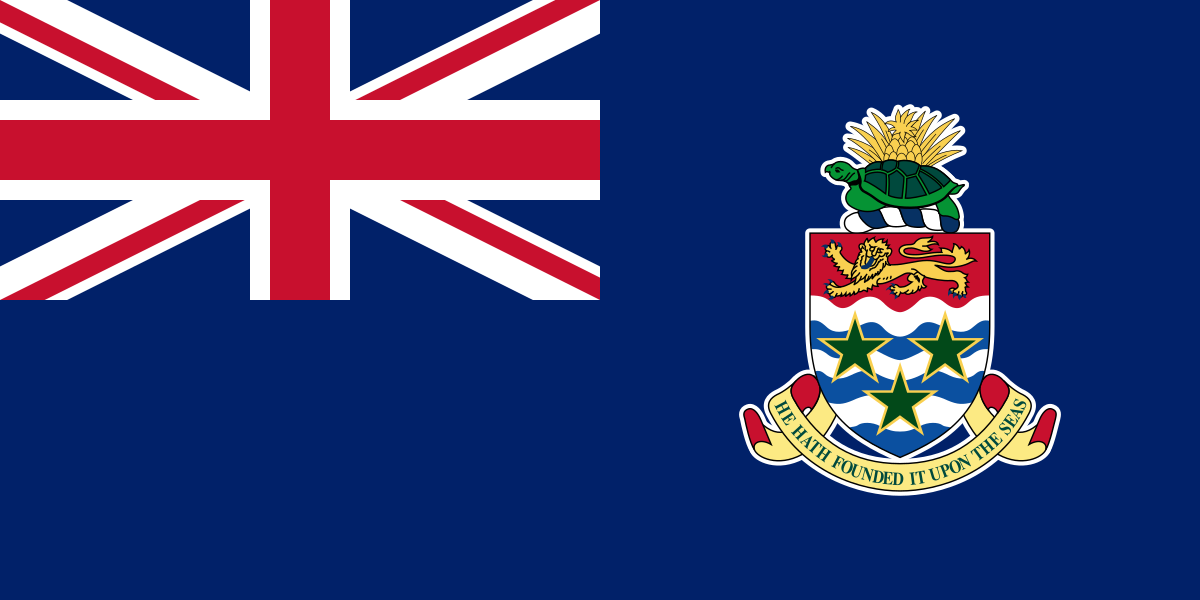 ### Pioneering the Probation and Welfare System For years, Hylton worked tirelessly as an unpaid volunteer and informal court advisor, preparing background social inquiry reports for judges and taking troubled youth into her own personal care. Her persistent lobby bore monumental fruit in the late 1950s and early 1960s when the government formally agreed to overhaul its legal machinery. She was instrumental in drafting and championing legislation that established a specialized Juvenile Court system, ensuring that minors were judged in private, supportive settings focused on rehabilitation rather than public retribution [2]. In 1963, recognizing her unmatched expertise and dedication, the Cayman Islands Government formally appointed Sybil Joyce Hylton as the nation's very first Probation and Welfare Officer [3]. This appointment marked the official birth of the Cayman Islands Probation and Welfare Department. Working initially with minimal staff and resources, Hylton built the department from the ground up. She served as its director and guiding spirit for nearly two decades until her formal retirement in 1982. During her tenure, Hylton revolutionized social intervention methodologies across Grand Cayman, Cayman Brac, and Little Cayman. She instituted mandatory pre-sentence social investigations, domestic violence counseling, foster care placements, and community rehabilitation programs. She worked closely with visionary pioneering women in government such as [Sybil Ione McLaughlin](/profiles/sybil-ione-mclaughlin), the first Speaker of the Legislative Assembly, and [Mary Evelyn Wood](/profiles/mary-evelyn-wood), the first woman elected to the legislature, to ensure that national budget allocations prioritized child welfare, maternal health, and indigent relief. > "A child who stands before the court is not a broken vessel to be discarded into a prison cell, but a crying soul crying out for guidance, structure, and the redeeming power of human compassion." — Sybil Joyce Hylton's plea to the Legislative Assembly [1] ### Broad-Based Community Leadership and Youth Empowerment Sybil Hylton understood that probation and courtroom intervention were ultimately reactive measures; true social salvation required proactive youth empowerment and community development. To prevent juvenile delinquency before it took root, she dedicated her evenings and weekends to establishing robust youth mentorship and civic organizations across the islands. She became a foundational pillar of the scouting movement in the Cayman Islands, working tirelessly to organize Boy Scout and Girl Guide troops that instilled self-reliance, leadership, and ethical values in generations of young Caymanians. She recognized that structured extracurricular activities provided a vital refuge for youth from fractured homes. Furthermore, Hylton served with distinction on the Cayman Islands Adoption Board, ensuring that orphaned and abandoned children were placed in loving, stable environments subjected to rigorous welfare oversight [3]. Her volunteerism extended into the wider civic arena through active leadership in the Lions Club of Grand Cayman and various church benevolent societies. Whether organizing food drives for the elderly during hurricane aftermaths, fundraising for medical treatments for indigent children, or mentoring young social workers entering the civil service, Hylton embodied the absolute ideal of civic duty. Her home was widely known as a safe haven where troubled teenagers, distressed mothers, and destitute elders could always find a warm meal, sympathetic counsel, and fierce advocacy.  ### Honours, Recognition, and National Hero Status Sybil Joyce Hylton's monumental contributions to social justice and human development did not go unnoticed by her island community or the British Crown. In 1968, she was awarded the Cayman Islands Certificate and Badge of Honour in recognition of her pioneering welfare initiatives [2]. A decade later, in 1978, Queen Elizabeth II appointed her a Member of the Order of the British Empire (MBE), elevating her life's work to international acclaim and cementing her status as one of the preeminent social reformers in the Caribbean basin [1]. Even after her formal retirement from the civil service in 1982, Hylton remained the moral conscience of the nation on matters of youth welfare. She continued to advise government ministers, mentor probation officers, and speak out passionately against policies that threatened social equity. When she passed away on October 1, 2006, at the venerable age of 93, the entire nation went into mourning. Her passing marked the end of an era of pioneering social construction, but her institutional legacy remained vibrant. In 2011, during a historic National Heroes Day ceremony, the Cayman Islands Government officially bestowed upon Sybil Joyce Hylton the title of National Hero of the Cayman Islands [3]. She became one of the very few women enshrined in the nation's highest pantheon of honor, standing proudly alongside legislative luminaries like [Thomas William Farrington](/profiles/thomas-william-farrington), [James Manoah Bodden](/profiles/james-manoah-bodden), [William Warren Conolly](/profiles/william-warren-conolly), and composer [Leila Elberta Ross-Shier](/profiles/leila-elberta-ross-shier). > "She found our judicial system punishing children as adults, and through the sheer force of her moral conviction, she birthed a modern social welfare system that has saved thousands of lives." — National Heroes Day Proclamation [2] Today, the modern Department of Children and Family Services and the Department of Community Rehabilitation in the Cayman Islands operate directly on the compassionate, restorative foundations laid by Sybil Joyce Hylton. Her name is invoked in courtrooms, social work classrooms, and community centers across the region as the eternal "Mother of Probation"—a beacon of boundless empathy whose life demonstrated that the true measure of a society lies in its treatment of its most vulnerable children.
View Profile →Yvette Fleming-Hodge
### Introduction and Historical Context of 20th-Century Saint-Martin The history of the Caribbean island of Saint-Martin during the twentieth century is a narrative of profound transformation, shifting from a quiet, agrarian, and salt-producing society into a vibrant, internationally renowned crossroads of commerce and cultural exchange[1]. Within this sweeping evolution, few figures cast as long or as influential a shadow as Yvette Fleming-Hodge. Revered across the Caribbean as a foundational matriarch, astute business entrepreneur, and visionary philanthropist, Fleming-Hodge navigated over a century of political, economic, and social transition[2]. Known affectionately throughout the territory as the "Doyenne of Saint-Martin," her life embodied the resilience, elegance, and steadfast determination of Antillean leadership[3]. During an era when Caribbean political and economic structures were overwhelmingly dominated by patriarchal systems, Yvette Fleming-Hodge carved out a position of undisputed authority and profound civic responsibility. Her leadership bridged the traditional, family-centered governance of pre-war Saint-Martin with the modern municipal administrative structures that began to take root in the latter half of the century. Whether steering extensive commercial enterprises, preserving a storied political dynasty, or donating invaluable familial lands to construct vital public infrastructure, her contributions were instrumental in shaping the modern identity of French Saint-Martin[1][4]. Her biographic journey provides a vital lens through which to understand the intersection of family dynasty, commerce, and female leadership in the Francophone Caribbean. ### Early Life, Heritage, and Marriage into the Fleming Dynasty Born around 1916, Yvette Hodge grew up in a Caribbean region deeply interconnected by maritime trade, kinship networks, and shared cultural traditions[2]. From her earliest years, she was steeped in the values of discipline, community mutual aid, and entrepreneurial enterprise that characterized the resilient merchant families of the northern Lesser Antilles. Educated in the rigorous French educational traditions of the era, she developed a sharp analytical mind, a deep fluency in both French and English, and an acute awareness of the socio-economic realities facing island residents. In her young adulthood, Yvette married into the prominent Fleming family, uniting her with [Louis-Constant Fleming](/profiles/louis-constant-fleming), a distinguished local figure who served as the Mayor of Marigot (the administrative capital of French Saint-Martin) beginning in 1928[2]. Mayor Louis-Constant Fleming was a towering figure in local governance, guiding the commune through the turbulent decades of the Great Depression and World War II. As the Mayor's wife, Yvette was thrust into the heart of civic life, acting not merely as a traditional political spouse, but as a trusted confidante, advisor, and community organizer[2]. > *"To understand the modern development of Saint-Martin is to trace the quiet, unwavering footsteps of Yvette Fleming-Hodge—a matriarch who held the community's future in her hands and gave generously so that future generations might thrive."* When Mayor Louis-Constant Fleming passed away prematurely in 1949 after more than two decades of dedicated public service, Yvette found herself a young widow tasked with raising their children and safeguarding the family's extensive agricultural, commercial, and political patrimony[2]. Rather than retreating from public view, she stepped decisively into leadership, demonstrating an extraordinary resolve that would define the remaining seven decades of her life.  ### Matriarchal Leadership and Political Stewardship (1949–1989) Following her husband's death, Yvette Fleming-Hodge became the central pillar and guiding strategist of the Fleming dynasty[2][3]. In the close-knit political landscape of French Saint-Martin, where familial alliances and grassroots loyalty formed the bedrock of municipal governance, her influence was pervasive. She functioned as the de facto powerbroker and moral compass for leaders across the island, cultivating strong relationships with regional officials in Guadeloupe and metropolitan France. Her political stewardship reached a definitive pinnacle during the crucial governance era between 1983 and 1989. During this period, Saint-Martin experienced rapid demographic expansion and infrastructure development, necessitating decisive civic leadership. While municipal administration was formally guided by prominent figures such as Mayor [Albert Fleming](/profiles/albert-fleming), Yvette Fleming-Hodge exerted immense, celebrated influence as the undisputed matriarch of municipal affairs. Her son, [Louis-Constant Fleming Jr.](/profiles/louis-constant-fleming-jr), carried forward his father's legacy by serving as First Deputy Mayor during this pivotal 1983–1989 mandate. Working in seamless synergy with her son and municipal leaders, Yvette was celebrated in popular narrative and local historiography as a guiding force behind the administration's socio-economic initiatives. Her ability to command respect across political factions and societal divides made her an indispensable arbiter of local progress. She championed policies that balanced rapid economic modernization with the preservation of local cultural heritage, ensuring that the indigenous populations of Marigot, Grand Case, and Quartier d'Orléans were not displaced by incoming foreign investments. Her leadership during the 1980s solidified her reputation as the island's premier "First Lady" of civic guidance, proving that female authority in the Caribbean could operate powerfully both within and alongside formal mayoral structures. ### Entrepreneurial Empire and Economic Modernization Beyond her political influence, Yvette Fleming-Hodge was a formidable and visionary business tycoon[1]. At a time when women were rarely seen at the helm of major commercial corporations in the French West Indies, she built and expanded a diverse entrepreneurial empire that became a primary driver of local economic growth. Possessing a keen foresight for the island's transition toward tourism and regional transportation, she invested heavily in automotive commercial enterprises and transportation infrastructure[1]. She successfully established and managed leading automobile dealerships on the island, recognizing early on that mobility would be essential to economic modernization[1]. Furthermore, she owned and operated the landmark service and gasoline station located at the Grand Case Airport (L'Espérance Airport)[1]. This enterprise was vital to maintaining the operational logistics of the territory's domestic aviation hub, facilitating trade, travel, and communication between Saint-Martin and neighboring islands such as Saint-Barthélemy and Guadeloupe. Through meticulous management, strict integrity, and a commitment to hiring and mentoring local talent, Fleming-Hodge demonstrated that commercial success and community empowerment were mutually reinforcing endeavors. Her boardroom maneuvers shattered gender barriers, inspiring generations of Antillean women to pursue business ownership and executive leadership. ### Visionary Philanthropy: Transforming Healthcare and Education While her entrepreneurial ventures generated substantial wealth, Yvette Fleming-Hodge is most universally revered for her transformative philanthropy[1][4]. Deeply motivated by a civic ethos that viewed private landholdings as a trust for the public good, she executed several monumental land donations that fundamentally reshaped the institutional landscape of French Saint-Martin. Her most celebrated contribution was the donation of vast tracts of prime familial land in the Concordia district for the construction of the island's modern, fully equipped hospital facility[1][4]. Opened to serve the growing healthcare needs of the northern Caribbean, the medical complex was dedicated as the **Centre Hospitalier Louis-Constant Fleming** in honor of her late husband[1][4]. Today, this hospital stands as the premier medical center of the collectivity, saving lives daily as a direct result of her generosity. > *"True wealth is not measured by what we accumulate, but by the institutions we build and the community we uplift through our generosity."* In addition to her healthcare philanthropy, Fleming-Hodge recognized that educational and cultural empowerment were vital for youth liberation. She donated substantial parcels of land to the local commune for the establishment of the Territorial Library and the Archives of Saint-Martin, creating dedicated sanctuaries for learning, literacy, and historical preservation[1][4]. Furthermore, during times of acute housing shortage, she quietly facilitated the transfer of land at accessible terms to working-class families in Concordia, enabling hundreds of local citizens to attain homeownership and generational stability[1].  ### Centennial Celebration and Enduring Legacy As Yvette Fleming-Hodge entered her centennial years, she became a living monument of Caribbean history[3][4]. Reaching her 100th birthday around 2016, she was celebrated across the island with extensive tributes from government dignitaries, civic organizations, and everyday citizens who had benefited from her decades of service. Her sharp memory, regal poise, and unwavering love for her island remained intact to the very end. On November 11, 2017—coincidentally falling on St. Martin Day, the national celebration of island unity—Yvette Fleming-Hodge peacefully passed away in Miami, Florida, at the extraordinary age of 101[1][3]. Her passing marked the end of a monumental era in Antillean history. Memorial services across Marigot and beyond drew thousands of mourners, paying homage to a woman whose life spanned ten decades of progress. Today, her legacy endures through the healing wards of the Centre Hospitalier Louis-Constant Fleming, the cultural records stored in the Territorial Archives, and the vibrant business community she helped pioneer. She stands enshrined as an eternal model of Caribbean matriarchal leadership, civic devotion, and dignified grace.
View Profile →