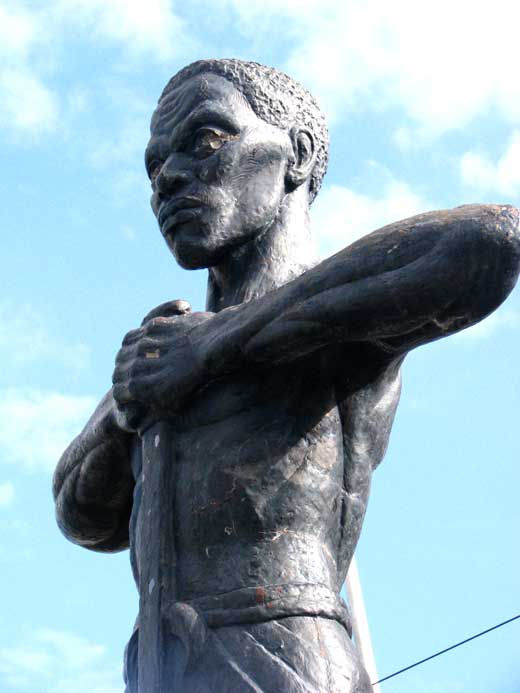
Bob Marley

Bob Marley
Biography
Introduction
Robert Nesta Marley, globally celebrated as Bob Marley, stands as one of the most influential and iconic musicians of the 20th century. Born in the rural hills of Jamaica, his life journey transformed him from a marginalized youth in Kingston's ghettos to a global ambassador for reggae music, the Rastafari movement, and Pan-Africanism. His music transcended entertainment, becoming an anthem for liberation, social justice, and peace across the globe. Through his profound lyrical genius and charismatic stage presence, Marley gave a voice to the voiceless, elevating the struggles of the Third World to the forefront of global consciousness. Even decades after his passing, his legacy endures as a symbol of resistance against oppression and a beacon of universal love.
Early Life in Nine Mile and Trench Town
Bob Marley was born on February 6, 1945, in Nine Mile, a small, vibrant agricultural community in Saint Ann Parish, Jamaica. His birth was the result of an interracial union between Norval Sinclair Marley, a white Jamaican of English descent who worked as a plantation overseer and served in the Royal Marines, and Cedella Booker, a young Afro-Jamaican woman. Norval was largely absent from his son's life, and his family rejected the union, leaving Cedella to raise young Robert in the rural countryside. This mixed-race heritage deeply affected Marley's early life, as he often faced prejudice and a sense of alienation from both black and white communities, forcing him to forge his own identity.
In the late 1950s, seeking better economic opportunities, Cedella relocated with Bob to Trench Town, a harsh, impoverished neighborhood in West Kingston. Trench Town was a melting pot of rural migrants and urban poor, characterized by government yard housing, fierce political rivalries, and severe economic deprivation. However, it was also a crucible of immense cultural creativity. Here, Marley was exposed to the rich musical traditions of mento, ska, and the rhythm and blues broadcasting from American radio stations. The struggles and everyday realities of Trench Town life would later become the central themes of his songwriting, anchoring his global message in the authentic experiences of the Jamaican underclass.
The Birth of The Wailers and Musical Evolution
In Trench Town, Marley formed a profound bond with Neville Livingston, famously known as Bunny Wailer, and Winston Hubert McIntosh, who would become legendary as Peter Tosh. Together, they formed a vocal harmony group initially called the Teenagers, which eventually evolved into The Wailing Wailers. Under the mentorship of local musician Joe Higgs, who taught them vocal harmonies and the fundamentals of songwriting, the trio honed their craft in the local yards.
In 1963, they caught the attention of Clement "Coxsone" Dodd, a pioneering Jamaican record producer who ran the influential Studio One label. Dodd recorded their first single, "Simmer Down," an urgent ska track appealing to the "rude boys" (street gangs) of Kingston to cease their violence. The song became a massive local hit, establishing the Wailers as voices of the urban youth. Throughout the 1960s, the group navigated the shifting musical landscape of Jamaica, transitioning from the upbeat tempos of ska to the slower, more soulful rhythms of rocksteady. During this period, Marley also briefly lived in the United States, working at a Chrysler plant in Delaware to earn money for his family and musical ambitions.
Rastafari Awakening
Upon his return to Jamaica in 1966, Marley's life took a definitive spiritual turn. The visit of Emperor Haile Selassie I of Ethiopia to Jamaica that same year profoundly impacted the island, catalyzing the growth of the Rastafari movement. Marley, along with Tosh and Wailer, began to deeply embrace Rastafari, adopting its dietary laws, growing dreadlocks, and incorporating its theology into his worldview. Rastafari provided Marley with a spiritual framework that interpreted the struggles of Black people through a biblical lens, identifying the oppressive establishment as "Babylon" and promoting a return to Africa, or "Zion," both physically and spiritually.
"My music will go on forever. Maybe it's a fool say that, but when me know facts me can say facts. My music will go on forever." — Bob Marley
This spiritual awakening coincided with the birth of reggae, a genre characterized by its distinctive one-drop rhythm, heavy basslines, and socially conscious lyrics. The Wailers began working with visionary producer Lee "Scratch" Perry, resulting in groundbreaking tracks like "Soul Rebel" and "Duppy Conqueror." Perry's innovative studio techniques and the Wailers' profound lyricism created a completely new sound that resonated with the burgeoning Black consciousness movements worldwide.
International Breakthrough and Island Records
In 1972, a fateful meeting with Chris Blackwell, the founder of Island Records, propelled the Wailers onto the international stage. Blackwell, recognizing the rock-and-roll potential of reggae, provided the group with an unprecedented advance to record a full-length album in a professional studio. The result was Catch a Fire (1973), a critically acclaimed masterpiece that introduced reggae to global audiences. This was quickly followed by Burnin' (1973), which featured anthems like "Get Up, Stand Up" and "I Shot the Sheriff." The latter gained massive international exposure when Eric Clapton covered it in 1974, scoring a number-one hit in the US.
Despite their growing success, internal tensions and the rigorous demands of touring led to the departure of Peter Tosh and Bunny Wailer in 1974. Marley pressed on, restructuring the band as Bob Marley and the Wailers. He brought in the I-Threes (consisting of his wife Rita Marley, Marcia Griffiths, and Judy Mowatt) to provide vocal harmonies, further enriching the group's distinctive sound. The 1975 album Natty Dread solidified his solo stardom, featuring the poignant masterpiece "No Woman, No Cry."
Political Turmoil and the Smile Jamaica Concert
By the mid-1970s, Jamaica was engulfed in severe political violence. The nation was fiercely divided between the democratic socialist People's National Party (PNP) led by Michael Manley and the conservative Jamaica Labour Party (JLP) led by Edward Seaga. Kingston's streets became battlegrounds for armed political factions. Marley, perceived as a figure of immense influence, found himself caught in the crossfire.
In an effort to ease tensions, Marley agreed to headline the "Smile Jamaica" concert in December 1976, an event ostensibly organized by the government to promote peace. However, two days before the concert, armed gunmen stormed Marley's home at 56 Hope Road. Marley, his wife Rita, and his manager Don Taylor were shot and wounded. Remarkably, Marley survived and, displaying extraordinary courage, performed at the concert anyway, famously stating that the people trying to make the world worse don't take a day off, so why should he.
Exile in London and Global Exodus
Following the assassination attempt, Marley relocated to London, entering one of his most prolific and creative periods. Over the next two years, he recorded the monumental albums Exodus (1977) and Kaya (1978). Exodus, later named the Album of the Century by Time Magazine, perfectly balanced militant political anthems like "Exodus" and "Guiltiness" with universal messages of love and unity in tracks like "Jamming" and "One Love / People Get Ready."
Marley returned to Jamaica in 1978 for the historic One Love Peace Concert. In a dramatic and highly symbolic moment, he called both Michael Manley and Edward Seaga to the stage, forcing the bitter rivals to hold hands above their heads in a gesture of unity.
Pan-Africanism and the Zimbabwe Independence Concert
Marley's influence extended deeply into the African continent, where he was revered as a prophet of liberation. He passionately supported the struggles against apartheid in South Africa and colonialism across the continent. In 1980, Bob Marley and the Wailers were invited to perform at the official independence ceremony of Zimbabwe. Spending tens of thousands of dollars of his own money to transport his equipment, Marley played to a jubilant crowd, cementing his status as a champion of African liberation. His album Survival (1979) remains one of the most powerful expressions of Pan-African solidarity in musical history.
Illness, Death, and Enduring Legacy
In 1977, Marley was diagnosed with acral lentiginous melanoma, a rare form of skin cancer, which originated under his toenail. Citing his Rastafari beliefs, which advise against the amputation of body parts, Marley refused the recommended treatment of amputating the toe. The cancer eventually spread throughout his body. Despite his declining health, he continued to tour extensively, completing his massive Uprising Tour in 1980.
Bob Marley passed away on May 11, 1981, at Cedars of Lebanon Hospital in Miami, Florida, at the age of 36. His final words to his son Ziggy were reportedly, "Money can't buy life."
Marley was given a state funeral in Jamaica, blending elements of Ethiopian Orthodoxy and Rastafari tradition, and was buried in a chapel near his birthplace in Nine Mile. He received the Order of Merit, Jamaica's third-highest honor. Today, Bob Marley is more than a musician; he is an international symbol of peace, human rights, and anti-colonial resistance. His music continues to inspire successive generations across the globe, ensuring that the voice of the "Tuff Gong" remains eternal.
Major Contributions
- Bob Marley revolutionized global music by introducing reggae and the philosophical tenets of the Rastafari movement to international audiences.
- His lyrical focus on social justice, Pan-Africanism, and resistance against oppression provided an enduring anthem for marginalized communities and liberation movements worldwide, notably influencing the independence of Zimbabwe and anti-apartheid struggles in South Africa.
- Beyond his musical achievements, Marley was a unifying political force in a deeply divided Jamaica.
- His courageous performance at the Smile Jamaica concert following an assassination attempt, and his orchestration of a symbolic handshake between rival political leaders [Michael Manley](/profiles/michael-manley) and [Edward Seaga](/profiles/edward-seaga) at the 1978 One Love Peace Concert, cemented his legacy as an ambassador for peace and humanitarianism.