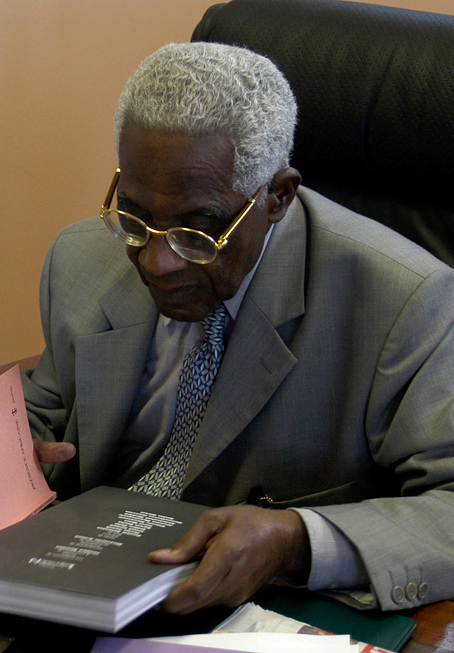
Auguste Joyau

Auguste Joyau
Biography
Auguste Joyau: Chronicler of Martinican Identity and the Legacy of Saint-Pierre
Introduction and Overview
Auguste Joyau (1903–1984) stands as one of the most dedicated and influential cultural historians and literary figures in 20th-century Martinique. Operating during a transformative era when the French Antillean intelligentsia was beginning to assert its distinct cultural identity against centuries of colonial assimilation, Joyau dedicated his life to documenting the historical evolution, folklore, and literary heritage of his island homeland. Born in Fort-de-France just one year after the catastrophic volcanic eruption of Mount Pelée obliterated the former cultural and economic capital of Saint-Pierre, Joyau grew up in an island profoundly shaped by grief, memory, and reconstruction. Throughout a multi-decade career as an author, civil servant, literary critic, and cultural organizer, he co-founded early native literary journals such as Lucioles, authored foundational historical texts on early French colonization, and produced sweeping surveys of Antillean literature. His masterwork, La Martinique : carrefour du monde caraïbe (Martinique: Crossroads of the Caribbean World), received the prestigious Prix Broquette-Gonin from the Académie française in 1968, cementing his reputation as a premier interpreter of Caribbean civilization. Serving as Vice-President of the Société d'histoire de la Martinique, Joyau tirelessly championed the preservation of local archives and historical memory, leaving an indelible mark on Caribbean historiography.
Early Life, Family Roots, and the Shadow of Saint-Pierre
Auguste Joyau was born on September 3, 1903, in Fort-de-France, the administrative capital of Martinique. His birth occurred at a pivotal socio-psychological juncture in Caribbean history: exactly sixteen months earlier, on May 8, 1902, Mount Pelée had erupted with unimaginable fury, completely destroying the city of Saint-Pierre and killing nearly 30,000 inhabitants within minutes. Prior to the disaster, Saint-Pierre had been celebrated globally as the 'Paris of the Caribbean'—a sophisticated urban center renowned for its vibrant theater, grand architecture, distilleries, intellectual salons, and diverse cosmopolitan population. Genealogical records indicate that members of the Joyau family had long been established in Saint-Pierre as prominent distillers, merchants, and civic figures. The sudden annihilation of this cultural epicenter cast a long shadow over Joyau’s upbringing.
Growing up in Fort-de-France, which rapidly expanded to absorb refugees and assume the mantle of the island's primary city, the young Joyau was surrounded by survivors who recounted stories of Saint-Pierre's lost glory. These oral histories instilled in him a deep reverence for the past and an urgent realization that cultural memory must be rigorously preserved before it is swept away by time or natural disaster. He received his formal education at the Lycée Schœlcher in Fort-de-France, an elite institution that served as the intellectual crucible for generations of Martinican leaders, including future luminaries such as Aimé Césaire and Frantz Fanon. Immersed in classical French literature alongside the emerging currents of West Indian consciousness, Joyau developed a refined literary style and a formidable analytical intellect.
The Literary Awakening: Co-Founding Lucioles in 1925
During the 1920s, Martinique experienced a profound cultural awakening. Educated young Antilleans began questioning the rigid Eurocentric curriculum imposed by the colonial administration, seeking instead to articulate an authentic Caribbean voice. In 1925, at the age of twenty-two, Auguste Joyau joined forces with fellow young intellectuals and writers to co-found the literary journal Lucioles (Fireflies). Published in Fort-de-France, Lucioles emerged as one of the earliest and most vital periodicals dedicated to showcasing native Antillean poetry, fiction, and literary criticism.
The journal served as a critical stepping stone in the intellectual lineage leading to the Négritude movement. While earlier Martinican writing often imitated Parisian literary conventions, Joyau and his collaborators used Lucioles to explore local themes, tropical landscapes, Creole folklore, and the psychological realities of Caribbean life. In his editorial contributions and essays, Joyau argued that Antillean literature possessed its own unique genius, born from the synthesis of European language and African-descended historical experience. This pioneering work helped cultivate a receptive audience for later Caribbean literary pioneers, establishing dialogue with contemporaneous intellectual movements led by figures like Paulette Nardal in Paris and René Maran.
'A people without literature is a people without a mirror. If we rely solely on reflections cast from across the Atlantic, we remain forever strangers to our own soil. Our task is to illuminate the hidden fireflies of Antillean memory and let our own history speak.' — Auguste Joyau, essay on Caribbean literary identity, circa 1928
Chronicler of Colonial Martinique: Belain d'Esnambuc and Historical Scholarship
Alongside his literary activism, Joyau entered the civil service, balancing administrative responsibilities with exhaustive historical research. He recognized that understanding modern Martinique required a rigorous examination of its colonial origins. In the mid-20th century, he turned his analytical focus toward the 17th century, researching the complex dynamics of early European settlement, indigenous Carib displacement, and the establishment of the plantation economy.
In 1950, Joyau published Belain d'Esnambuc, a detailed historical biography of Pierre Belain d'Esnambuc, the Norman adventurer and colonizer who established the first permanent French settlement on the island of Saint-Christophe (St. Kitts) in 1625 and subsequently claimed Martinique for France in 1635. Drawing extensively from colonial archives, administrative correspondence, and early maritime logs, Joyau provided a nuanced portrait of European expansionism in the Caribbean. Rather than presenting a sanitized hagiography, Joyau examined the harsh realities of early colonial enterprise—the ruthless competition between European powers, the precariousness of early settlements, and the tragic subjugation of the indigenous Kalinago population. His historical approach demonstrated a commitment to empirical archival documentation, setting a high standard for Caribbean historical scholarship.
Crossroads of the Caribbean: Prix Broquette-Gonin and Masterworks
During the 1960s, Joyau produced his most mature and celebrated works, synthesizing decades of research into accessible, authoritative volumes. His writings celebrated the cultural vitality and historical centrality of the Lesser Antilles. Among his notable publications during this period was Héroïnes et aventurières de la mer Caraïbe (Heroines and Adventurers of the Caribbean Sea), a captivating historical collection that highlighted the oft-overlooked lives of women—from formidable plantation matriarchs to maritime figures—who shaped the social fabric of the West Indies.
In 1967, Joyau published his monumental work, La Martinique : carrefour du monde caraïbe (Martinique: Crossroads of the Caribbean World). In this sweeping study, Joyau analyzed Martinique not as a peripheral colonial outpost, but as a vibrant geopolitical and cultural pivot connecting North America, South America, and Europe. He explored the island's unique social stratification, its linguistic evolution, its economic transformations, and its enduring contributions to global culture. The book received widespread critical acclaim across the French-speaking world. In 1968, the Académie française awarded Joyau the prestigious Prix Broquette-Gonin in literature and history, recognizing the exceptional scholarly merit and cultural significance of his work. This accolade brought international attention to Martinican historiography and validated Joyau's lifelong dedication to his homeland.
Preserving Caribbean Memory: Society of History and Later Years
Throughout his later career, Joyau played an institutional role in safeguarding Martinique's historical heritage. He was elected Vice-President of the Société d'histoire de la Martinique (Society of History of Martinique), where he led initiatives to locate, catalog, and publish endangered historical manuscripts, parish registers, and colonial records. He also served as a corresponding member of the prestigious Académie des sciences d'outre-mer in Paris, representing Antillean scholarship on an international stage.
In addition to his historical monographs, Joyau authored Panorama de la littérature à la Martinique, an indispensable literary history that chronicled the evolution of Martinican letters from the early colonial chronicles to the explosive modernist poetry of Aimé Césaire and philosophical essays of Édouard Glissant. He mentored young historians and writers, consistently emphasizing that thorough archival research must underpin all cultural critique. Even in his retirement, his home in Fort-de-France remained a vibrant salon for researchers, writers, and students visiting from across the Caribbean and Europe.
'To understand the Antillean soul, one must walk the ruined cobblestones of Saint-Pierre and read the forgotten registers of our parishes. History is not merely dates and governors; it is the heartbeat of a resilient people who built a rich civilization amidst the wreckage of empires.' — Auguste Joyau, address to the Société d'histoire de la Martinique
Enduring Legacy and Historiographical Impact
Auguste Joyau passed away peacefully in Fort-de-France on July 31, 1984, at the age of eighty. His passing marked the end of an intellectual era characterized by classical erudition, meticulous archival research, and deep civic devotion. Today, Joyau is remembered as a foundational pillar of Caribbean historiography. His pioneering efforts to document the legacy of Saint-Pierre ensured that the memory of the 'Paris of the Caribbean' survived intact for future generations. His co-founding of Lucioles helped ignite the Martinican literary renaissance, while his award-winning historical studies established Martinique's rightful place as a central crossroads of Caribbean civilization. By preserving the written and oral heritage of his people, Auguste Joyau constructed an enduring bridge connecting Martinique's colonial past to its modern cultural identity.
Major Contributions
- Auguste Joyau made foundational contributions to the preservation and articulation of Martinican history and cultural identity.
- As a pioneering literary activist, he co-founded the journal *Lucioles* in 1925, which gave early voice to native Antillean literature and fostered an intellectual climate that contributed to the Négritude movement.
- As an authoritative historian and Vice-President of the *Société d'histoire de la Martinique*, Joyau produced groundbreaking archival research on colonial expansion and 17th-century settlement, exemplified by his biography *Belain d'Esnambuc* (1950).
- His masterwork, *La Martinique : carrefour du monde caraïbe* (1967), repositioned Martinique as a vital geopolitical and cultural crossroads of the Americas, earning him the prestigious Prix Broquette-Gonin from the Académie française in 1968.
- Through his tireless safeguarding of historical manuscripts and his poignant preservation of the memory of Saint-Pierre before the 1902 eruption, Joyau permanently enriched Caribbean historiography.