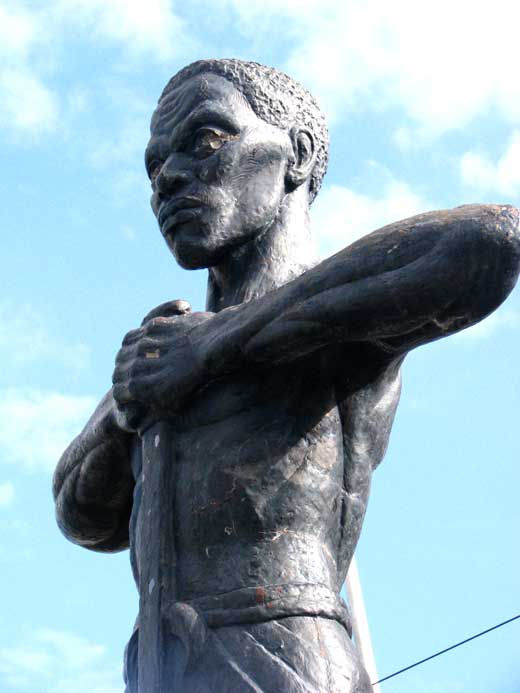
Nanny of the Maroons

Nanny of the Maroons
Biography
Nanny of the Maroons
Queen Nanny, or Nanny of the Maroons, is one of the most celebrated figures in Jamaican history and a towering symbol of resistance against British colonial rule in the Caribbean. Born around 1686, she became the spiritual, cultural, and military leader of the Windward Maroons, a community of formerly enslaved Africans who had escaped into the rugged, treacherous terrain of Jamaica's Blue Mountains. Unlike many historical figures whose lives are documented extensively in written archives, Nanny's legacy has been preserved largely through the rich oral traditions of the Maroon people, supplemented by the often fearful and bewildered accounts of British colonial officers. Today, she is honored as Jamaica’s only female National Hero, an enduring icon of freedom, resilience, and the indomitable spirit of the African diaspora.
Early Life and Origins
While precise details of her birth and early life remain elusive, historical consensus and Maroon oral traditions suggest that Nanny was born in present-day Ghana, West Africa, and belonged to the Asante (Ashanti) people. The Asante were renowned for their formidable military organization and deep spiritual traditions, both of which Nanny would later employ with devastating effectiveness in Jamaica.
Captured and forced into the transatlantic slave trade, Nanny survived the horrors of the Middle Passage and arrived in Jamaica. According to legend, she was never truly enslaved, or if she was, she escaped almost immediately upon arrival. Some accounts suggest she came to the island with several brothers—including Cudjoe, Accompong, Quao, and Johnny—who also became legendary Maroon leaders. While Cudjoe and Accompong led the Leeward Maroons in the western part of the island, Nanny and Quao established their stronghold in the eastern Blue Mountains, organizing the Windward Maroons.
The Windward Maroons and Nanny Town
The environment of the Blue Mountains was incredibly harsh, featuring steep inclines, deep ravines, and dense rainforests. Yet, under Nanny's leadership, the Maroons turned this inhospitable terrain into an impenetrable fortress. She established a community that would become known as Nanny Town. Strategically located on a high ridge overlooking the Stony River, Nanny Town was accessible only by a narrow, treacherous path that forced any attackers to approach in single file.
In this hidden sanctuary, Nanny fostered a thriving community. The Maroons cultivated crops such as yams, plantains, and peppers, and raised livestock. They operated a highly organized society based on Asante customs, maintaining their language, religious practices, and communal values. Nanny was not just a military tactician but also a Chieftainess, governing the daily lives of her people and ensuring their physical and cultural survival.
Military Leadership and Guerrilla Warfare
During the First Maroon War (c. 1720–1739), the British colonial government launched numerous campaigns to eradicate the Maroon threat. The Maroons frequently raided plantations to free enslaved people and acquire weapons and supplies, fundamentally threatening the island's plantation economy.
Nanny’s military genius lay in her mastery of guerrilla warfare. She understood that fighting the well-armed British military in open combat was suicidal. Instead, she utilized the terrain to her advantage. Her fighters used a system of communication based on the abeng—a cow horn whose distinct sounds could carry across valleys, transmitting complex messages that the British could not decipher.
"The Maroons were invisible, striking from the shadows of the forest and vanishing before a shot could be returned. Their leader, a woman of fierce countenance, seemed to control the very elements of the jungle." — A synthesis of British colonial accounts regarding the Maroon resistance.
Nanny’s forces were famous for their camouflage. They would cover themselves in branches and leaves, standing motionless until British soldiers walked right into an ambush. The British were continuously outmaneuvered, suffering heavy casualties from traps and sudden strikes. One of the most famous legends is that of Nanny's "boiling pot," a cauldron she supposedly kept boiling without fire in a narrow mountain pass, which mesmerized British soldiers who would fall in and die. Historians view this as an allegory for her brilliant traps and the sheer terror the British experienced in the unfamiliar jungle.
Obeah and Spiritual Power
A crucial aspect of Nanny's leadership was her role as an Obeah woman. In traditional Asante culture, spiritual leaders held immense power, acting as intermediaries between the physical world and the ancestors. For the Maroons, Nanny's spiritual authority was a source of profound strength and unity. She was believed to possess supernatural powers that protected her warriors from British bullets.
One persistent legend claims that Nanny could catch British musket balls in her hands (or sometimes other parts of her body) and fire them back. While the British dismissed Obeah as "witchcraft" and used it to portray her as a demonic figure—sometimes referring to her in dispatches as "the old Hagg"—her followers understood it as a profound spiritual shield. This religious cohesion made the Maroons fiercely loyal and completely fearless in battle.
The Treaty of 1740 and Later Years
By 1739, the prolonged and costly war forced the British to the negotiating table. Cudjoe signed a peace treaty for the Leeward Maroons, granting them autonomy and land in exchange for an agreement to return runaway slaves and assist the British in repelling foreign invasions.
Nanny was deeply opposed to this treaty, seeing it as a betrayal of the fundamental principle of freedom for all enslaved people. However, realizing the pragmatic necessity of peace for her community's survival, she eventually agreed to a similar treaty for the Windward Maroons in 1740. As part of this agreement, Nanny and her followers were granted 500 acres of land, where they established "New Nanny Town," modern-day Moore Town.
Nanny's exact date and cause of death are unknown, though she is believed to have died around 1760. Her remains are supposedly buried at "Bump Grave" in Moore Town, a sacred site for modern Maroons.
Legacy
Nanny of the Maroons represents the ultimate defiance against the institution of slavery. In 1975, the government of Jamaica declared her a National Hero, the only woman to receive this honor. Her portrait graces the Jamaican $500 banknote, ensuring her face is seen by millions daily.
Beyond formal honors, Nanny lives on in the cultural memory of the Caribbean. She is immortalized in poetry, song, and literature, standing as a beacon of Black female empowerment and anti-colonial resistance. The community she fought to establish, Moore Town, still exists today, preserving the unique Maroon heritage and proving that her fight for autonomy was ultimately victorious.
Major Contributions
- Nanny of the Maroons was instrumental in the survival and autonomy of the Windward Maroons in Jamaica.
- Her masterful use of guerrilla warfare tactics, deep knowledge of the Blue Mountains, and spiritual leadership united her people and allowed them to successfully repel heavily armed British colonial forces for nearly two decades during the First Maroon War.
- Her ultimate legacy is the preservation of African cultural practices in the Caribbean and the successful establishment of independent Maroon communities.
- By forcing the British to sign the 1740 treaty, she secured land rights and self-governance for her people—freedoms that the community in Moore Town continues to exercise today.
- As Jamaica's only female National Hero, she remains a definitive symbol of resistance against oppression.