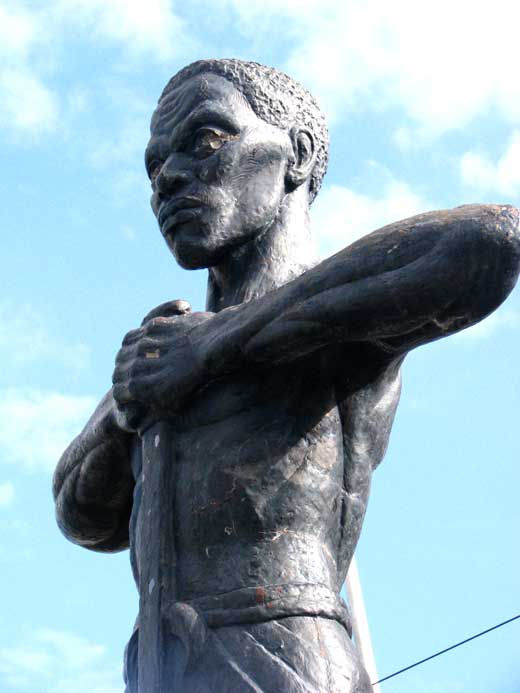
Norman Manley

Norman Manley
Biography
A Nation's Architect: Norman Washington Manley
Norman Washington Manley (July 4, 1893 – September 2, 1969) stands as one of the towering figures of Caribbean history — a man whose intellect, integrity, and unshakeable belief in the dignity of his people transformed a colonial backwater into a proud, sovereign nation. Lawyer, scholar, athlete, political visionary, and statesman, Manley wore each identity with equal distinction. As the founder of the People's National Party, Jamaica's first Premier, and a principal architect of independence, he gave institutional form to the aspirations of generations of Jamaicans who had lived under the weight of British colonial rule. Declared a National Hero of Jamaica in 1969 — the very year of his death — his legacy endures in the law schools, political institutions, and democratic culture he helped forge.
Early Life: Roxborough to the World
Norman Manley was born on July 4, 1893, in the rural community of Roxborough in Manchester, Jamaica, to Thomas Albert Samuel Manley, a planter and produce dealer of mixed African and English descent, and Margaret Ann (née Shearer), a pen keeper of partial Irish ancestry. He was one of four children, and his early years were spent on his father's country property — a pastoral upbringing that would ground him in the realities of Jamaican rural life even as he rose to extraordinary heights of learning and influence.
The death of his father during his boyhood precipitated a move; his mother relocated the family to St. Catherine, where they settled on a property called Belmont. It was here that Manley's formidable academic abilities first began to attract notice. He attended Guanaboa Vale Elementary School from the age of eight, then embarked on his secondary education at Wolmer's Boys' School in Kingston, before transferring to Beckford and Smith's (now St. Jago High School) in Spanish Town to remain closer to home.
His academic brilliance eventually won him an Open Scholarship to Jamaica College, one of the island's most prestigious secondary institutions. At Jamaica College, Manley proved himself to be no narrow scholar — he was a formidable all-round athlete, excelling at football, cricket, boxing, and track and field. This combination of intellectual and physical excellence would characterize his entire life. After graduating, he taught briefly at Jamaica College and at the Hope Farm School, mentoring younger Jamaicans even as he prepared for the even greater stage that awaited him.
The Rhodes Scholarship and the Crucible of War
Manley's academic reputation earned him a Rhodes Scholarship to Jesus College, Oxford — one of the most prestigious academic honours in the British Empire. He arrived at Oxford in 1914, the world's great universities still humming with the confident pace of Edwardian learning, only for that world to be shattered almost immediately by the outbreak of World War I.
Manley did not hesitate. He enlisted in the Royal Field Artillery of the British Army and served with distinction on the Western Front. His courage under fire was formally recognised when he was awarded the Military Medal (MM) for bravery in action — a decoration that reflected not only physical valour but the force of character that would define his public life. War was not merely an interruption; it was a crucible. The experience of fighting alongside men of every background, and the exposure to the brutal realities of European imperialism in its most naked form, deepened Manley's convictions about equality, justice, and the right of peoples to determine their own destiny.
Returning to Oxford in 1919 after the Armistice, Manley distinguished himself academically as he had militarily. He graduated with a Bachelor of Civil Law (BCL) with First Class Honours — among the highest academic distinctions the university could confer. He also won the prestigious Lee Prizeman (Essay) award and received a Certificate of Honour at Gray's Inn, where he was called to the Bar in 1921. He had arrived in England as a colonial subject and left as one of the most credentialed legal minds the Caribbean had ever produced.
Jamaica's Greatest Barrister
Manley returned to Jamaica and established a legal career of almost legendary renown. Rising with extraordinary speed through the profession, he was appointed King's Counsel (KC) in 1932 — a recognition of the very highest level of legal advocacy. He became the first Jamaican to argue a case before the Judicial Committee of the Privy Council in London, Jamaica's highest court of appeal, a distinction that underscored both his exceptional skill and his standing among his peers.
In the courtroom, Manley was formidable: meticulous in his research, devastating in cross-examination, and capable of oratory that could move a jury to tears or a judge to reconsideration. Popular folklore in Jamaica held that if someone were in the most serious legal trouble — facing the gallows, perhaps, or confronting the full weight of the colonial state — then their best and perhaps only hope was to secure the services of Mr. Manley. He was known particularly for his willingness to represent the dispossessed, the worker, the ordinary Jamaican who had little voice before the colonial legal establishment.
It was his reputation as an advocate for justice — not merely for the wealthy — that made his transition into politics not a departure from his legal career but its natural continuation.
The Turbulent Year of 1938: Birth of the PNP
The year 1938 changed Jamaica forever. Driven by the economic devastation of the Great Depression, the island's labouring classes — plantation workers, dock workers, domestic servants — erupted in a series of strikes and riots that shook the foundations of colonial rule. The unrest began at the Frome sugar estate in Westmoreland in April 1938 and rapidly spread to Kingston and beyond. Workers demanded better wages, human dignity, and an end to the grinding poverty imposed by a system designed to benefit the British Empire, not the Jamaican people.
Into this moment of crisis stepped two cousins who would define Jamaican politics for a generation: Norman Manley and Alexander Bustamante. Bustamante, a charismatic and flamboyant labour agitator, became the voice of the streets — famously baring his chest to police during a confrontation and daring them to shoot, a moment of theatrical courage that made him a hero of the working class. Manley, the cerebral barrister, provided essential legal support to striking workers and, in a celebrated act of family loyalty and professional courage, defended Bustamante himself when the colonial authorities arrested the labour leader.
But Manley understood that legal victories alone could not transform Jamaica. What the island needed was a political vehicle capable of channelling the energy of 1938 into lasting constitutional change. In September 1938, just months after the peak of the unrest, Manley founded the People's National Party (PNP). He would serve as its president for the next 31 years, until the very last days of his life.
The PNP drew its early membership largely from the professional and educated middle class — lawyers, teachers, journalists — but its declared mission was explicitly the empowerment of the masses. Manley articulated a vision of Jamaica not as a colonial possession, but as a sovereign democratic nation in which political power belonged to the people. Universal adult suffrage was central to this vision.
Cousins, Rivals, and the Making of Two-Party Democracy
The relationship between Norman Manley and Alexander Bustamante is one of the great dramas of Caribbean political history — a story of family bonds, ideological divergence, and competing visions of what Jamaica should become.
Initially, the cousins operated in allied spheres: Bustamante commanding the labour movement and Manley providing its political and legal scaffolding. But their temperaments and ambitions were too different to sustain a permanent alliance. In 1943, Bustamante founded the Jamaica Labour Party (JLP), creating a rival political vehicle aligned directly with his Bustamante Industrial Trade Union (BITU).
When Universal Adult Suffrage was finally granted in 1944 — a cause Manley had championed tirelessly — it was the JLP that won the first election held under the new system, with Bustamante becoming Chief Minister. Manley and the PNP spent the next decade in opposition, refining their policies and expanding their base.
The rivalry between the two parties — and between the two cousins who led them — was often fierce, occasionally personal, and always consequential. Yet it also produced something remarkable: a functioning two-party democratic system in a newly self-governing Caribbean island, a model of political pluralism that would prove more durable than many of its contemporaries elsewhere in the decolonising world.
Premier of Jamaica: Building the Nation
In 1955, Norman Manley led the PNP to its first general election victory, becoming Chief Minister of Jamaica. Re-elected in 1959, he was elevated to the newly created title of Premier — the first and only person to hold that office in Jamaican history before independence. These years represent the pinnacle of his constructive political achievement.
Under his leadership, Jamaica achieved full internal self-government in 1959, with the local government gaining authority over most domestic affairs. Manley used this period to lay the institutional foundations of a modern state: building the civil service, expanding education, promoting economic development, and enshrining the rule of law as the bedrock of public life. He was a constitutionalist to his core — a man who believed that political freedom was only meaningful if undergirded by strong, impartial institutions.
"I say that the mission of my generation was to win self-government for Jamaica, to win political power which is the final power for the black masses of my country from which I spring. I am proud to stand here today and say to you who fought that fight with me, say it with gladness and pride, mission accomplished for my generation." — Norman Washington Manley, final address to the PNP Annual Conference, 1969
Manley was also an early and passionate advocate for West Indian regionalism. He saw the fragmented islands of the British Caribbean not as isolated outposts but as a potential federation that could achieve, collectively, the economic scale and political weight that none could attain alone. He championed Jamaica's membership in the West Indies Federation, which was formally established in 1958.
The Federation Referendum and the Road to Independence
Manley's commitment to the West Indies Federation was genuine and deeply held, but it put him on a collision course with popular sentiment — and with Alexander Bustamante, who ran a potent campaign against federation, arguing that Jamaica would be subsidising poorer islands at the expense of its own development.
In a bold act of democratic principle, Manley called a referendum on September 19, 1961 to let the Jamaican people decide the question themselves — an unprecedented step in Caribbean political history. The result was a defeat for his federalist vision: approximately 54% voted to withdraw from the Federation, with 251,935 "No" votes against 216,400 "Yes" votes. The West Indies Federation subsequently collapsed.
Manley accepted the verdict with characteristic dignity. Rather than allowing the defeat to paralyse his government, he immediately pivoted to the task of securing Jamaica's independence as a separate nation. He chaired the joint committee that drafted Jamaica's independence constitution and personally led the team that negotiated the terms of independence with the British government.
In the general election of April 1962, Manley lost to Bustamante's JLP — meaning that it was Bustamante, not Manley, who became the first Prime Minister of independent Jamaica when the island achieved sovereignty on August 6, 1962. For a lesser man, this might have felt like history's cruel joke: to lay all the groundwork for independence only to be denied the moment of formal triumph. But Manley moved gracefully into the role of Leader of the Opposition, in which he helped define the norms and responsibilities of parliamentary opposition in a young democracy — a contribution as important, in its way, as any he had made in government.
Family, Culture, and the Manley Dynasty
No account of Norman Manley is complete without his wife, Edna Manley (née Swithenbank, 1900–1987), whom he married in 1921. Born in England, Edna was a sculptor of extraordinary talent who became the acknowledged "mother of Jamaican art." Her work — deeply rooted in themes of social change, national identity, and the spiritual life of the Jamaican people — both reflected and inspired the nationalist movement her husband led. She helped found the Jamaica School of Art and Craft (later renamed the Edna Manley College of the Visual and Performing Arts) and was a founding member of the National Gallery of Jamaica.
Together, Norman and Edna had two sons, Douglas and Michael Manley (1924–1997). Michael followed his father into politics, succeeding him as leader of the PNP in 1969 and serving three terms as Prime Minister (1972–1980 and 1989–1992). A champion of democratic socialism, Caribbean solidarity, and the rights of the developing world, Michael carried his father's torch into a new era — making the Manleys the most consequential political family in Jamaican history.
Notably, Norman Manley was also the first cousin of Alexander Bustamante, his great political rival. Their kinship — and the way it was both reinforced and tested by their political rivalry — gives the founding of modern Jamaica an almost Shakespearean dimension: two men of the same blood, united by love of country but divided by temperament and method, between them giving their nation its democratic form.
Death and Posthumous Honours
Norman Manley retired from active political life on July 4, 1969 — fittingly, his 76th birthday — due to failing health. He delivered one final, electrifying address to the PNP's annual conference, in which he declared his generation's mission accomplished and challenged the next to build upon the political foundations they had laid. He spoke of the need to reconstruct Jamaica's social and economic life — to move from the achievement of political freedom to the harder work of genuine equality.
Just weeks later, on September 2, 1969, Norman Washington Manley died. In recognition of his incomparable contribution to Jamaican nationhood, he was posthumously declared a National Hero of Jamaica — one of only seven individuals to receive that honour.
His legacy is commemorated across Jamaica: the Norman Manley International Airport in Kingston bears his name, as does the Norman Manley Law School, the principal institution for legal education in the anglophone Caribbean. The law school is a particularly fitting tribute — honouring a man who used the law not merely as a profession, but as an instrument of justice and liberation.
Enduring Legacy
Norman Manley's place in Caribbean history is secured by the breadth and depth of his achievement. He was a man of the highest intellectual calibre — a First Class Honours graduate of Oxford, a Military Medal winner, King's Counsel, and the foremost barrister of his generation — who chose to place all of those gifts in the service of the least powerful members of his society.
He built institutions that outlasted him: the PNP, which has shaped Jamaican politics for nearly nine decades; the constitutional framework of an independent Jamaica; the Norman Manley Law School, which has trained Caribbean lawyers for generations. He stood alongside and against figures like Alexander Bustamante and helped give Jamaica a two-party democracy when such things were far from guaranteed.
His story is inseparable from those of other Caribbean giants: Marcus Garvey, whose pan-African vision animated the broader movement for Black self-determination in which Manley participated; Alexander Bustamante, his cousin and greatest political rival; and later leaders like Portia Simpson Miller, who inherited a democratic tradition Manley did so much to build.
In his final speech, Manley posed the question that has animated every Jamaican generation since: having won political freedom, what will we build with it? The question was his final gift — a challenge, not a conclusion. It is the measure of his greatness that Jamaicans are still answering it.
References
- Norman Manley — Wikipedia
- Norman Manley — Jamaica Information Service
- Norman Manley — National Library of Jamaica
- Norman Manley — Norman Manley Law School
- Norman Manley — Britannica
- Norman Manley — Jamaica National Heritage Trust
- The 1938 Labour Riots and the Birth of Jamaican Party Politics
- Norman Manley — The Guardian Obituary
- West Indies Federation Referendum 1961 — Jamaica Observer
- The Manley Family Legacy — Jamaica Observer
Major Contributions
- Norman Washington Manley's contributions to Jamaica and the Caribbean span law, politics, and democratic institution-building.
- As the founder and 31-year president of the People's National Party (PNP), he created the political vehicle through which Jamaica's working masses ultimately won universal adult suffrage and self-government.
- His legal career — culminating in his appointment as King's Counsel and his distinction as the first Jamaican to argue before the Judicial Committee of the Privy Council — established the rule of law as a foundational principle of Jamaican public life, and his willingness to represent ordinary citizens and striking workers gave the legal profession a social conscience it has never entirely lost.
- As Chief Minister and Premier from 1955 to 1962, Manley guided Jamaica through the critical transition from Crown Colony to self-governing democracy, negotiating full internal self-government in 1959 and drafting the constitutional framework for an independent Jamaica.
- Though he lost the 1962 election that brought formal independence, the institutions he designed — the constitution, the civil service, the parliamentary norms of opposition — provided the stable foundation upon which the independent Jamaican state was built.
- His legacy endures in the Norman Manley International Airport, the Norman Manley Law School (the principal legal education institution in the anglophone Caribbean), and the democratic political culture he modelled throughout his public life.